
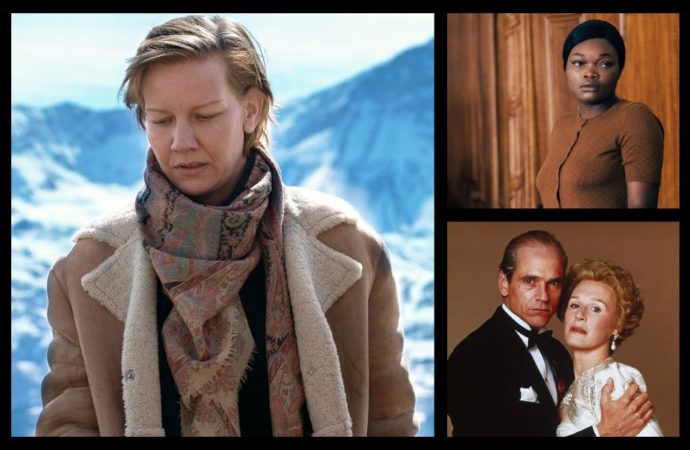

Courtroom dramas are not merely about procedures, robes, or verdicts. At its best, justice within the court becomes a narrative device capable of exposing the biases, fractures, and moral tensions that run through both the law and society itself. Rather than offering clear answers or reassuring judgments, these films address the viewer vicariously, placing us in the position of the judge and assigning us the role of someone who must pass judgment without certainty, aware that legal truth rarely coincides with moral truth. Few things are further removed from a comforting vision of justice.
Few narrative structures have proved as fertile for cinema as the trial. From the great courtroom dramas of classical Hollywood to contemporary explorations of truth and memory, the courtroom has become a privileged setting in which to confront opposing versions of reality, question the mechanisms of justice, and put a society’s moral convictions to the test.
The courtroom genre has produced some of the most influential works in film history. Sidney Lumet transformed jury deliberation into a masterclass in dramatic tension with 12 Angry Men (1957), starring Henry Fonda at the head of a memorable ensemble cast. Robert Mulligan addressed institutional racism in the American South through the figure of the iconic lawyer Atticus Finch, portrayed by Gregory Peck in To Kill a Mockingbird (1962). Stanley Kramer brought the moral wounds of the twentieth century to the screen in Judgment at Nuremberg (1961), assembling an extraordinary cast that included Spencer Tracy, Burt Lancaster, Maximilian Schell, Marlene Dietrich, and Montgomery Clift. Meanwhile, Otto Preminger revolutionized the genre through the moral ambiguity of Anatomy of a Murder (1959), starring James Stewart.
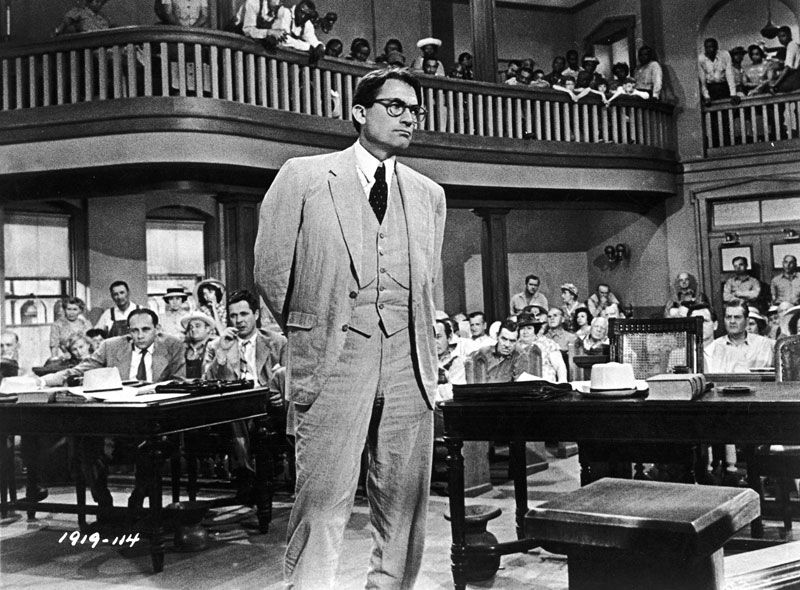
To Kill a Mockingbird (Robert Mullingan, 1962)
The following decades expanded the scope of courtroom cinema. Sidney Lumet once again explored the shadows of the legal system in The Verdict (1982), providing Paul Newman with one of the finest performances of his career. Rob Reiner turned a military tribunal into an acting duel between Tom Cruise and Jack Nicholson in A Few Good Men (1992), while Jonathan Demme used the case of a lawyer discriminated against because of his HIV status to reflect on social prejudice in Philadelphia (1993), starring Tom Hanks and Denzel Washington. Nor should we forget Francis Ford Coppola‘s contribution to the genre, adapting John Grisham‘s novel in The Rainmaker (1997), with Matt Damon as a young lawyer taking on a major insurance company.
Obviously, this list cannot be exhaustive, but it is worth noting that the genre has also served to revisit historical events and real miscarriages of justice. Jim Sheridan reconstructed one of the most scandalous cases of the Northern Irish conflict in In the Name of the Father (1993), featuring an extraordinary Daniel Day-Lewis, while Steven Soderbergh turned Julia Roberts into a popular icon with Erin Brockovich (2000).
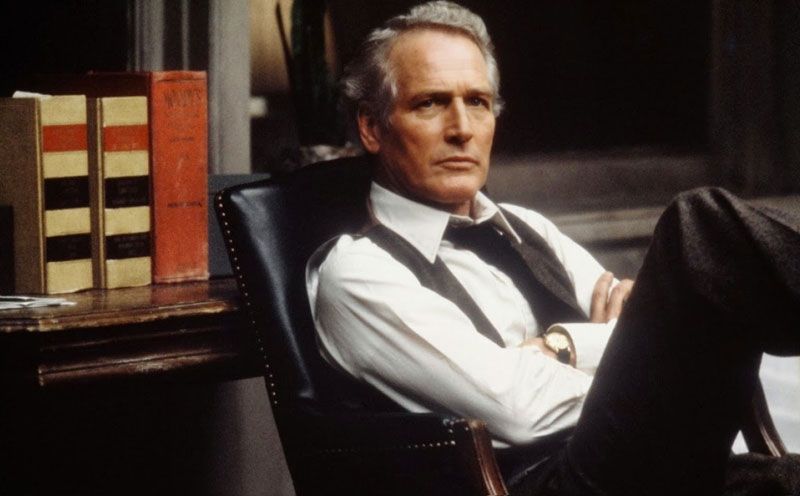
The Veredict (Sidney Lumet, 1982)
However, some of the most stimulating approaches to the genre have emerged away from the conventions of the classical courtroom drama. Films such as Saint Omer (Alice Diop, 2022), Reversal of Fortune (Barbet Schroeder, 1990), and Anatomy of a Fall (Justine Triet, 2023) use the trial as a tool for exploring much deeper issues: motherhood, social class, identity, memory, the construction of narrative, and the impossibility of arriving at a definitive truth.
It is on these three works that we will focus our attention, as they allow us to trace a revealing arc of how cinema has conceived the trial as a stage for power, interpretation, and cultural conflict—one that places women at its very center.
Reversal of Fortune: The Celebrity Lawyer and Reasonable Doubt
Based on the book by Harvard professor Alan Dershowitz, one of the most influential—and controversial—figures in American criminal and constitutional law, Reversal of Fortune is far more than the chronicle of a famous case. It also functions as a portrait of the celebrity litigator and of justice as spectacle.
Dershowitz, known for having defended figures as diverse as O.J. Simpson, Patty Hearst, Julian Assange, Jeffrey Epstein, and Harvey Weinstein, turns the Von Bülow case into a perfect laboratory for analyzing how a legal defense is constructed under conditions of intense media exposure, how reasonable doubt is articulated when the surrounding environment is burdened by prejudice, and how legal strategy becomes intertwined with public narrative.
Fragmented Truth and the Role of the Jury
The screenplay adopts a multiperspectival structure: Sunny Von Bülow‘s unsettling voice-over from her coma, Claus’s contradictory recollections, and the self-interested reconstruction of events. This narrative form reproduces one of the great problems of the law: how can truth be reconstructed when the sources are partial, biased, or simply inaccessible?
The film compels us, as spectators, to occupy the position of the jury, to evaluate incompatible versions of events, weigh evidence, and coexist with uncertainty. In this way, cinema dramatizes legal epistemology: the issue is not so much knowing “what happened,” but rather deciding what can be considered proven.
The Ambiguous Defendant and the Imperfect Victim
Jeremy Irons’s performance, which earned him the Academy Award, is a masterclass in ambiguity. We never truly know whether Claus Von Bülow is guilty or innocent. This opacity allows the film to reflect on the presumption of innocence, the distinction between legal truth and moral truth, and the media’s fascination with the figure of the “sophisticated villain.”
At the same time, the character of Sunny von Bülow—magnificently portrayed by Glenn Close—introduces a complex debate. Wealthy, addicted, emotionally unstable, and socially privileged, she embodies the notion of the imperfect victim: someone who elicits less public sympathy and whose life appears, implicitly, to be considered less valuable.
The film exposes the ways in which prejudices related to gender, class, and addiction inevitably contaminate—although they should not—the administration of justice.
Anatomy of a Fall: When Subjectivity Becomes Evidence
With Anatomy of a Fall, Justine Triet brings courtroom cinema into a fiercely contemporary territory. The starting point is a classic one: was the husband’s death an accident, a suicide, or a murder? Yet the film’s development is radical in its implications: it refuses to resolve the mystery.
Triet almost completely eliminates flashbacks. Like the judges and the jury, we know only what enters the case file. The spectator thus becomes a legal operator, forced to interpret incomplete evidence and conflicting narratives.
Criminalizing the Woman
Sandra Hüller plays a complex defendant: uncompromising, intellectually dominant, and emotionally opaque. The prosecution turns her personality, her professional success, her bisexuality, her status as a migrant woman, and her lesser involvement in caregiving into psychological indications of a potential capacity for murder.
The film exposes with surgical precision how the judicial system judges not only facts, but also the performativity of gender. Sandra does not fit the model of the repentant, fragile, and compliant woman that both the court—and society—expect. That very form of identity dissidence becomes incriminating evidence.
Marriage as Evidentiary Terrain
One of the film’s most brilliant insights is its transformation of married life into evidence. Every argument, every frustration, every imbalance is re-edited by the prosecution as a possible motive. Triet emphasizes an essential idea: judicial truth is a matter of editing. A different arrangement of the very same facts would produce an entirely different narrative.
Triet has even stated that she herself does not know whether Sandra is guilty. This authorial gesture is profoundly juridical: in criminal law, what matters is not metaphysical truth, but what can be proven beyond a reasonable doubt. The film’s fascination lies precisely within that fracture.
Saint Omer: The Trial as a Clash of Worlds
With Saint Omer, Alice Diop takes courtroom cinema into even more radical territory. Based on the real case of Fabienne Kabou, the film transforms the courtroom into a space where race, class, gender, colonial history, and systems of belief collide.
Race, Power, and Epistemic Authority
Laurence Coly, a Black, educated migrant woman, is judged by a court that presents itself as universal while operating from a very specific cultural matrix. A key moment occurs when her academic supervisor ridicules her desire to study Wittgenstein rather than “someone from her own culture.” The gesture reveals how the law also reproduces racial and cultural hierarchies under the appearance of neutrality.
Witchcraft as a Legal Challenge
Coly does not plead guilty. Nor does she invoke witchcraft as a psychological mitigating factor or as a cultural translation of postpartum depression. She does so for something far more radical: she suggests that the cause of her actions lies in an external agent embedded within a system of beliefs that the court should strive to understand.
In doing so, the film raises a crucial question: what place do non-Western cultural frameworks occupy within a European criminal justice system? How far does criminal responsibility extend when the accused operates from a different cosmology?
Motherhood, Myth, and Guilt
The film engages in dialogue with the myth of Medea while dismantling social expectations surrounding motherhood. Coly neither weeps, nor pleads, nor dramatizes her situation. This emotional distance is quickly interpreted as monstrousness. Saint Omer demonstrates how criminal proceedings simultaneously judge both the crime itself and the defendant’s conformity to the role of woman and mother.
Diop films with a composure that compels the viewer to confront their own prejudices. There are no definitive answers—only the recognition that justice, too, possesses its blind spots.
Cinema Faces Justice
These three films demonstrate that the trial in cinema is not merely a narrative device, but a highly symbolic arena in which essential questions are contested: what do we understand by truth, how do prejudices operate, who deserves empathy, and how far does the neutrality of the law extend? Above all, they reveal—consciously or unconsciously—that the administration of justice is also a matter of gender.
Courtroom cinema, in its most ambitious form, compels us to think even when disguised as spectacle. And although it is not always immediately apparent that every trial is shaped by narrative, power, and perspective, its unsettling and magnetic force continues to captivate us.




Nadie ha publicado ningún comentario aún. ¡Se tú la primera persona!