
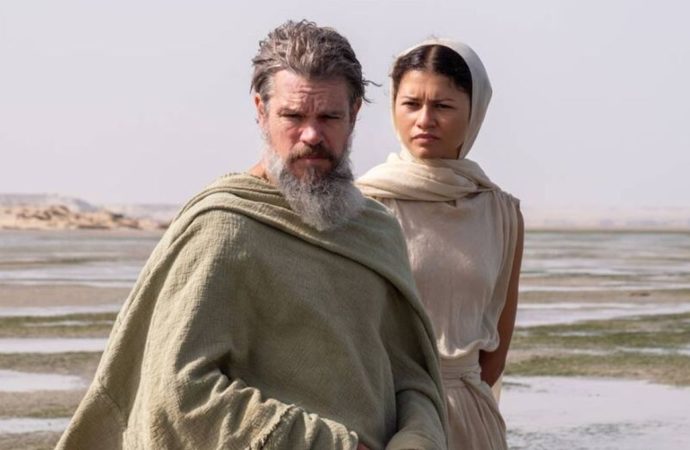

Only seven days before the release of Christopher Nolan’s new film, The Odyssey, The Telegraph published an interview with the director that explored, among other things, one of the questions I find most relevant surrounding this blockbuster. Nolan was asked about recent statements made by the film’s star, Matt Damon, who had expressed his sadness at feeling that The Odyssey belongs to a kind of film that will soon no longer be possible because no one will want to finance it.
Matt Damon literally stated that he decided to take part in The Odyssey because “it felt like the kinds of movies that were being made when I first started acting, and that is something that is going to disappear.”
In the aforementioned interview with The Telegraph, Christopher Nolan rejected such pessimism and, although he admitted that no one has made a film on the scale and characteristics of The Odyssey for quite some time, he also insisted that “cinema is vital and essential, and it continues to transform itself.”
Certainly, after having the opportunity to watch a film like this, one is compelled to ask whether we are indeed witnessing the final throes of a particular way of understanding mainstream cinema, one that will soon be replaced—if it has not been already—by other digital paradigms more closely tied to algorithms and political correctness than to the desire to tell stories free from the moral and ethical constraints of the moment in which they are made.
To begin with, it is quite likely that everyone, whether admirers of Nolan or not, can agree that there is currently no one else making this kind of production: large-scale filmmaking, grand themes, enormous all-star casts and a particular way of approaching them, with numerous locations, a predominance of practical effects—which are invariably more expensive—and, consequently, the reduction of digital effects to the bare minimum.
Denis Villeneuve’s Dune trilogy may come close; however, in my opinion, not only are the results far removed from Nolan’s achievements, but Villeneuve also fails precisely where Nolan excels most: in bringing coherence to the vast resources at his disposal. The two Dune films released so far, despite their virtues—particularly the second—and their flaws, feel like a disorganised puzzle in which the sheer scale of the spectacle devours the characters, reducing them to little more than accessories to the (digital) special-effects sequences. But this never happens with Nolan.

If there is one word that encapsulates Nolan’s The Odyssey, it is exuberance.
In this respect, what is particularly striking about The Odyssey is that, despite its enormous number of characters, motivations and narrative threads, everything is structured with remarkable clarity. This was perhaps the main criticism that could be levelled at Oppenheimer, which at times became a rather dense film to navigate. Nothing of the sort occurs here, despite, I insist, the sheer number of characters that populate the film’s exact three-hour running time.
For a film of undeniable dramatic complexity, Nolan has managed to distribute the narrative in a perfectly ordered manner, to the point that it may well end up being one of the most narratively accessible works of his entire filmography. More so than the cryptic Tenet, more so than Inception, and certainly far more than Memento—all of them, incidentally, featuring considerably fewer principal characters than The Odyssey.
This expository ability becomes even more surprising when one considers the scale of the film. Nolan is certainly not the first filmmaker to adapt Homer’s poems. As recently as two years ago, Ralph Fiennes starred in The Return, directed by Uberto Pasolini, a film that deliberately distanced itself from the Homeric texts: not only does it entirely dispense with any fantastical elements, but Homer himself does not even appear in the credits as the original source, clearly signalling Pasolini’s intention to explore certain themes—trauma and the return home—without necessarily linking them to Homer’s epic poem.
Nolan, however, is arguably the director who has brought the greatest degree of ambition to an adaptation of the Homeric rhapsodies. This is hardly surprising coming from a filmmaker who has consistently—and especially since the pandemic—championed not only cinema-going itself, but cinema as a sensory feast. His approach to The Odyssey is therefore marked by an exuberance entirely in keeping with the coordinates of the original tale. The imagery is defined by a fascinating contrast of landscapes, ranging from the black-sand underworld to Penelope’s (Anne Hathaway) fortress in Ithaca, passing through the sun-drenched yellows of Ogygia, the paradise of endless beaches where Calypso (Charlize Theron) holds Odysseus captive for seven years, depriving him of his personal memories.
Exuberance is also evident in the way the fantastic manifests itself throughout the narrative. Many of the threats faced by the film’s suffering heroes force them to look upwards: at the Cyclops Polyphemus, at devastating storms, or at the terrifying tentacles of the sea monster Scylla. Nolan thus emphasises the insignificance of human beings, the smallness of human life, forever at the mercy of forces infinitely more powerful than themselves. Greatness and power are constantly presented in opposition to the fragility of the human body, mere appendages of the gods. It is an idea that, to no small extent, also informed the Avengers films with the appearance of the villain Thanos.
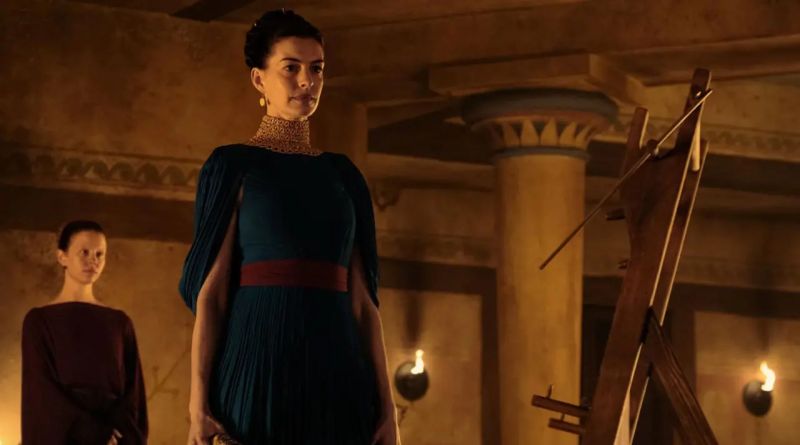
Anne Hathaway, magnificent—as is the rest of the cast—in The Odyssey.
And yet, despite being an exuberant film in so many varied ways, The Odyssey manages to avoid becoming a mere postcard. Its exuberance never turns contemplative, to the point that, although it undeniably looks like an expensive production, it fortunately refrains from relying excessively on long descriptive shots—a temptation Nolan surely had to resist given the film’s monstrous budget (250 million dollars, according to most sources). I would not say that every dollar spent is not visible on screen, but certainly not in the heavy-handed and self-conscious manner of other big-budget productions so intent on demonstrating to the audience just how expensive they are.
This brings me directly to another of The Odyssey’s greatest virtues: Nolan has managed to construct a narrative that, despite its 180-minute running time, advances at a relentless pace with barely any respite. The images never become burdensome, the film’s internal rhythm is remarkably effective, and until Odysseus finally reaches Ithaca—by which point two-thirds of the film have already passed—the spectator’s encounter with this audiovisual proposition remains genuinely enthralling.
The epic scale, the sheer grandeur, conveyed through Hoyte van Hoytema’s vibrant cinematography, combined with a devilishly effective editing rhythm and wrapped in Ludwig Göransson’s frenzied score, produces moments that, on a purely audiovisual level, I suspect will remain etched in viewers’ memories for a very long time. I am referring to sequences such as the assault on Troy, the desperate escape towards the sea from Polyphemus’ cave, or indeed the entire passage in Circe’s house (Samantha Morton), where the transformation of Odysseus’ men into swine allows Nolan to offer a curious—and unexpected—nod, though I am not entirely sure whether to Brian Yuzna’s Society (1989), Neil Jordan’s The Company of Wolves (1984), or perhaps both.
The film’s final third serves to bring together all the themes that have gradually emerged throughout the first two acts: the return home, embodied in the deeply moving reunion between Odysseus and his dog Argos, who has waited twenty years without dying simply to be petted one last time by his master; the pursuit of humility through detachment from material possessions—Odysseus returns to his own home disguised as a beggar, having lost not only all his companions along the journey but also much of the cruel and ambitious man he was when he departed for Troy; the persistence of memory, embodied by a steadfast Penelope who refuses every suitor in the firm belief that her husband will one day return; and also the corruption of power, crystallised in the loathsome figure of Antinous, played by a magnificent Robert Pattinson.
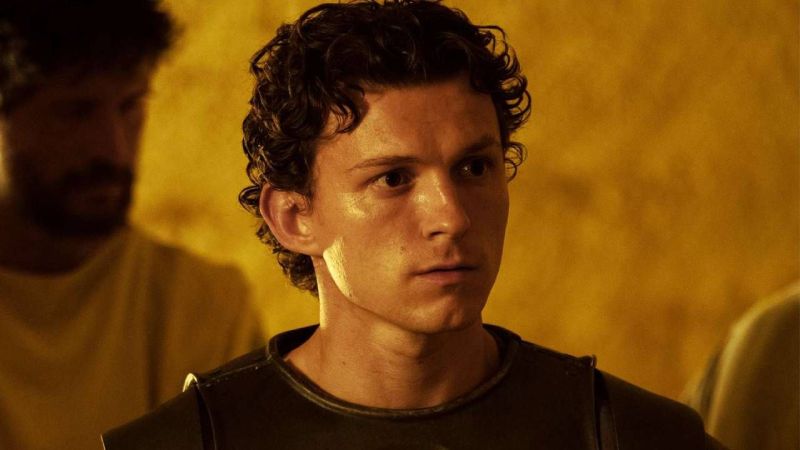
Tom Holland takes on the role of Telemachus in Christopher Nolan’s The Odyssey.

Nadie ha publicado ningún comentario aún. ¡Se tú la primera persona!