


The new Hulu and Disney+ series Furious, created by Elizabeth Meriwether (New Girl, Dying for Sex), initially presents itself as a crime thriller about the hunt for a serial killer. Yet beneath its seemingly familiar premise lies a far more ambitious reflection on violence, female rage, obsession, and the gradual erosion of the boundaries between victim and perpetrator.
Furious belongs to an increasingly visible trend in contemporary film and television: the rise of narratives centered on female anger. From Promising Young Woman to series such as Sharp Objects, Big Little Lies, and Mare of Easttown, recent fiction has shown a growing interest in exploring emotions traditionally denied to female characters, allowing them to occupy spaces of moral ambiguity, violence, and resentment that for decades were largely reserved for male antiheroes.
Starring Emmy Rossum (Shameless) and Lola Petticrew (Say Nothing) in two particularly compelling performances, the series — whose spoiler embargo list is remarkably extensive — follows FBI agent Alice Black (Rossum), tasked with capturing Catherine (Petticrew), a mysterious killer whose crimes appear to be guided by a highly personal notion of justice. As the two women draw closer, their trajectories begin to mirror one another, and the series ventures into increasingly ambiguous moral territory.
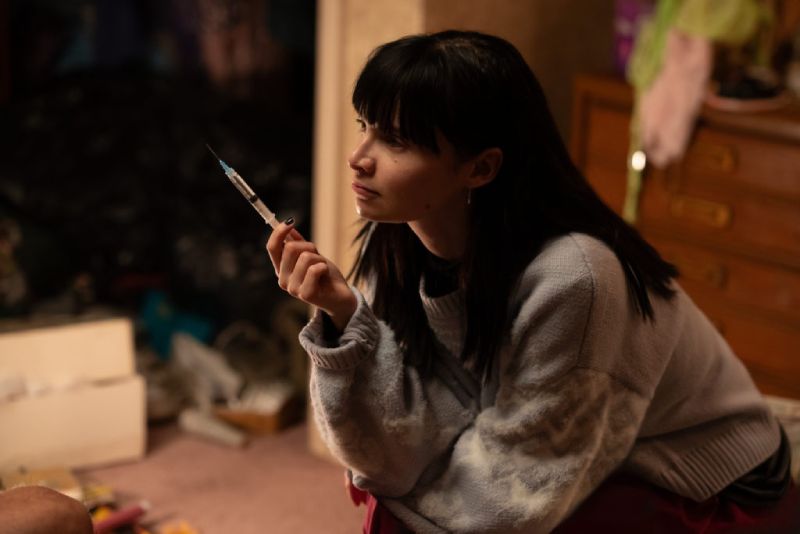
During the international press conference held on July 15, Elizabeth Meriwether explained that her intention was never to construct a traditional narrative of heroes and villains. “I never wanted the audience to feel comfortable deciding who is right and who is wrong,” the creator remarked, insisting that the series’ dramatic tension emerges precisely from the complexity of its characters.
What Drives a Woman to Kill?
One of the most compelling aspects of Furious is its attempt to explore the circumstances that might push a woman toward extreme violence. Emmy Rossum admitted that she was deeply fascinated by that very question. “What does it take for a woman to kill, and then to kill again?” the actress asked during the press conference. For Rossum, the series investigates “that inner engine, that impulse, that absolute commitment to justice and revenge.”
The actress even acknowledged experiencing a certain degree of identification with Catherine, the character played by Lola Petticrew. “I found myself thinking: am I identifying with a serial killer right now?” Far from being mere provocation, this identification constitutes one of the genre’s essential mechanisms, forcing viewers to recognize uncomfortable and liminal aspects of themselves.
Obsession as a Driving Force
Rossum also defended a particularly interesting idea: obsession is usually perceived in negative terms, yet it often proves indispensable for anyone who seeks to excel at something.
After meeting with FBI agents and law-enforcement officers while preparing for the role, the actress concluded that many of them experience their profession as something that transcends the notion of a mere job. “To do something really well, you have to be a little obsessed,” she argued. “For them, it isn’t simply employment; it’s an essential part of their identity.”
This notion of obsession ultimately becomes one of the central themes of Furious. Alice’s determination to capture Catherine gradually begins to resemble the killer’s own unwavering pursuit of justice, blurring the distinctions between hunter and prey. In this sense, the series suggests that both women are driven by similar impulses, differing less in their emotions than in the means through which they choose to channel them.
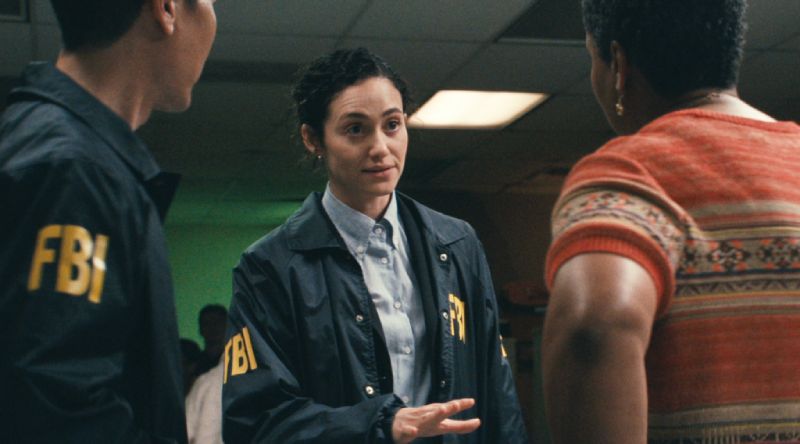
This obsession equally affects the series’ protagonists. Rossum emphasized that Alice, Catherine, and Nora (Quincy Tyler Bernstine) are women who have been consistently underestimated and who, precisely because of this, have been forced to work harder, behave differently, and develop particular survival strategies.
The Fury of Women
It is no coincidence that the series’ title explicitly evokes the Furies of Greek mythology, the avenging deities charged with pursuing crimes that remained unpunished. During the press conference, Lola Petticrew pointed out that this female rage is neither a passing trend nor merely a reaction to a specific contemporary event, but rather a historical and structural experience rooted in centuries of subordination and violence.
Rossum was particularly forceful on this point: “There is a fury of women, a fury toward society and toward everything women have endured throughout history.” The actress also lamented that, in many of the most notorious cases of violence and abuse, collective memory tends to remember the names of the perpetrators more readily than those of their victims. “The sad thing is that we know these men’s names perfectly well. I wish we also knew the names of those women, and that some of them were still here to tell their stories.”
Imperfect Women
One of Furious‘ greatest strengths lies precisely in its determination to dismantle the notion of the “perfect victim.” During the press presentation, Lola Petticrew defended the importance of portraying women who are contradictory, unsettling, and morally ambiguous. According to the actress, the series constantly forces viewers to reassess their own moral boundaries, leading them to justify behaviors they likely would have rejected before watching it.
For her part, Rossum admitted that she is increasingly drawn to characters who are difficult to classify ethically. “I’m fascinated by the grey areas of morality,” she explained. “I’m much more interested in the messiness of reality and in human complexity.”

A Thriller for Our Times
The series speaks to us about the danger of rage ultimately consuming those who experience it, but it also addresses other issues such as the loss of trust in institutions, systemic violence against women, and the impossibility of achieving justice.
Furious attempts to avoid both ideological simplification and the fantasy of pure revenge. Although the series adopts the form of a crime thriller, it does not present fury as a solution, but rather as a deeply ambivalent force: it can become a driving force for survival and resistance, but it can also consume those who experience it. Elizabeth Meriwether insisted that anger can be liberating, but it can also become a trap and lead to forms of self-destruction.
Beyond being a story about a serial killer, Furious shows what happens when a society produces enough pain, frustration, and a sense of impunity for fury to cease being merely an emotion and become a way of life. As in many recent narratives, the real conflict does not arise solely from the existence of evil, but from the feeling that social and legal mechanisms are incapable of responding adequately to it.
Furious premieres on July 27 on Hulu and Disney+, with three initial episodes and new weekly installments until the season finale, scheduled for August 31.





Nadie ha publicado ningún comentario aún. ¡Se tú la primera persona!