


Lluís Miñarro, director of Emergency Exit, is not only a key figure in Spanish independent cinema: he is one of the last genuine agitators of European film. A producer behind authors who reshaped contemporary cinematic language —from Apichatpong Weerasethakul to Manoel de Oliveira, from Albert Serra to Naomi Kawase— and responsible for some of the most uncompromising experiments born on Europe’s creative periphery, Miñarro has built a career that consistently defies market expectations, critical trends, and industry rules.
His new film, Emergency Exit, which premiered in the most radical section of the Tallinn Black Nights Film Festival (Rebels With a Cause), reaffirms this aesthetic militancy. Conceived as an existential road movie trapped inside a bus with no destination, and populated by a celestial cast —Oriol Pla, Emma Suárez, Albert Pla, Marisa Paredes, Arielle Dombasle, Francesc Orella, Myriam Mézières, Aida Folch…— playing fragmented versions of themselves, and shot with a retro stylization that evokes both Buñuel and the artisanal cinema of the 1970s, the film becomes a funhouse mirror reflecting our obsessions, our masks, and our profound difficulty in confronting mortality.
At a time when global cinema aligns itself with digestibility, explanation, and message control, Miñarro continues to work in the opposite direction: he embraces mystery, excess, and everything that refuses to fit neatly into place. Emergency Exit does not seek to please or persuade; it aims to unsettle, seduce, and question the comforting narrative we construct to endure the journey.
With the blend of candour, lucidity, and audacity that defines him, Lluís Miñarro speaks with El Hype about this drift toward the unknown.
A Bus to Nowhere
Emergency Exit is a remarkably free film that vibrates on its own wavelength —as is often the case in its director’s body of work— and slips away from safe narratives and recognisable formats. It unfolds as a kind of passage, a journey toward a contemporary Styx. That bus with no destination is also a metaphor for the world: an inventory of desires populated by multiple, diverse figures, almost like a caravan of wandering souls.
Is the film a generational reading, a social critique, or rather a more intimate reflection on the passage of time? Miñarro confirms it: “It could be all three, but I think the last one is the most appropriate, though it’s not only personal —it’s also collective. I’m interested in our view of death, which in the West is terribly dramatic, perhaps because of our cultural roots. It’s a vehicle going nowhere, on one hand, but it’s also a vehicle you could metaphorically see as a coffin on wheels, because those lost souls you see inside could also be described as ghosts.”
Like a boat of Charon, carrying its passengers across an existential threshold —a presence that inevitably evokes Buñuel, a libertarian spirit, and that artisanal cinema from another era that fascinates the director.
The Spirit of the ’70s and the End of a “Pure Cinema”
In Emergency Exit, Miñarro’s deep cinephilic background coexists with distinctly contemporary concerns —a dialogue he has managed to weave seamlessly. “For me, the cinema of the 1970s, even the early ’80s, still had a kind of virginity,” he explains. “In the sense that it was always inventing itself, and in some way it wasn’t yet market-driven, nor dependent on postproduction structures, on digital or computer-generated processes. Those new technologies hadn’t yet appeared —technologies that, for me, have distorted the pure, original essence of cinema.”
“That’s precisely why I set the film in the ’70s. For various reasons. One is that, for me, that’s where ‘pure’ cinema ends, so to speak. After that comes a drift into advertising aesthetics, music videos, platforms… Everything has changed radically, not only in what cinema communicates but also in how it is made. Keeping that slightly artisanal spirit alive —as one of the masters I worked with, Manoel de Oliveira, used to do— was essential for me. It also reminded me of a stage in my life when I was writing film criticism, attending and commenting on cine-clubs; I was deeply immersed in cinephilia, but I was not yet a producer or a director. It’s a period of my youth that I carry very vividly with me, and that, in many ways, shaped who I am today.”
Barcelona, Counterculture and Magical Realism
The period Miñarro evokes was culturally explosive: “It also coincides with the political transition —the end of the dictatorship. And with the advantage I had in those years in Barcelona, where one could meet an entire spectrum of extraordinary writers, the very people who led me toward magical realism. These writers were Gabriel García Márquez, Mario Vargas Llosa, Bolaño, Jorge Edwards… People who were very close to cinema, who frequented certain circles at the time, often guided by someone strongly connected to Valencia: Ricardo Muñoz Suay.
Thanks to Ricardo Muñoz Suay —then producer or co-producer of films like Viridiana, films by Francesco Rosi, and others— being part of that circle was something very beautiful and, in a way, surprisingly accessible for someone like me, who came simply from cine-club culture. It allowed me to participate in that world and meet fascinating people, all of them deeply cinephile.
For me, this film is also, in a way, an indirect homage —even if it’s not explicitly stated— to that entire generation, to those individuals, to that vital moment of the 1970s. That is why I set the film in that era. The cars belong to that period, the passengers are from that period, the older actresses seem as if they’ve stepped out of that period and somehow become unmoored from time.”
Metalanguage, Cinephile Clues and the “Non-Place” of the Bus
In Emergency Exit, there is something wondrous about those figures “out of time,” almost like characters from silent cinema —their makeup, their gestures. The film is filled with metalanguage and carefully embedded cinematic references: “Yes, of course. There is a clear reference, which is Buñuel’s The Exterminating Angel, as a point of departure. The idea for the story came to me in Mexico, after finishing the shoot of Love Me Not there. Besides Buñuel, whom I admire, there are very specific cinematic nods for viewers with a broad cinephile background. And if they don’t catch them, it doesn’t matter —they are simply signals, symbols.
There’s Eros, a character who tries to seduce or unsettle everyone, someone who could have stepped out of Pasolini’s Teorema, in a different tone. Or the coat that subtly suggests the wearer might be naked underneath, like Dominique Sanda in Jacques Demy’s Une chambre en ville. Emma Suárez wears a hairstyle reminiscent of Last Year at Marienbad… These are small details that don’t hold up the story —the film would be the same without them— but they act as small keys for cinephiles, fragments of films that are personal favourites.”
Back Projection, Shared Dream and Dislocated Characters
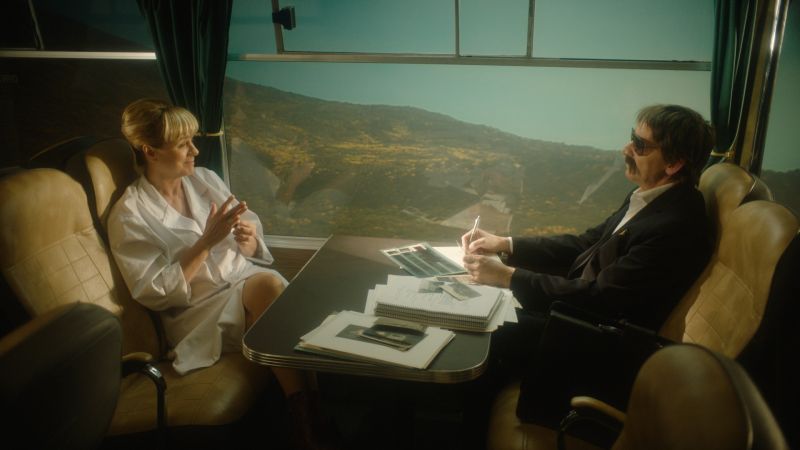
The unity of place —the bus as a space suspended between life and the afterlife— is presented to the viewer in a minimalist, almost theatrical environment that pares down narrative artifice to heighten another kind of experience. Miñarro saw this as the only possible way to shoot Emergency Exit, Hitchcock-style: “I probably couldn’t have made this film any other way. Imagine driving that bus on real roads, with traffic cuts, external noise, and all the complications. From the start, I knew the only feasible method was to do it like Hitchcock: in a studio, with the landscapes filmed separately and projected via back projection.”
This technique contributes decisively to the atmosphere of a shared dream: saturated colours, pink skies, unreal landscapes. “Yes, I was interested in that ‘non-place’: on one hand a specific location, and on the other, somewhere impossible to pinpoint, even if you recognise landscapes from La Gomera or Tenerife,” he explains. “And with the kind of characters who board the bus —a man who looks Mexican, Naomi Kawase, a Japanese woman— this mixture of worlds placed me in an atmosphere halfway between dream and reality.”
Between the Kitsch and the Metaphysical: An Impossible Balance
Emergency Exit moves constantly between the absurd, the kitsch and the metaphysical. It never slips into parody or solemnity, and the viewer can easily empathize with its characters. Miñarro sees this as a continuation of a stylistic thread already present in his earlier films: “It’s hard to explain, but it was already there in my cinema. If you think of Stella Cadente, that film also dealt with a serious subject —the counter-Reformation spirit that keeps resurfacing in Spain— and yet humour was always present. I suppose it has to do with who I am. I love being a bit mischievous, even though I’m over 70.”
Curiosity and mischief, he says, are what keep us alive and receptive. In this, Miñarro recalls his mentor Oliveira, a true role model: that boundless curiosity. “It comes naturally to me,” he admits. “On one hand, I like to surround myself with beauty —you can see that. On the other hand, I can have a kitsch or even quirky streak. There is something very Valencian about the film —the dacha-style carpet, the sense of excess. I think people in Valencia will understand it very well.”

Cast, Desires, Masks and Synchronicities in Emergency Exit
The ensemble cast is remarkable: they play either versions of themselves or symbolic archetypes, moving from the intensely carnal to the overtly spiritual. The film often feels like a collective exorcism —an inventory of desires, wounds, contradictions, human obsessions, trauma, and memory. This blend of autofiction and allegory was one of the elements that most attracted Lluís Miñarro: “What interested me was the sense of universality. These are characters in which, in some way, anyone could recognise themselves. We are all ‘devils,’ if you like. We have different layers, masks, ways of interpreting life. Deep down, we are all lost on the same boat, not knowing where we’re going or where we come from. Faced with that, what I want to transmit is an attitude of: ‘relax, this is life.’ From the moment you’re born, you already know that one day you will die —it’s implicit.”
Emergency Exit is also filled with powerful synchronicities, something the director is fully aware of: “There are very strong synchronicities. Marisa Paredes plays a version of herself, and then she passed away. It’s as if the film had anticipated something, as if she had been ‘chosen’ to make her final film. These are magical things that we usually overlook, but they’re what truly matter. They seem like anecdotes, and yet they are essential, because they’re part of the magic of our existence.”
Naomi Kawase, Brazilian Models and a Deeply Personal Casting Process
The cast of Emergency Exit is astonishingly diverse: friends of Miñarro, cinephile icons and unexpected figures coexist inside the bus. The director explains his casting process: “Many of them are actors I had already worked with: Francesc Orella, Gonzalo Cunill, Emma Suárez… I knew Naomi Kawase as a filmmaker, but here she practically debuts as an actress. And then there’s Jhonattan Burjack, that overflowing Eros —a Brazilian high-fashion model; I discovered him while browsing fashion websites.”
Oriol Pla, an extraordinary actor who has just won an Emmy for Yo, adicto, was someone Miñarro already admired from his theatre work: “And look at him now—he’s just received an important award… Another coincidence. The entire cast responds to that mixture of personal closeness, intuition, and the desire to create a very alive microcosm.”
The State of Art-House Cinema: Overproduction, Screens and Safe Havens
Emergency Exit premiered at the Tallinn Black Nights and Gijón Film Festival, both programming it in sections that champion formal rupture and risk-taking. Does this signal a greater openness to radical proposals, or do we still inhabit a fundamentally conservative ecosystem? Miñarro is unequivocal: the situation remains extremely difficult for independent auteur cinema. “Even if you manage to produce the film, the big problem is that distributors don’t want it, and it has no space in theatres. And on top of that, cinema attendance has plummeted; since the pandemic, audiences have become accustomed to watching audiovisual content at home, with a different attention span and different formats.
The system is designed so that films get made—there are funds, film schools, mechanisms that help—yet Spain now produces around 300 films a year, when before it was 180. All of them then compete for the same screens, and many don’t last more than a week in theatres. It’s terrible. What consoles me is that the kind of cinema I make has a strong life in festivals, cinematheques and cineclubs. It isn’t a wasted effort: these films are revisited, seen with perspective. It’s not like advertising, made today and thrown away tomorrow.”

Against Cinema That Explains Everything
“I ask the viewer to participate, but I demand nothing from them. I invite them on a journey; I offer them a gift to take with them. I do it out of respect for the audience.” Miñarro is not interested in cinema that explains everything. Emergency Exit is, in this sense, an act of resistance against the didactic, algorithm-friendly storytelling of today’s platform model. It is a proposal for viewers who appreciate being trusted—trusted to bring their own cultural background, experiences and sensibilities, and to see them reflected, in some way, in what is presented to them. The beauty lies in that interaction, in the possibility that viewers may identify with something. Those of us who work in culture should feel that responsibility,” Miñarro asserts. “Predictable cinema has never interested me as a viewer; why would I want to produce it or direct it? If it’s predictable, I’m simply not interested.”
The Producer Who Also Directs: Truth, Labels and a Personal Map of Cinema
As a producer, Miñarro has played a decisive role in the early films of essential auteurs —Albert Serra, Lisandro Alonso, Marc Recha— and enabled key works by filmmakers such as Naomi Kawase, Apichatpong Weerasethakul, Béla Tarr or José Luis Guerin. His career reveals a refined ability to detect talent and commit to it long before the industry does. When asked what he recognises in a filmmaker that makes him want to support them, he answers without hesitation: “Their truth. That I can see they’re authentic and vibrate with what they propose, that they connect emotionally with the project and that their cinematic references resonate with mine.”
It is tempting to say that Miñarro has a personal map of cinema, and that a dotted line would connect him to these filmmakers. “Yes, I like that image,” he says. “There are always points in common—parallel or very similar ways of understanding the cinematographic experience.” Yet the challenge of balancing producing and directing at such a high creative level has followed him throughout his career: “The perversity lies in the fact that, because I’ve produced more than forty films, people sometimes look at me with reservations as a director, as if the two crafts were incompatible. Labels… For me, they are distinct dimensions: producing and directing do not involve the same emotional implications. When I direct, there is something far more personal at stake, a much more intimate exposure.”

Next Emergency Exits
The title Emergency Exit seems to hint at a personal escape route —but what comes after? “This is my imminent emergency exit,” Miñarro says. “I’ve carried this film on my back for five years, with endless financing problems and ministry issues… Now that it’s finished and starting to travel through festivals, yes, I finally have some room to think about what’s next. I’m still active as a producer; I’m working on a film about the Russian era of forced labour, with fascinating archival material. And I have ideas for my own next escape route… But being dedicated to this project hasn’t left me much time. Still, I have ideas.”
Emergency Exit confirms that Lluís Miñarro continues to operate on his own frequency, outside commercial urgencies and new cultural orthodoxies, pushing boundaries with unwavering conviction. His cinema does not explain —it provokes. In an increasingly sanitised and programmatic cinematic ecosystem, his work insists on reminding us that art does not need to be edifying, useful or transparent. It can —and perhaps must— be uncomfortable, contradictory, unclassifiable, and yet profoundly beautiful.
In a time of polarised discourse and trends that reduce cinema to a slogan or a commodity, the absolute freedom of the artist and the intelligence of the spectator matter more than ever. Emergency Exit is a testament to that belief: a journey to nowhere that, precisely for that reason, forces us to confront the radical uncertainty of being alive.
Cinema can still be an act of resistance, and Miñarro continues to champion bewilderment as a creative engine —curiosity as a constant wonder in a universe where we should not forget our place.






Nadie ha publicado ningún comentario aún. ¡Se tú la primera persona!