

I couldn’t miss the opportunity to visit the new museographic reordering proposed by the Museo Nacional Centro de Arte Reina Sofía (MNCARS) around its Contemporary Art Collection 1975 – Present, which aims to “tell the story of art from the Transition to the present, following a route structured in three itineraries […] based on a selection of works from the Reina Sofía’s collections.”
As the flagship institution of Spanish contemporary art —and presumably of Ibero-American art as well— the entire art system assumes and accepts that the selection of artists and the narratives constructed and organized through the curatorship of the works displayed on the fourth floor of the Sabatini building —that is, its historiographic narrative— must be taken as canonical. Put differently: in this monumental exhibition, those who are not included do not exist. And those who are included are there because their works are absorbed into and explained through an institutionalized narrative, fixed in time, that grants them a form of immortality determined by the authority of its museological canon, leaving no room for alternative readings.
In this vast exhibition, those who are absent do not exist. And those who are present are framed and interpreted through an institutionalized narrative.
Within this framework, I was struck—both surprised and disappointed—to find that the entire generation of artists who helped shape today’s digital culture in the second half of the twentieth century—particularly in its final decades—had completely vanished from this selection. No trace of them. Not a single work of digital, multimedia, electrographic, fax-based, immersive, or online art. It is evident that invisibility, produced through indifference and lack of attention by the most influential contemporary art institution in the Ibero-American sphere, renders irrelevant whatever is not shown. After completing the long journey through the 21 rooms, the viewer inevitably internalizes the museum’s authority in this exclusion, accepting as canonical what is and is not considered art. The implicit message is clear: this, dear viewer, is Spanish art from 1975 to 2026—and nothing more.
This perverse and deeply biased museographic narrative of such a turbulent, heterogeneous, and multifaceted period in Spain’s creative landscape at the turn of the century avoids —whether out of incapacity or, perhaps, simple laziness or convenience— key artistic tendencies that are essential to understanding how citizens experienced and managed their digitalization, their technologization, and their transformation into what they are today: prosthetic, hybrid beings, operating between the physical world and its full digital replica—its reality and events translated into virtual, online, continuously flowing forms.
The argument used to justify this inexcusable omission—I allow myself such strong wording because I consider new media art to be the set of artistic practices that most accurately, effectively, and convincingly represent the zeitgeist of that period—rests on the absence of a narrative that has simply not been constructed. This specific discursive framework, which not only seeks to explain each movement and tendency included in the exhibition but also determines the very way in which they are distributed and organized, ultimately becomes the central criterion for inclusion. It is the underlying argument that legitimizes what is shown.
In other words, what cannot be articulated through a discourse aligned with traditional modes of presenting art is denied the possibility of existing, or at least of being considered relevant. This is precisely what has happened to new media art practices produced in Spain or by Spanish artists during the period covered by the exhibition. Their importance is such that this omission is not only striking, but fundamentally indefensible.
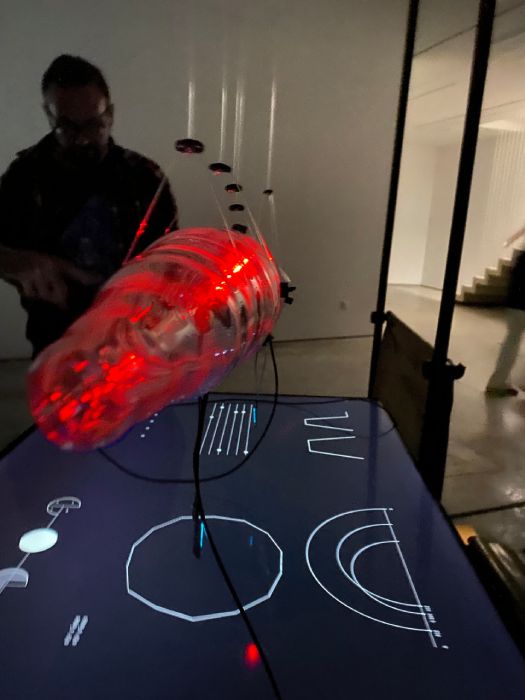
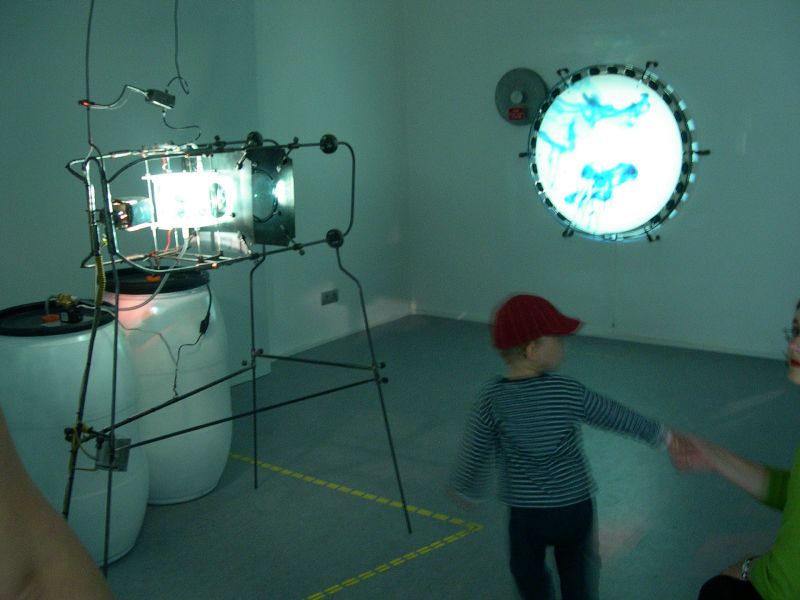
Moisés Mañas. Data/Golem Visualization. 2023. Installation.
Since the 1980s, numerous art and new media centers have shaped the Spanish cultural landscape: the International Museum of Electrography in Cuenca; Arteleku in San Sebastián; Laboratorio de Luz in Valencia; Medialab Madrid (later transformed into MediaLab Prado) in the capital; the CIEJ and Mediateca of the “la Caixa” Foundation in Barcelona; MECAD-ESDI in Sabadell; the Fundación Arte y Tecnología (now Fundación Telefónica) in Madrid; Bilbao Arte in Bilbao; Laboral Centro de Arte y Creación Industrial in Gijón; Intermedia-Matadero in Madrid; MEIAC in Badajoz; HANGAR in Barcelona; eTOPIA in Zaragoza; and the Harddiskmuseum in Valencia.
Perhaps their narratives, discourses, and modes of storytelling operate through different frameworks, but that does not make them any less significant or influential. On the contrary, they may be even more relevant if we consider their capacity to embody the zeitgeist of this historical period. These practices engage with questions of form and language: new narrative structures, new visual languages, new imaginaries, and new interfaces, all emerging from artists’ creative use of technical images and their technological devices, particularly in digital, multimedia, and online environments.
They reflect on the new conditions of communication, on the emerging patterns that become new rituals and myths shaping contemporary daily life —one that is fundamentally different due to our transformed human condition. In doing so, they have enabled the incorporation of new artistic paradigms. The old ones had already been dismantled and put into crisis by the avant-garde movements of the twentieth century, yet without successfully establishing new frameworks in their place. That task, in many ways, fell to digital culture and media arts.
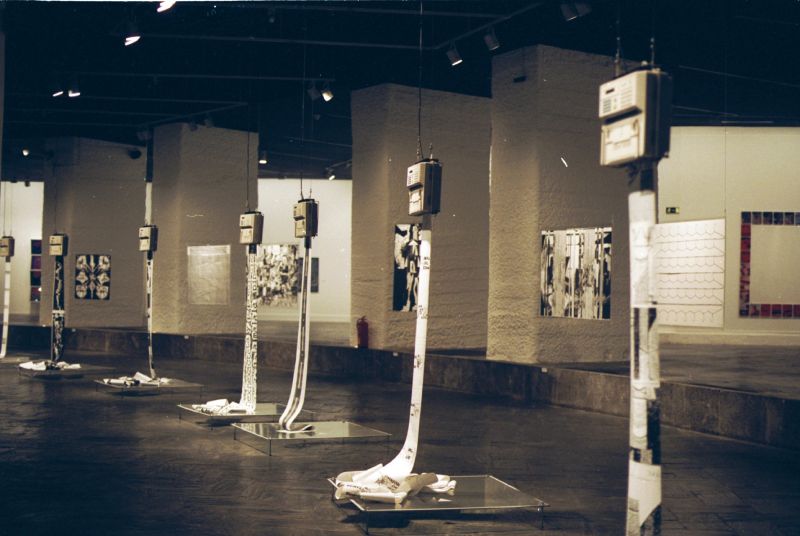
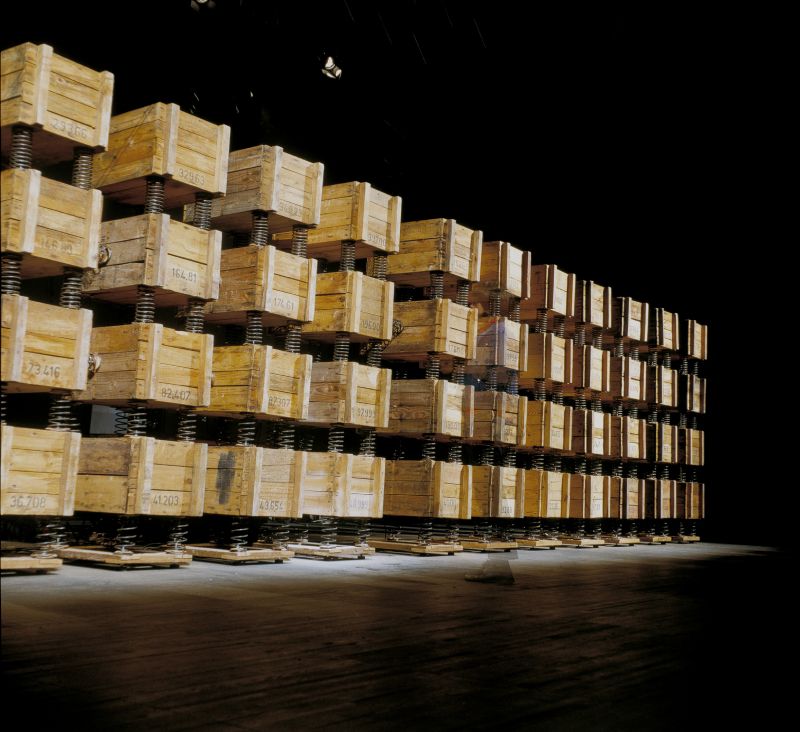
Rubén Tortosa. La Activación de la Superficie Plana. Fundación Telefónica. Exhibition Variaciones en Gris. Madrid 1992. Installation-Fax.
There is no excuse for such a glaring omission. We cannot allow a self-proclaimed museum of contemporary art to entirely evade, by rendering invisible and showing complete indifference toward the very set of artistic practices that most accurately represent the spirit of our time, and that, within our own geography, within the geopolitical space of what we call “Spanish,” have had —as already outlined— a significant and substantial presence.
In the words of Toni Calderón —creator and director of the iconic alternative art space Sala Naranja in Valencia, and founder and co-developer of the project cisma.art— reflecting on this same critical analysis: “For years, there have been scarcely any acquisitions in this field; institutions have either not known how, or not wanted, to sustain these practices, and the ecosystem of galleries and fairs has consciously marginalized them. The museum, in the end, merely absorbs all of this and turns it into a narrative, although in doing so it also legitimizes it. The result is exactly what is described [in this brief critical text]: it is not just an absence, it is a mutilation. An essential part of contemporary art is left out —arguably the very part that best explains the time we live in, even more so than more traditional languages such as painting.”
We are fully aware of the immense challenge involved in devising a new (alternative) museographic model, one that moves beyond the white cube and is capable of fully and coherently accommodating the paradigms underpinning twenty-first-century artistic practices: the ephemeral, the virtual and intangible, the fluid, the online and networked, the immersive, the process-based, and so on. But as unavoidable as it is, someone will have to take it on.
To invent, test, and implement such a model entails formidable challenges, yet tentative efforts are already beginning to emerge around the world. Which makes the museum’s omission —or at the very least its failure to provide an explanation for it— all the more unacceptable.
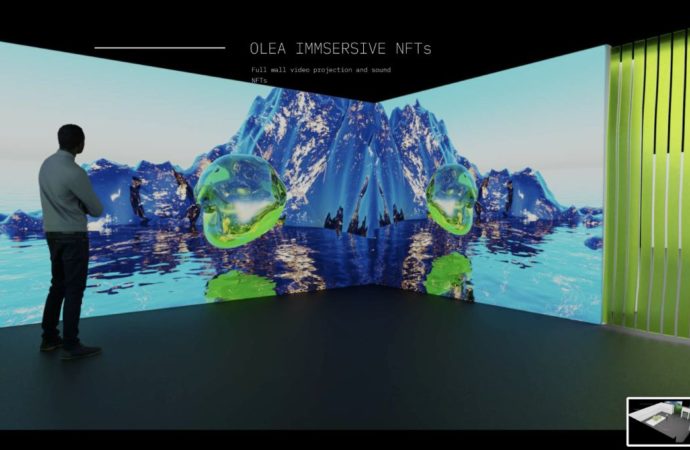
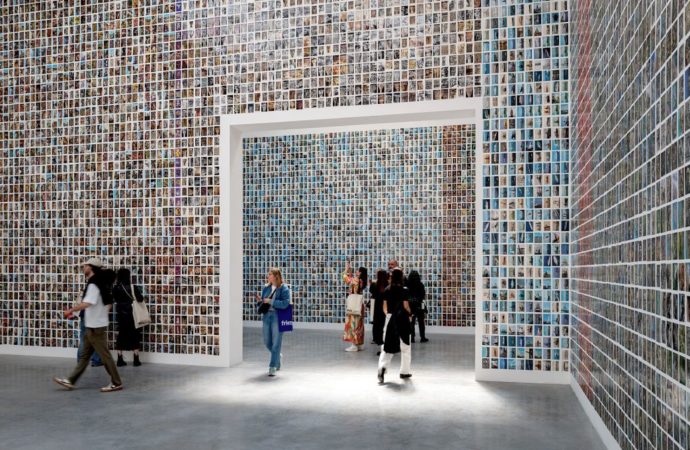
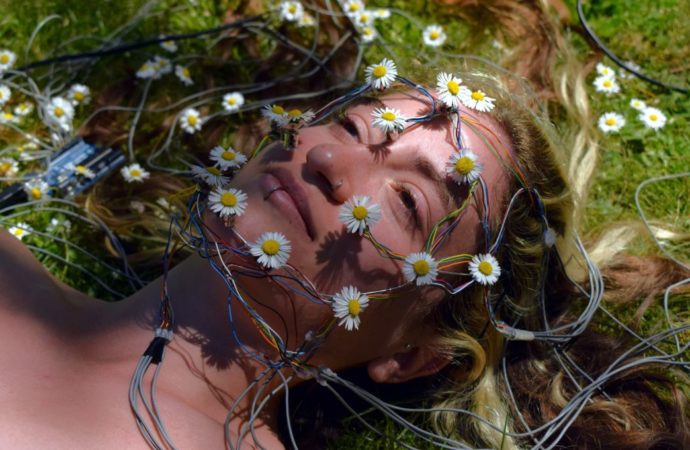
Header image: Solimán López. Olea. 2023. Immersive projection of an NFT.


Nadie ha publicado ningún comentario aún. ¡Se tú la primera persona!