
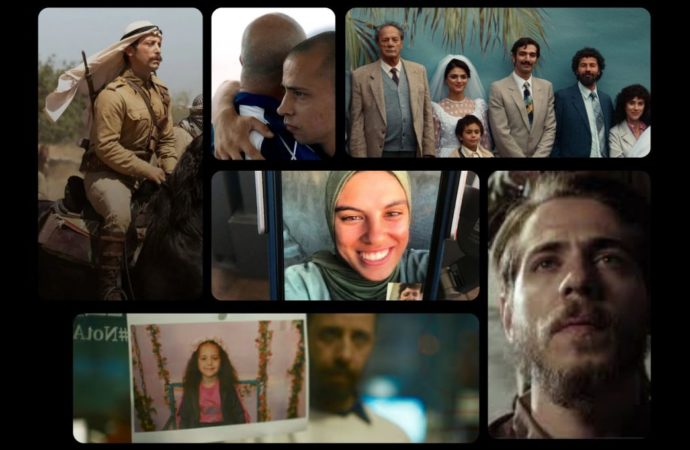
In a year marked by historical urgency, where politics, humanitarian concerns, and culture alike have been compelled to take a stance, the cinema connected to Palestine achieved extraordinary political and formal relevance in 2025. Far from offering a singular perspective, films produced in or centered on territories occupied by Israel have mapped out a complex landscape where historical narrative, intimate memory, direct testimony, and narrative experimentation coexist. Their presence across major festivals and awards circuits, earning prestigious recognitions, stands as both proof of life and an artistic testimony of incalculable value.
Within this momentum, several women filmmakers stand out in particular —Cherien Dabis, Annemarie Jacir, Kaouther Ben Hania, Diana Allan, Sepideh Farsi, and Nada Khalifa— who are behind some of the year’s most significant works, many of them internationally awarded. Their perspective shifts the focus toward micro-history, toward bodies and affective genealogies where politics becomes lived experience, without losing sight of the historical backdrop and geopolitical implications of the conflict.
Fiction Features: Between History and Wound
All That’s Left of You, directed by Cherien Dabis—Jordan’s official submission for the Oscars—has established itself as one of the central works of the year, winning the Audience Award in Thessaloniki and Best Director in Seville. Co-produced by Germany, Cyprus, Palestine, Jordan, Greece, Qatar, Saudi Arabia, the United States, and Egypt, and starring Dabis herself alongside Mohammad Bakri (in his final screen appearance), Saleh Bakri, and Adam Bakri, the film unfolds as a generational fresco spanning from foundational trauma to the present. Its retrospective structure—triggered by a teenager caught in an Intifada protest—reveals how history inscribes itself within family intimacy and the transmission of identity.
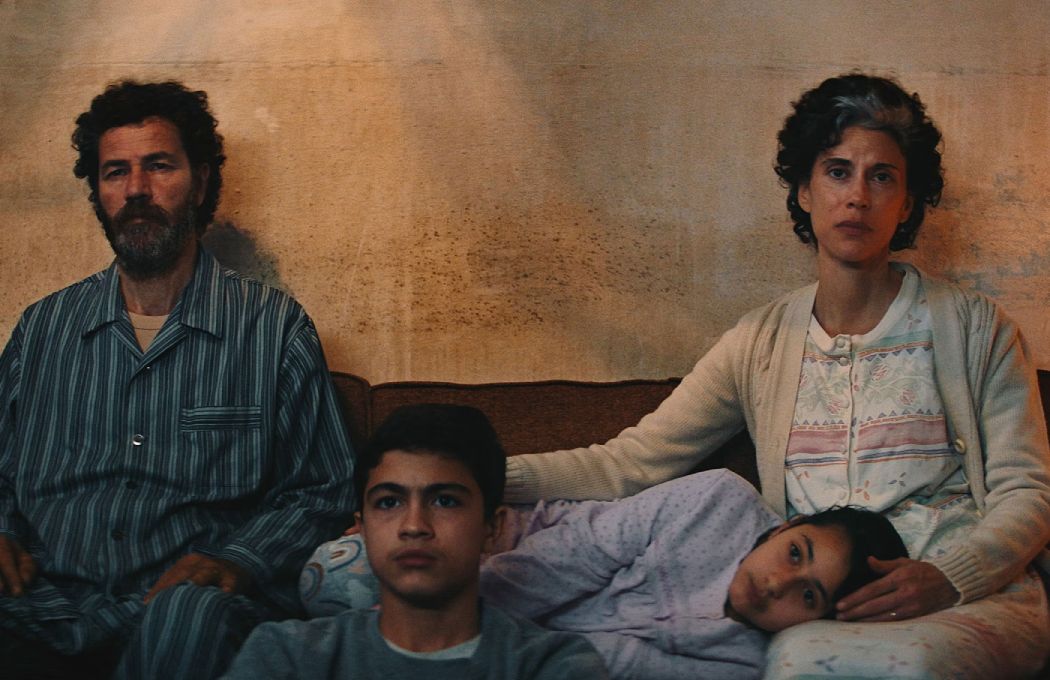
All That’s Left of You (Cherien Dabis, 2025).
In Once Upon a Time in Gaza, by the brothers Tarzan Nasser and Arab Nasser —awarded Best Director in Un Certain Regard at the Cannes Film Festival 2025— the conflict takes on an unexpected form: that of a crime thriller. Starring Nader Abd Alhay, Majd Eid, and Ramzi Maqdisi, the film situates a narrative of corruption and survival in Gaza in 2007, where structural violence contaminates even the codes of genre cinema. The directors—who previously won Best Screenplay at the Valladolid Festival with Gaza, mon amour (2020)—demonstrate once again that cinema can function as an art of resistance, capable of raising awareness while entertaining under the harshest conditions.
Palestine 36, directed by Annemarie Jacir and winner of Best Film at the Tokyo Festival, returns to the 1936 uprising against British rule. Its historical ambition is supported by a strong cast led by Hiam Abbass, Kamel Al Basha, Yasmine Al Massri, Saleh Bakri, and Jeremy Irons. The film constructs an epic dimension without losing its grounding in individual experience, portraying the inevitable collision of historical forces. As villages in Mandatory Palestine rise against colonial rule, Yusuf drifts between his rural home and the restless energy of Jerusalem, yearning for a future beyond the growing unrest—yet history proves relentless, and its consequences reverberate into the present.
The Voice of Hind Rajab, directed by Kaouther Ben Hania—awarded the Grand Jury Prize and the Golden Lion at the Venice Film Festival and nominated for Best Picture at the Oscars reduces scale to intensify impact. Based on a real case, the film constructs extreme suspense with minimal resources, generating total identification with a child trapped under fire, a symbol of collective tragedy. On January 29, 2024, Red Crescent volunteers receive an emergency call and contact with six-year-old Hind Rajab, shot inside a car where her relatives have been killed by gunfire from the Israeli army. This French-Tunisian co-production became one of the most widely discussed, seen, and selected in festivals last year, provoking both empathy and controversy, from its ban in India to the denial of entry into the United States for actor Motaz Malhees, and the director’s rejection of the Cinema for Peace award at the Berlin Festival.
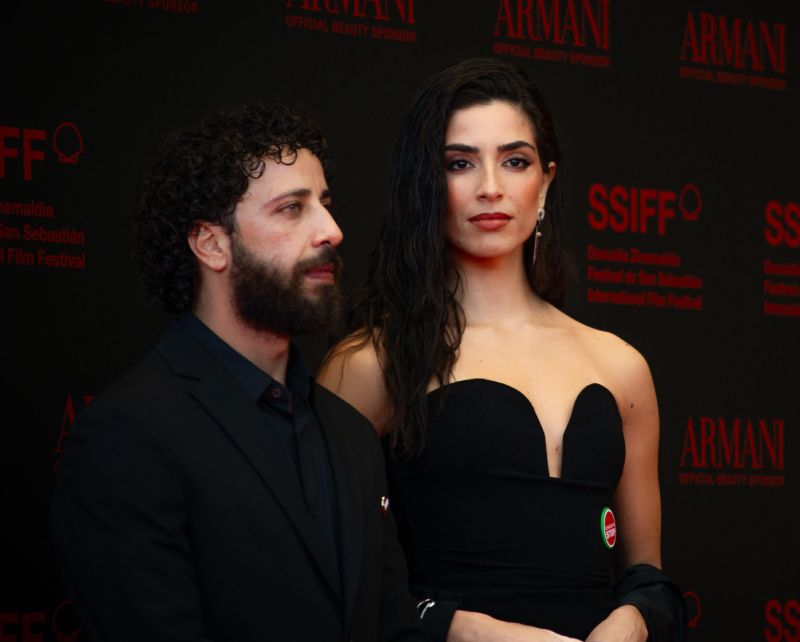
Saja Kilani and Motaz Malhees, in San Sebastian Film Festival. Photo: @Milena Fontana (El Hype).
Documentaries: Rewriting Memory
Partition, directed by Diana Allan, reconstructs the period from 1917 to 1948 through recontextualized colonial archives. This co-production between Palestine, Lebanon, and Canada —while not heavily awarded— has had strong visibility in academic and festival circuits. By re-photographing archival material and merging it with resistance songs and the voices of Palestinian refugees in Lebanon, Allan challenges the authority historically granted to colonial imagery. The film retraces over a century of occupation and displacement through echoes, multiple perspectives, and oral histories, rejecting linear narrative in favor of a decolonial re-reading of the past.
Put Your Soul on Your Hand and Walk, by exiled Iranian filmmaker Sepideh Farsi, has been widely recognized as Best Documentary in several circuits. Perhaps the most emotionally devastating film alongside The Voice of Hind Rajab, it follows a young Palestinian woman in Gaza through mobile video calls documenting her life under bombardment—her attempts to flee with her family in search of impossible refuge—until her disappearance. The film’s intimate and harrowing dimension is built through a presence that lingers even after silence. Fatima Hassouna’s personality is as moving as her desire to live, to travel, to continue dreaming, even as she accepts her fate as part of a collective destiny. Her smile fills the screen—chilling in its strength amid suffering.
With Hasan in Gaza, directed by Kamal Aljafari, has enjoyed an exceptional festival run: Grand Prize at DMZ IDFF, the Europa Cinemas Label in Locarno, the Ulysses Award at Cinemed, among others. Based on MiniDV tapes from 2001 that were recently rediscovered, the film reconstructs an irretrievable past in which the memory of life in Gaza appears in fragments. This reflection on loss and the passage of time began as a search for a former prison mate from 1989 and evolved into an unexpected road trip from the north to the south of Gaza with Hasan, a local guide whose current whereabouts remain unknown.
The Flowers Stand Silently, Witnessing, by Greek-Lebanese-Palestinian director Theo Panagopoulos, based in Scotland and awarded at IDFA and Sundance, examines the violence of representation through botanical archives. Its approach reveals how absence itself constructs narrative. What initially appears as a bucolic essay ultimately questions the role of image-making as a tool for witnessing violence, particularly when people and land are deeply intertwined. The archival footage —rendered in an unreal, almost artificial color— depicts a prosperous and fertile Palestine, where the protagonists are foreign visitors conducting scientific explorations: strolling among flowers, collecting specimens, smiling. By contrast, only two minutes of the recovered material include the presence of Palestinians. What is not shown does not exist: the plants emerge as anonymous heritage, silent witnesses to dispossession and indifference.
Short Films: The Intensity of the Minimal
I’m Glad You’re Dead Now, by actor and director Tawfeek Barhom (Boy from Heaven, Tarik Saleh, 2022), won the Palme d’Or for Best Short Film at the Cannes Film Festival and stands as one of the year’s most significant works. Starring Barhom himself in his directorial debut, the film constructs—through radical minimalism—a devastating narrative about trauma and abuse, where off-screen space carries decisive weight. A co-production between Palestine, Greece, and France, the short creates a space where loss and the possibility of repair intersect, sustained by intense performances and an enveloping cinematography that translates emotional tension while offering a singular perspective on human bonds. It is available to watch on Arte.
In Qaher, directed by Nada Khalifa, Jason —a Palestinian Canadian— returns to Palestine after years away to surprise his sister, bringing with him an unusual gift: a goat, a traditional offering for his newborn nephew. On his journey toward reunion, the trip becomes a process of rediscovering identity. Distance, which had previously softened his understanding of the conflict, proves insufficient when he confronts its violence and consequences firsthand. Through his gaze—still unaccustomed, almost naïve—the film restores a sense of astonishment in the face of the intolerable, revealing horror through the shock of the unexpected.

Nadie ha publicado ningún comentario aún. ¡Se tú la primera persona!