
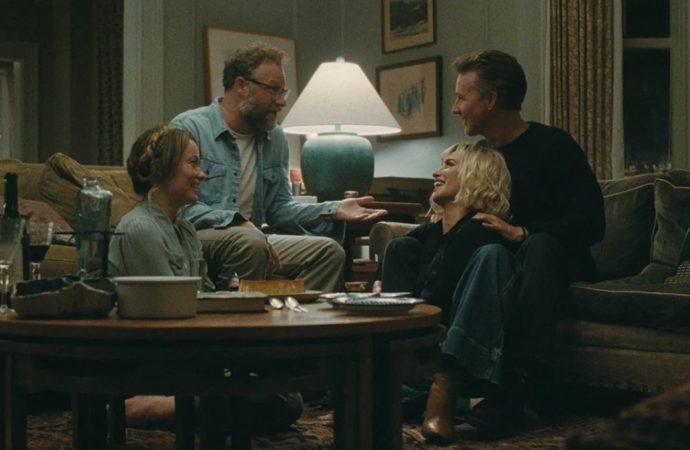

The Invite, starring Penélope Cruz, Seth Rogen, Olivia Wilde, and Edward Norton, is an adaptation of Cesc Gay’s Spanish film Sentimental (2020), itself based on his stage play Los vecinos de arriba (The People Upstairs), originally performed by Javier Cámara, Belén Cuesta, Alberto San Juan, and Griselda Siciliani. The result is a sophisticated comedy of manners about marriage, desire, and the frustrations of middle age, one that reflects with melancholy on the erosion of long-term relationships and the difficulty of continuing to choose one another.
Adapting the Story to an American Context
During the international press conference held on July 17, Rashida Jones — who previously wrote Quincy, the documentary about her celebrated father — and Will McCormack, screenwriters of The Invite, explained that the main challenge lay precisely in translating the story into an American cultural context. Whereas Cesc Gay’s film responded to deeply Spanish social codes, The Invite draws on some of the most contemporary obsessions of the American middle class.
Contemporary relationship culture has increasingly shifted toward a state of permanent emotional self-assessment.
“Americans, especially people our age, are obsessed with the idea that relationships can — or should — constantly improve,” Jones remarked. The screenwriter directly linked this anxiety to the proliferation of self-help relationship podcasts and media therapists such as Esther Perel, Terry Real, or the popular series Couples Therapy. According to Jones, much of contemporary relationship culture has become centered on an ongoing process of emotional self-examination.
In this sense, the film also engages with current debates surrounding new forms of partnership, open relationships, the redistribution of gender roles, and the transformation of the family unit itself. “There is a fascination with polyamory and with all these new ways of understanding life together,” Jones explained.
Architecture and Emotional Space
Beyond its cultural updating, The Invite preserves one of the original’s greatest strengths: its extraordinary precision in observing the dynamics of long-term relationships. The film transforms a single apartment into a space laden with meaning, where silences, glances, and interruptions carry considerable dramatic weight.
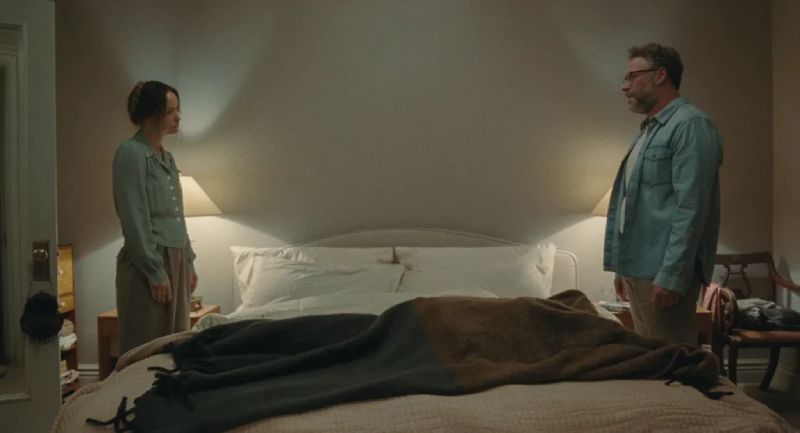
Both screenwriters emphasized the importance of space as a key element in the film. Joe (Seth Rogen) and Angela’s (Olivia Wilde) apartment is divided into compartments, enclosed rooms, and transitional areas that mirror the couple’s own emotional fragmentation. Particularly significant is the description of the bedroom, a space that has been all but forgotten by its occupants.
“It’s the last place they think about,” Rashida Jones explained. “They’re the only two people who should be enjoying it, but they don’t anymore. That’s extremely meaningful and pretty sad.”
This spatial organization becomes a subtle reflection of the state of their relationship. The apartment no longer functions as a shared home but rather as a collection of isolated emotional territories, places where intimacy has gradually been replaced by routine, resentment, and emotional distance. In this sense, The Invite uses architecture not merely as a setting but as a visual extension of the characters’ inner lives, turning domestic space itself into a map of a marriage in crisis.
A Bittersweet Comedy About Marital Ennui
This bittersweet tone is one of the film’s defining qualities. The Invite is, on one level, a comedy of sexual entanglements and awkward misunderstandings. Yet beneath its playful surface lies a painfully familiar reality: that moment when two people realize that love alone may no longer be enough to sustain a shared life.

The film’s greatest departure from Sentimental lies precisely in its more explicitly emotional dimension. Jones and McCormack acknowledged that they incorporated numerous personal experiences and anecdotes shared by the actors during rehearsals. Penélope Cruz, Edward Norton, Seth Rogen, and Olivia Wilde all actively contributed to reshaping the characters and adapting the story to their own sensibilities.
“You don’t have to be perfect, and you don’t even have to be good in a marriage. But you do have to try.”
Particularly revealing is the introduction of the attempted partner swap, which is absent from the Spanish version. For the screenwriters, this development responds to a specifically American cultural logic, one in which emotional and sexual experimentation is often viewed as a natural extension of the pursuit of personal happiness.
Yet the film never judges its characters. As McCormack suggested, the true interest of the story lies in observing how people struggle to remain together despite emotional wear and tear, routine, and the accumulation of disappointments over time.
A Hollywood Ending?
“You don’t have to be perfect, and you don’t even have to be good in a marriage. But you do have to try.” That idea reaches its culmination in the film’s beautiful ending, which was completely reinvented in comparison with the Spanish version. According to the screenwriters, Joe sitting down at the piano was the only element that remained unchanged throughout every iteration of the project.
For Jones and McCormack, that moment was always intended to be deliberately ambiguous. It could be an apology, a promise of change, an attempt to begin again, or perhaps simply an acknowledgment of a shared love.
It is precisely this ambiguity that makes the ending so moving. Will they stay together? Is the piano a new beginning or a farewell gesture? The writers themselves admitted to having heard radically different interpretations.
That uncertainty lies at the very core of The Invite. As McCormack explained, when he and Jones were younger, they wrote about heartbreak; now they write “about the heartbreak of life.” Ultimately, the film deals with something universal: loss, the fear of time passing, and the difficulty of remaining connected to those we believe we know best.
Rashida Jones perfectly captured the spirit of the film when she said that she and McCormack are “obsessed with how painful life can be, and also how incredibly funny all of that can be.” Laughing together at our own miseries, she added, is one of the few ways we have of feeling less alone.
What initially appears to be a sophisticated comedy of manners and desire gradually reveals itself as something far more melancholic: the story of two people trying to determine whether it is still worth playing the same melody together.

Nadie ha publicado ningún comentario aún. ¡Se tú la primera persona!