
Amsterdam’s Eye Filmmuseum is dedicating the first exhibition in the Netherlands to Austrian filmmaker Ulrich Seidl. The retrospective brings together early works, little-known pieces and new creations to explore the universe of an auteur who has made discomfort, intimacy and human contradiction central to his cinema.
What happens when a camera penetrates the surface of an apparently ordinary life and uncovers what its protagonists would rather keep hidden? Where does documentary observation end and the construction of fiction begin? To what extent do our moral convictions shape the way we look at others?
These questions run throughout the work of Ulrich Seidl (Vienna, 1952), one of the European filmmakers who has most persistently explored the contradictions of the human condition. Now, Eye Filmmuseum is dedicating Über das Leben, die Liebe und den Tod (On Life, Love and Death) to his work, his first exhibition in the Netherlands, which opened on 18 September 2026.
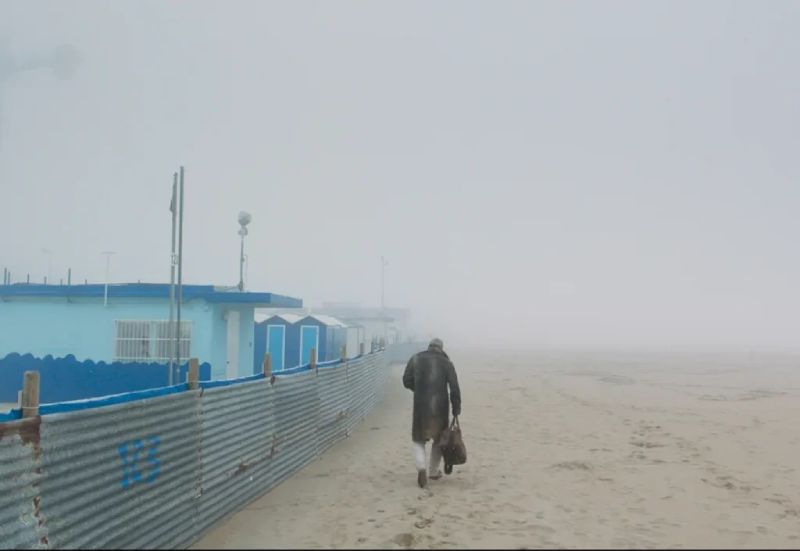
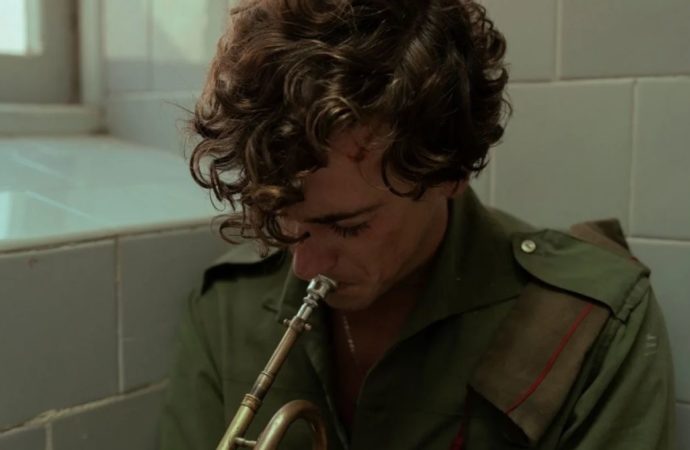
Rimini (Ulrich Seidl, 2022)
The exhibition brings together a wide selection of Seidl’s early work, little-known pieces and newly commissioned creations. Its aim is to immerse visitors in a universe populated by individuals searching for affection, happiness and some sense of meaning in their lives, within a society where, according to the exhibition’s premise, consumerism has progressively displaced other sources of meaning.
Intimacy in the Spotlight
Seidl’s cinema is particularly interested in those who live outside social conventions, although his characters do not always conform to what we traditionally associate with marginality. They may be individuals who appear perfectly integrated into their surroundings, people with recognizable habits who nevertheless find in the privacy of their homes a space in which to express desires, frustrations and behaviours they would rarely reveal in public.
His films venture into these domestic territories to observe how we live, what we think, how we arrange our surroundings and the mechanisms we use to combat loneliness or create a sense of security.
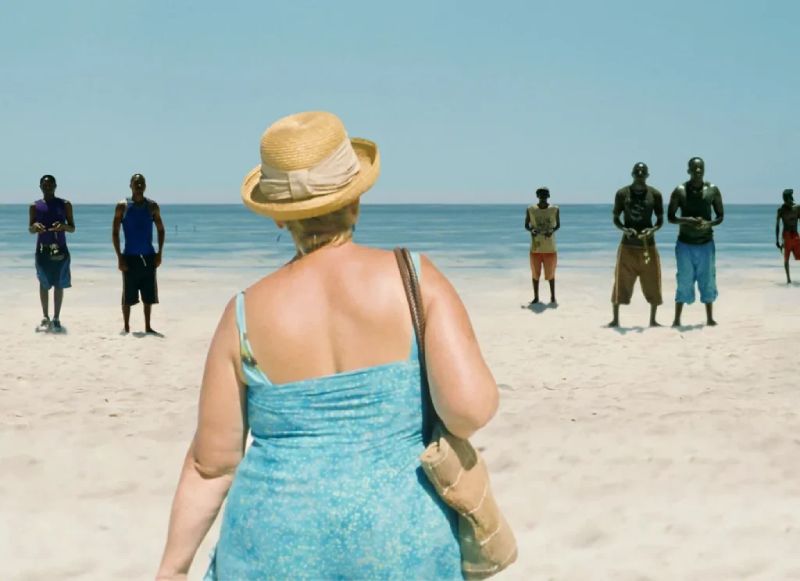
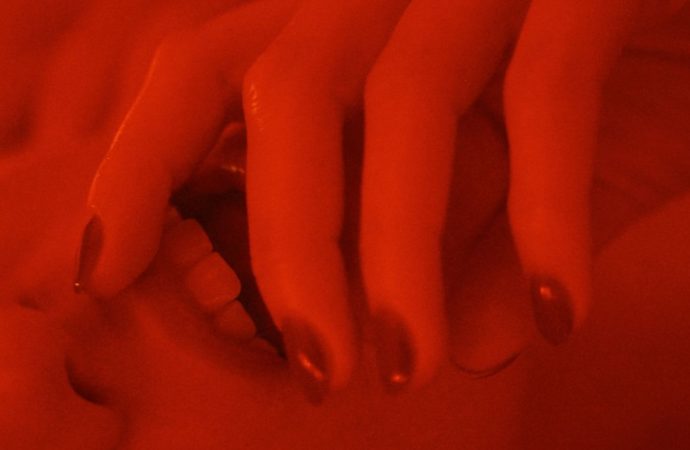
Paradise: Love (Ulrich Seidl, 2012).
In the presentation accompanying the exhibition, the filmmaker explains that his aim is to look behind beautified surfaces and enter private spaces, even when what he finds proves uncomfortable and differs from the image his subjects would prefer to project.
That sense of discomfort—which Seidl conveys with remarkable effectiveness—is one of the defining devices of his work. He is not interested in presenting exemplary characters or providing unequivocal moral answers. On the contrary, he creates situations that force viewers to confront their own prejudices.
Ambiguity thus becomes a form of questioning: what initially provokes rejection may reveal a need for affection, while seemingly ordinary behaviour may conceal contradictions that are difficult to justify.
Between Documentary and Fiction
One of the most recognizable features of Seidl’s cinematic language is his deliberate blurring of the boundaries between reality and representation.
His films begin with research into real people, places and situations, but subsequently incorporate fictional elements and constructed characters. Non-professional performers appear in their own environments, while professional actors enter these settings and improvise.
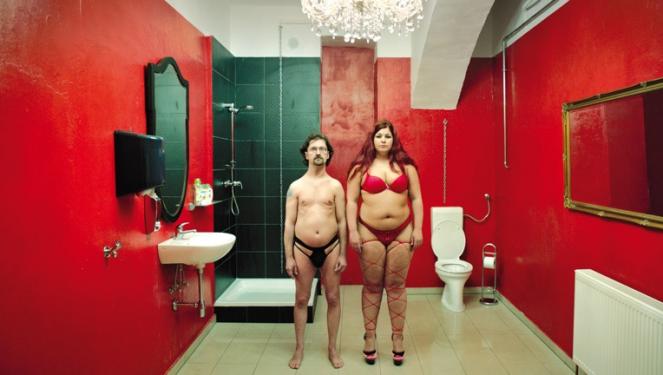
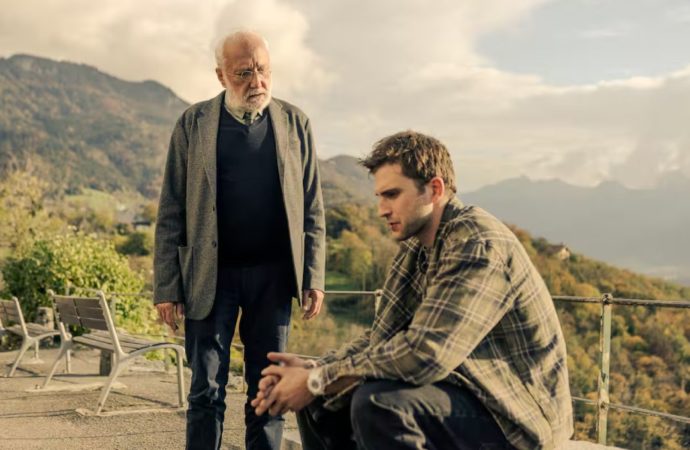
In the Basement (Ulrich Seidl, 2014).
The result is a form of cinema in which it becomes difficult to determine where documentary ends and staging begins. The camera records a reality that has, at the same time, been arranged for us to observe.
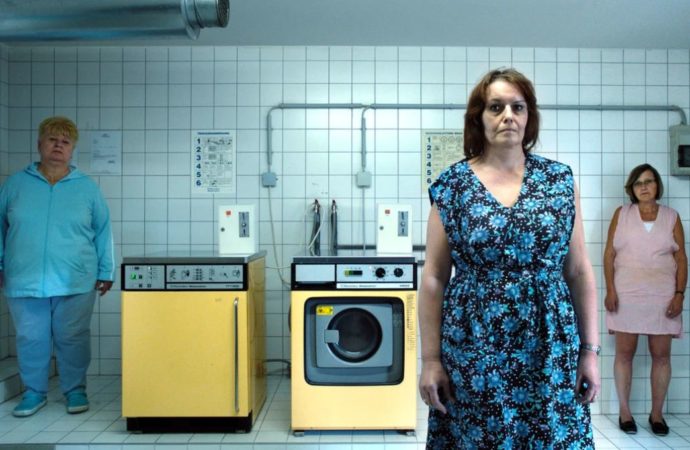
This ambiguity finds one of its most distinctive expressions in Seidl’s tableaux: rigorously composed scenes in which the characters remain motionless, staring directly into the camera. The frontal nature of these portraits, the silence and the precision of the framing create a strange sense of artifice, even when we are looking at real people and real spaces.
The viewer ceases to be an invisible observer. The characters’ gaze reflects our own presence back at us, turning the scene into a confrontation. This tension between spontaneity and staging is one of the most recognizable features of Seidl’s work and lies at the heart of his distinctive aesthetic, which resists the conventional classifications of documentary cinema.
Ulrich Seidl: Five Decades of Provocation and Observation
The exhibition also offers an opportunity to trace a career spanning approximately half a century of filmmaking, photography and theatre.
Seidl began to gain international recognition during the 1990s with documentaries such as Good News (1990), Mit Verlust ist zu rechnen (1992), Tierische Liebe (1995) and Models (1998).
His first feature film regarded as fiction, Hundstage (Dog Days, 2001), received an award at the Venice Film Festival. Later, Import Export (2007) and Paradies: Liebe (Paradise: Love, 2012) premiered at the Cannes Film Festival. His most recent work, the diptych Böse Spiele – Rimini Sparta (2023), was presented at the International Film Festival Rotterdam.
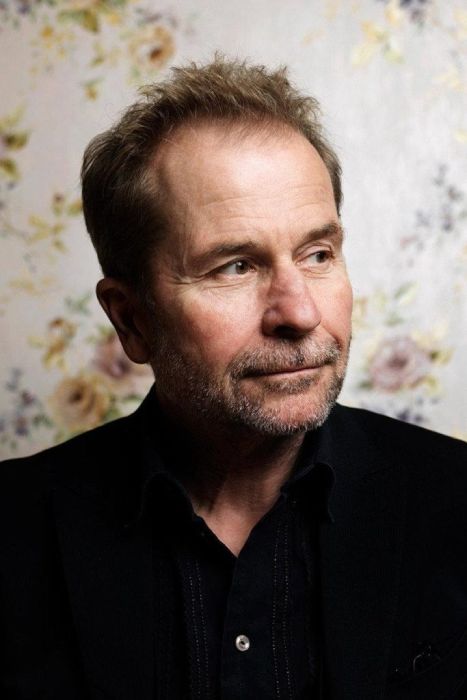
Ulrich Seidl.
Alongside his work in cinema, Seidl has also pursued an extensive career in theatre, with productions such as Vater Unser, staged at Berlin’s Volksbühne in 2004, and Böse Buben / Fiese Männer, premiered as part of the Wiener Festwochen in 2011. His photographic work represents another facet of an artistic practice that finds common creative ground in the observation of bodies, spaces and human relationships.
An Exhibition That Continues in the Cinema
Über das Leben, die Liebe und den Tod extends beyond the exhibition space. The Eye Filmmuseum has organized an extensive film programme featuring a selection of Seidl’s works, some screened from 35mm prints held in the museum’s collection.
Seidl himself will visit Eye during the exhibition to take part in an artist talk devoted to his work. In addition, several special editions of the Eye on Art programme will explore themes from his filmography in greater depth, as well as the connections between his work and that of other contemporary filmmakers and artists.
The exhibition also carries particular institutional significance: it is the farewell exhibition of Jaap Guldemond, Director of Exhibitions, who helped shape the museum’s artistic direction from the opening of its Amsterdam-Noord building in 2012 and has curated forty exhibitions for Eye.
Cinema as a Mirror of Society
The retrospective arrives as Seidl prepares a new international project, Distances, scheduled to begin shooting in early 2027. Seidl will also serve as producer, with Philippe Bober, representing France and Germany, and Spanish filmmaker Albert Serra joining the project as co-producers.
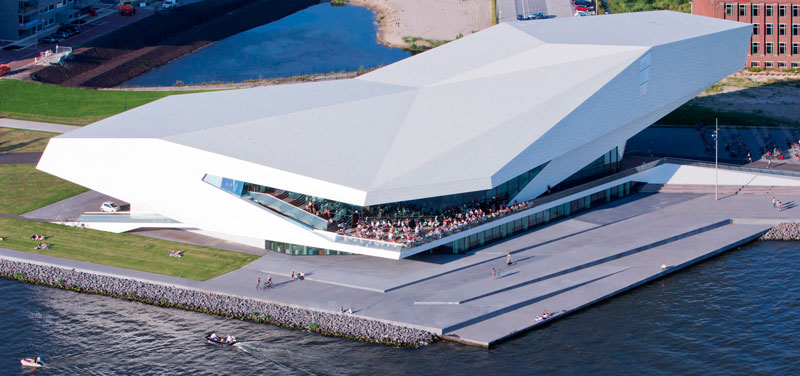
Eye Filmmuseum. Photo © Ewan Baan.
Ultimately, the Amsterdam exhibition invites us to revisit a body of work that has found in vulnerability, desire and the contradictions of everyday life a means of interrogating Western society.
Seidl turns his camera towards individuals seeking love and affection in a world shaped by consumerism, yet the true object of his enquiry seems to lie on the other side of the screen: in the gaze of those of us who observe, judge and, occasionally, recognize something of ourselves in what unsettles us.
Exhibition information:
Über das Leben, die Liebe und den Tod
18 September 2026–31 January 2027
Eye Filmmuseum, IJpromenade 1, Amsterdam
Information, programme and tickets: Eye Filmmuseum

Nadie ha publicado ningún comentario aún. ¡Se tú la primera persona!