
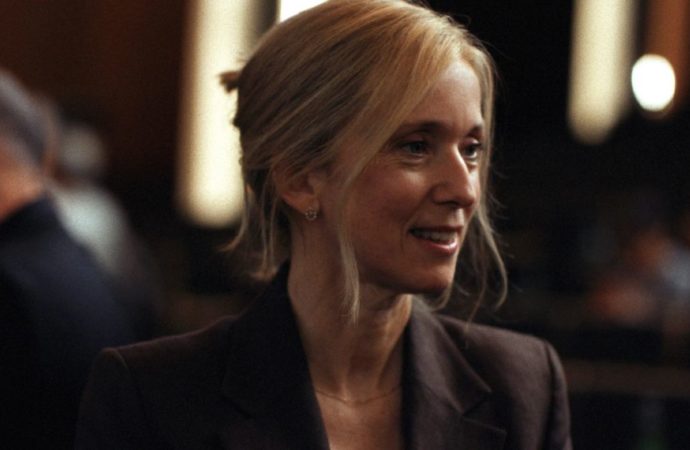
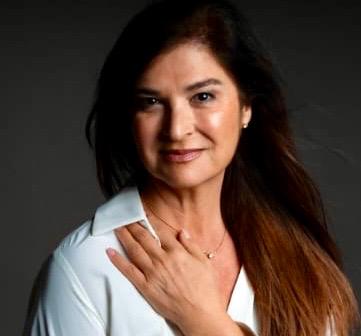
Gabrielle, the protagonist of A Woman’s Life, is a prestigious surgeon in her fifties who appears to have built the perfect life: a brilliant career, a stable marriage and an existence shaped by her sense of responsibility towards others. The arrival of Frida, a writer with whom she unexpectedly falls in love, disrupts that balance and confronts her with a desire beyond her control. Starring Léa Drucker, Mélanie Thierry, Charles Berling, Marie-Christine Barrault and Laurent Capelluto, Une vie de femme is Charline Bourgeois-Tacquet’s second feature film, following her remarkable debut with Anaïs in Love (2021). Her new film competed in the Official Selection at the 2026 Cannes Film Festival.
Ahead of its release in Spain, I interviewed Léa Drucker, one of my favourite actresses and the winner of two César Awards — for Custody (2017) and Case 137 (2025) —, an extraordinarily versatile performer who has worked with filmmakers as different as Quentin Dupieux (Incredible but True, 2022) and Catherine Breillat (Last Summer, 2023). We talked about Gabrielle and the desire that suddenly enters a life seemingly under control, but also about vulnerability, the passage of time, the power of art and the freedom of an actress who, even after achieving recognition, insists on the need to keep taking risks.
EVA PEYDRÓ: Gabrielle is a woman who seems to have built her entire life around responsibility: towards her patients, her team, her mother, her husband… and even the woman she falls in love with. For you, is her real transgression not so much desiring another woman as finally allowing herself to relinquish control?
LÉA DRUCKER: Yes. There is the whole construction of her family life, her relationship with others, her relationship with care, the exhilaration she experiences every day from what she excels at, from her technical prowess as a doctor, a head of department, a woman in a position of authority, and so on. And indeed, this unexpected encounter, the fact that she falls passionately in love with another woman, makes her lose that sense of control you are talking about.
She is someone who believes she has controlled everything in her life and who realises that, in fact, we cannot control everything that belongs to the realm of romantic feeling, of this feeling that is nevertheless universal. She did not see it coming at all, nor did she think she would be able to respond to it in a controlled way.
In that respect, she even becomes a young girl again. And that is very beautiful because she is a woman in her fifties and, suddenly, we see her become this young girl in love, fragile and youthful. I love that because it corresponds to what I think about life: that these things cannot be controlled.
And another thing I really like is that she is with her husband [Charles Berling]. Their relationship works. Her husband is an intelligent, loving man. They have a beautiful relationship. She is not a woman who is bored and needs an affair. She already has an adventure every day through what she does, but this encounter completely turns her world upside down.
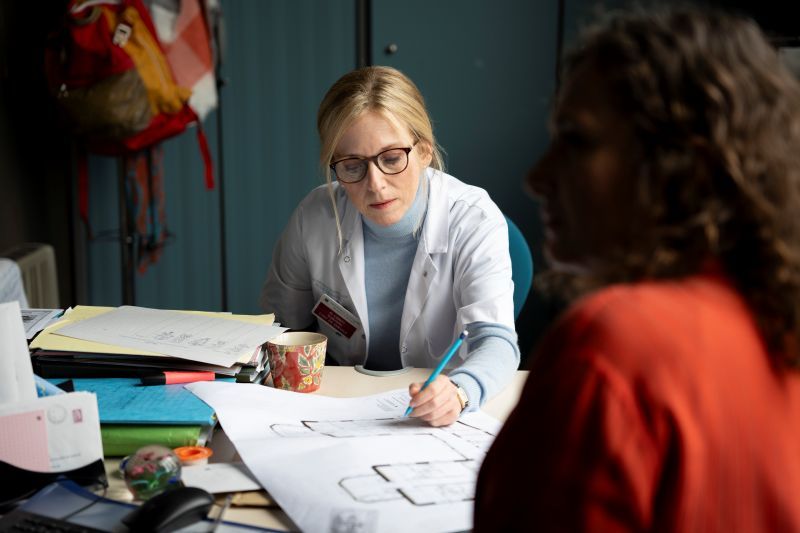
In your performance, you move very fluidly from the surgeon, extremely precise and perhaps even authoritative, to the daughter, the wife and then the lover, who is much more vulnerable. How did you approach these different facets of Gabrielle without feeling as though you were playing several different characters?
I did it by working with Charline Bourgeois-Tacquet, the director, who had a very carefully developed approach to directing. Charline is very good with actors. The screenplay was extraordinarily well written and extremely precise. I never changed anything; I didn’t change a single line of the script.
And the way the character was constructed allowed me to reveal different facets of this portrait of a woman. And, as you say, the challenge was to make sure she always remained the same person.
But I think it is entirely coherent to see a woman in full command of her abilities, exercising her authority in her relationship with her teams, a strong woman who is confident in what she does, and at the same time to see her being fragile. We are all multifaceted because of all the revolutions taking place within us.
The question is how much freedom we allow ourselves. And I think this is a film about freedom. What do we allow to exist of everything we carry within us? And what do we allow others to see? Cinema allows us to express intimacy. It allows us suddenly to reveal things that this character gives herself permission to experience.
I am convinced that a woman can be very strong and, shortly afterwards, feel completely disarmed and fragile. I think we always remain little girls in some way. The young woman we once were, the child we once were, is still there somewhere.
Obviously, being an actress allows me to… In my personal life, I am still a woman; I have my social mask, like everyone else. And I have my own sense of reserve, like everyone else. There are things about myself that I don’t want people to see. But in film, in theatre, everything is allowed.
“This is a film about freedom. What do we allow to exist of everything we carry within us?”
The film is structured in eleven chapters and follows a very linear trajectory, over the course of which we see Gabrielle gradually transform. Did that structure influence the way you built the character? Was the film shot chronologically?
Yes, more or less. But it’s true that we began with the hospital scenes. Everything that takes place in the hospital was shot at the beginning.
And that worked very well because it allowed me to establish the backbone of who this woman is as a surgeon. Then, little by little, we begin to deconstruct her. And that is what is interesting.
But there is also the way Charline’s mise-en-scène, at a certain point, takes this woman somewhere else. We see her in the hospital and then, for example, in the mountains. This woman who appears so commanding within her department suddenly becomes tiny beside the mountain. She becomes completely contemplative and her rhythm changes. And that, too, comes from the mise-en-scène.
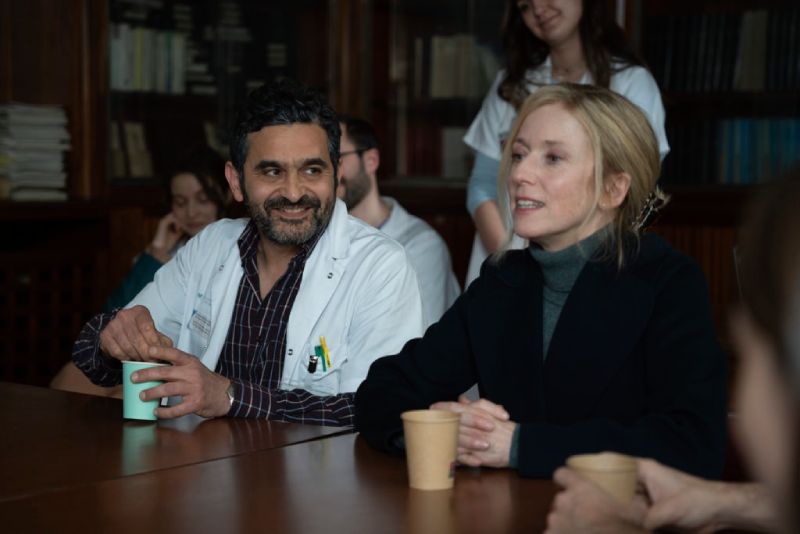
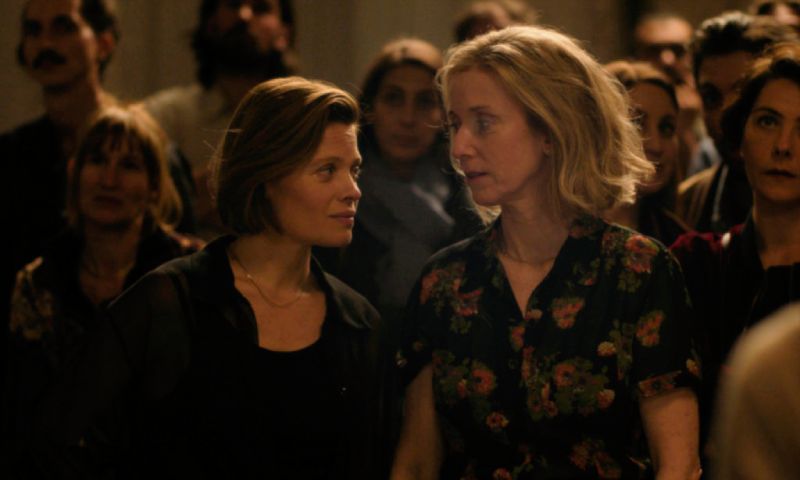
One scene that particularly struck me is the ballet sequence. Frida (Mélanie Laurent) declares her feelings in the half-light, among dancers mingling with the audience, while Gabrielle seems almost paralysed. There is something very sensual about it, but also something suspended in time. How did you approach that moment, in which almost everything happens through stillness, listening and emotional turmoil rather than words?
First of all, I love dance. I love dancers, being around them. I let myself be enchanted. I was completely spellbound by the choreography.
And they were also very difficult scenes to shoot from a staging point of view. We had very little time. So we had to be extremely focused to allow the dancers to do what they needed to do without disturbing them or getting in their way. It required an enormous amount of concentration.
I let myself be captivated by the performance, just as I would have been if I had gone to see a performance like that, in a place like that. And at the same time, I allowed myself to be affected by Mélanie Thierry. Mélanie is very generous in the way she looks at you; she has a very strong presence and, in fact, she helped me enormously.
I put myself in a position where I could receive all of it as though everything were happening for the first time. And there, Gabrielle becomes almost like a young girl again. It is a suspended moment because this is a woman who spends her days confronting questions of life, death, illness and treatment, very difficult things, and who is deeply committed to a life devoted to healing. Then, suddenly, this suspended time appears, this moment of escape that comes through dance and that also speaks to what culture brings to our lives.
That’s very interesting. Culture… and also the power of art.
Yes. We allow ourselves to be carried away by the magnetism of art. It was very beautiful.
You mentioned the scenes in the mountains with Erri De Luca, when Gabrielle accompanies Frida to meet the writer. That part of the film introduces old age, solitude and also an awareness that everything is fleeting. But it also offers Gabrielle an image of ageing that is the opposite of that of her dependent mother, who has Alzheimer’s. By contrast, the writer remains free, independent and profoundly lucid. Did this confrontation between two very different ways of ageing allow you to explore something else in Gabrielle, perhaps in her own relationship with the passage of time?
Yes. So, when you talk about old age, you mean the relationship with the character of the mother…
Yes, old age and the character of the mother. Does it allow Gabrielle to reflect, or to become aware of how fleeting everything is, to make the most of her time, to contemplate her own life from another perspective?
And also to allow herself to be observed by someone. It is also through the gaze of the writer, Frida, that Gabrielle allows herself to be observed, and her relationship with time changes at that moment as well.
And that resonates with the fact that her mother is losing her sense of time because she is ill. But there is also the question of the time we allow ourselves. Gabrielle is a woman who has no time. All her time is occupied. There is no room for time itself. That is life in the hospital. We know public hospitals well: the pace is relentless.
And she gives her own time to others.
All the time, yes, absolutely. And here, the time she allows herself, even if it is only to sit in a deckchair, face a mountain and simply stop, is something completely exceptional.
And we can clearly see that, at that moment, something in the character begins to listen, her rhythm changes. She watches Frida herself talking to Erri De Luca, the writer. She looks at the mountain, and there is something slightly metaphysical about the passage of time: do we make the most of it? Do we allow ourselves silence, pauses and moments of contemplation, or are we caught up in a frantic race?
Perhaps it is another suspended moment within the film.
Yes, exactly.
I also loved your performance in Last Summer, for which I had the opportunity to interview Catherine Breillat. Anne and Gabrielle are very different women, but I found an echo between them: they are both women with firmly established professional and social identities whose lives, at a certain point, are disrupted by desire. But they respond to it in very different ways. Do you also see a connection between them, or are they two completely different women for you?
I understand what you mean about the connection that might exist between them, even though their responses to desire are completely different.
With Anne, there is something destructive and self-destructive, something very dark, very dangerous. I think she descends into the depths of desire. There is something more dangerous about it.
Whereas Gabrielle, who also gives herself the freedom to experience that desire, is more defenceless. She is not destructive at all. She allows herself to be taken by surprise; she is fragile, she controls nothing. She has completely relinquished control.
But it is true that Charline wanted to work with me on this character, I think, because she had seen Last Summer. So there is necessarily a connection, because Charline wanted to talk about female desire and about giving oneself the freedom to experience it. But the consequences are not the same.
Yes, but perhaps it is also because we remain who we are even when our lives are disrupted by desire. We feel and experience desire according to the woman and the person we are. You always show Gabrielle’s loyalty, whereas Anne perhaps reveals another side of her personality. Desire is present in both cases, but their personalities still shape the way they experience it.
And speaking of Charline, she waited a year to be able to work with you. What changes when you know that a director is not simply looking for an actress to play Gabrielle, but actually imagines you in the role? Does that bring an additional sense of responsibility?
It’s funny because I wasn’t really aware that she had waited a year until I was actually working on the film. I mean, during the year she spent waiting, I made other films, Case 137… So, as an actress, I didn’t really realise what that meant until I was on set, working with Charline, building the character, and finally understood the responsibility that came with it.
Perhaps it was better that I didn’t realise it straight away because otherwise the pressure would have been very intense.
Maybe I was also protecting myself so that I could arrive with a little less awareness of it. But it’s true that being wanted in that way is a gift. It’s a reward. I’ve had the opportunity, the good fortune, to receive very important awards throughout my career, but this is also a reward: having someone think of you.
She didn’t write the character for me, but in any case, the fact that she waited expresses a very strong desire. And it’s true that this drives me. It’s something that supports me while we’re working, that probably makes me even more sensitive and makes me want, indeed, not to spoil that desire.
But when I’m working, I try not to think about all of that because otherwise it becomes quite overwhelming.
“When you enjoy a certain degree of fame, I think you have to make first films.”
You now have two César Awards and a career marked by very different characters and filmmakers. As time has gone by, do you feel that you have become freer as an actress, more willing to take risks and experiment? The alternative might be to become more conscious and discerning while remaining within a kind of work in which you feel more secure. My impression is that recognition makes it even more important to remain free.
You have to be free. You have to be free and have the desire to take risks, and not let yourself be absorbed by the idea that, “Well, this worked.” You have to break free from what feels comfortable and keep taking risks. Absolutely. Because when you take risks, I think you work better. It’s more rewarding, more exhilarating.
Then you have to find where you can take those risks, something you haven’t done before. When you have a career that is going well, when you enjoy a certain degree of fame, I think you have to make first films, for example, because those debut films are where new talents will emerge, and we should also be able to play a part in enabling those talents to exist.
So that, for example, is something I enjoy and want to continue doing. And then, of course, finding scripts where there is something that makes you think: “Ah, but this is something that could be…”
That’s very generous, too.
But it is a genuine artistic question, of course.
Thank you very much for your time, Léa, and congratulations on the film.
Thank you.
A Woman’s Life, which opens in Spain on 9 October, found in Drucker an actress capable of making visible everything that escapes our control: desire, fragility and the passage of time, in a film about the freedom to allow oneself to live when everything already seemed settled.
Nadie ha publicado ningún comentario aún. ¡Se tú la primera persona!