
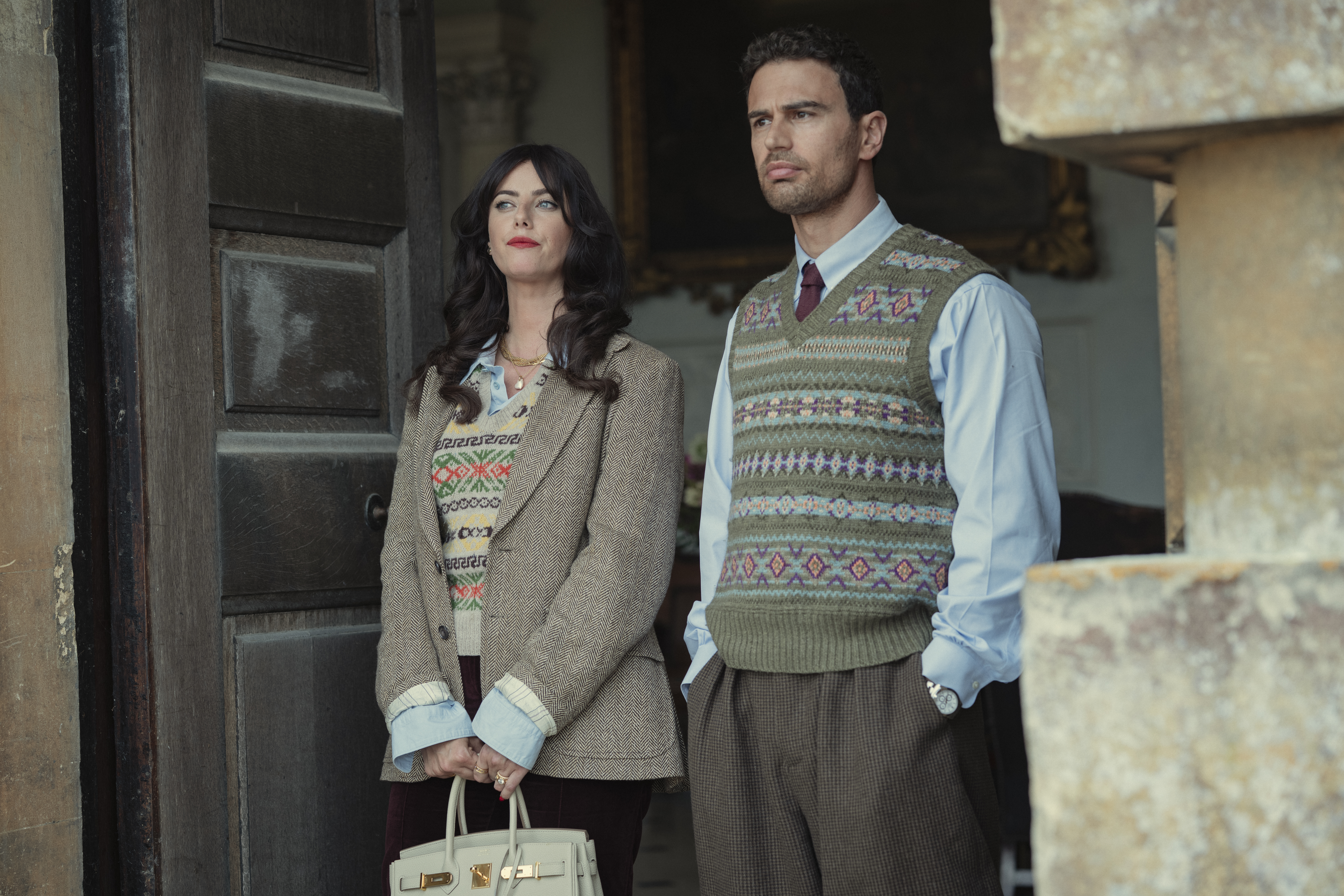

The first season of The Gentlemen (a Primetime Emmy winner) achieved something that was by no means guaranteed: it translated the criminal, aristocratic, violent and sardonic universe of Guy Ritchie into a television series and turned it into an international phenomenon. It also prompted sharply divided responses to its quality. Where some celebrated the return of the most recognisable Ritchie, his visual virtuosity, black humour and two leads with undeniable chemistry, others saw precisely the flipside of those virtues: mannerism, repetition, characters reduced to types and a formula rather too pleased with itself.
The second season therefore arrives in a peculiar position: backed by success, but obliged to prove that there is still a story to tell behind the formula.
That tension was very much present at the international press conference for the new season, attended by Guy Ritchie, creator, writer and executive producer; Matthew Read, writer and executive producer; and its stars, Theo James (Eddie Horniman) and Kaya Scodelario (Susie Glass). It was a relaxed conversation — at times deliberately irreverent — that offered glimpses of a season larger in scale, more European and apparently more interested in the moral consequences of power.
Ritchie formulated its central theme almost as a maxim: how to rise without destroying yourself.
Ritchie formulated its central theme almost as a maxim: how to rise without destroying yourself. How to remain aggressive and ambitious without ultimately being destroyed by your own ego. Read immediately added the question that turns this premise into dramatic conflict: what price Eddie will have to pay to become more powerful and whether, in his ascent, he risks losing his soul.
Because if the first season was largely about Eddie Horniman’s accidental entry into a criminal ecosystem, the second seems determined to strip away the excuse of innocence once and for all.
Eddie Horniman Discovers the Pleasure of Power
In the first season, Eddie could justify himself. He had inherited a problem and had to solve it. Protecting his family, saving the estate and surviving a criminal enterprise that had been operating beneath his feet before he even knew it existed provided a certain moral cover for his decisions. Now it no longer does.
Theo James described Eddie as a man who is “on the rise” and who is beginning to discover not only his ability to navigate that world, but also his capacity to wield violence for his own benefit. The character begins to make decisions that call his own moral code into question and, with them, something of his original goodness begins to erode.

Benedetta Porcarli (Isabella ‘Bella’ Soranza de Parme) in The Gentlemen S2.
James went even further, speaking of a progressive loss of empathy and the possibility of moving closer to the mechanisms of a sociopathic personality, without suggesting that Eddie has yet reached that extreme. What interests the actor lies precisely in tracing the distance between the relatively conventional man at the beginning of the series — a soldier, connected to the United Nations and convinced that he is doing the right thing — and someone who, by the end of this new chapter, may have become an extraordinarily dangerous individual.
It is hardly surprising, then, that when asked which character from another series he would bring into The Gentlemen, James chose Tony Soprano. Beyond the obvious Mafia connection, what interests him about the character played by James Gandolfini is his contradictory nature: a man capable of being charming, repulsive, vulnerable and terrifying in turn.
The reference also offers a glimpse of the ambition behind this second season. The question will be whether the writing manages to give Eddie that moral complexity, or whether his descent into hell remains within the superficial pleasures of Ritchie-style transgression.
Susie Glass Is Not Cold: She Is Controlled
If Eddie is moving towards power, Susie Glass is beginning to wonder why she still has to ask permission to wield it.
Kaya Scodelario was particularly keen to defend a character she believes is frequently misunderstood. She does not see Susie as cold, but as extremely controlled: a woman who measures her moves, understands exactly how the business works and has long been, as she herself put it, the “boots on the ground”, while still answering to the almost totemic figure of her father.
The season begins approximately a year later, with Eddie and Susie having expanded the operation considerably, extending it into Italy. Beginning from a position of success is dramatically suspicious: when a story places its characters so high up from the very first episode, we know it is unlikely to intend to leave them there.
Scodelario stressed that both characters continue to have ambitions of their own. They work extraordinarily well together, there is affection — the actress even spoke of “some kind of love” — but they are not necessarily pursuing the same goal. That is the basis of the tension.

Sergio Castellitto (Marco Moretti) in The Gentlemen S2.
Susie watches as Eddie breaks free from the role he initially occupied within the Glass organisation and begins to wonder what she herself has helped create. The actress even introduced the idea of guilt: perhaps Susie is not entirely comfortable with what she has awakened in Eddie, or with what that transformation reveals about her own morality.
The romance, if it can ever be called that, therefore continues to occupy territory far more interesting than simple romantic consummation. They need each other, are attracted to one another, have fun together and possibly love each other; but they could also end up becoming the greatest obstacle to each other’s ambitions.
When asked directly whether working together made them more powerful or turned them into each other’s greatest threat, James offered little reassurance: if this is a story of ascent, at some point someone is going to have to stand in someone else’s way.
Two Heirs Trying to Stop Being Heirs
At this point in the conversation, Ritchie introduced its most intriguing idea: that the true subject of The Gentlemen, according to its creator, is not so much power as the difference between an inherited identity and a self-created one.
Eddie appears to represent absolute privilege: title, property, family name, social position. But Ritchie sees that inheritance precisely as a kind of curse. What we inherit also determines who we are supposed to be. The character therefore needs to use what he has inherited to build something he can regard as truly his own.
What is interesting is that Susie finds herself, at the apparently opposite end of the social spectrum, in an almost identical situation. One has inherited an aristocratic dynasty; the other, a criminal one.
Eddie must escape the role his class has written for him, and Susie the shadow of Bobby Glass. Hence, as Ritchie pointed out while intervening in one of Scodelario’s answers, they are able to recognise themselves in each other: both are trying to discover at what point they stop managing what they have inherited and begin generating power of their own.
But that emancipation has a less noble side. Breaking free from inheritance also means aspiring to control. The question, then, is no longer who Eddie and Susie are, but what they are prepared to do to become who they want to be.
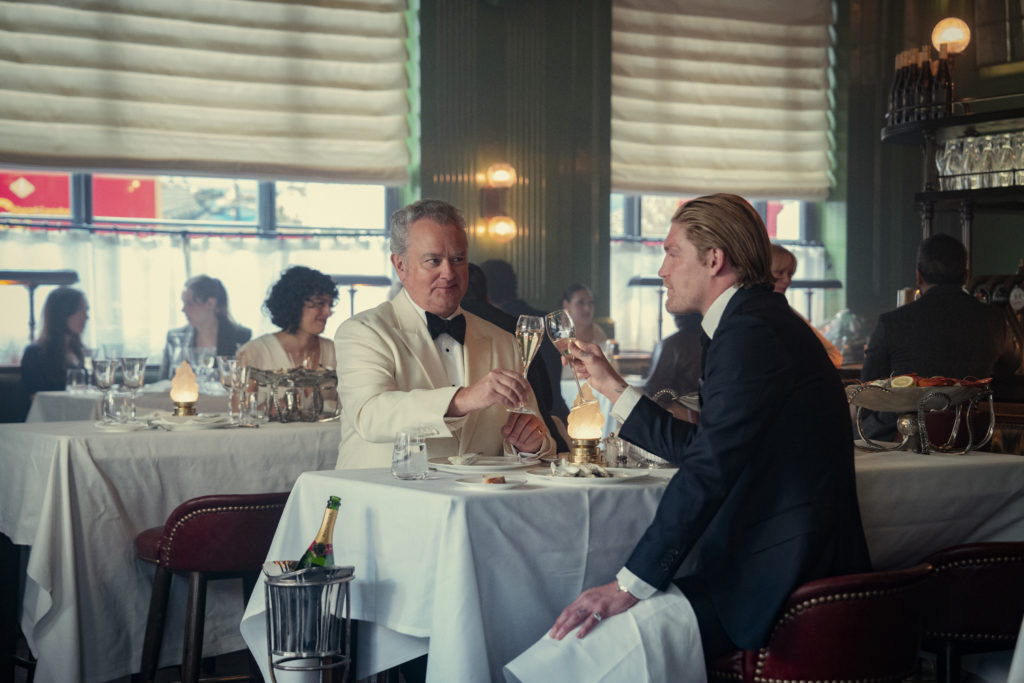
Harry Goodwins (Jack Glass) and Hugh Bonneville (Lord Hawthorne) in The Gentlemen S2.
Italy: Aristocrats, Mafiosi, Bellini and Caravaggio
The second season partially leaves behind its British confines and expands its geography into Italy, a move that might seem almost inevitable for a series fascinated by the coexistence of old money and criminality.
Ritchie explained the choice with his customary lack of solemnity: if you are looking for an underworld of infamous villains, Italy seems like a good place to start. But there was a more interesting reason. Italy retains an impoverished aristocracy that allows the series to extend one of its fundamental principles: the coexistence of heritage, decline and economic necessity.
Matthew Read spoke of the desire to avoid reducing Italy solely to an aesthetic surface. Wine, art, family, inheritance and old money all form part of the power relations in the new season.
The preparation itself ultimately became infused with the Italian experience. During his stay in Milan, Read attended a Bellini opera, and one of the arias he heard that evening eventually found its way into the end of the fourth episode.
Caravaggio also entered the conversation, not only as a cultural reference but as a visual one. Ritchie acknowledged that certain scenes were conceived with his lighting in mind and that the series has had a consistent colour palette from the outset.
It is not difficult to imagine how naturally Italy fits into the world of The Gentlemen: mansions, wine, art, faded aristocracy, family codes and the Mafia provide Ritchie with an iconographic catalogue practically designed for his camera. More interesting will be seeing whether, as Read promises, this display ceases to function merely as an aesthetic fetish and acquires a genuine narrative purpose.
“We Have to Make It Better”
The elephant in the room for any successful second season finally emerged explicitly. Why continue?
The first season could perfectly well have ended there, Theo James acknowledged. If they were going to return, they had to deepen, complicate and expand that world. Otherwise, “what’s the point?”
Ritchie admitted that the interest generated by the first instalment had surprised them, and that this was precisely where the main creative problem arose: giving viewers what they had come looking for without serving them exactly the same dish again.
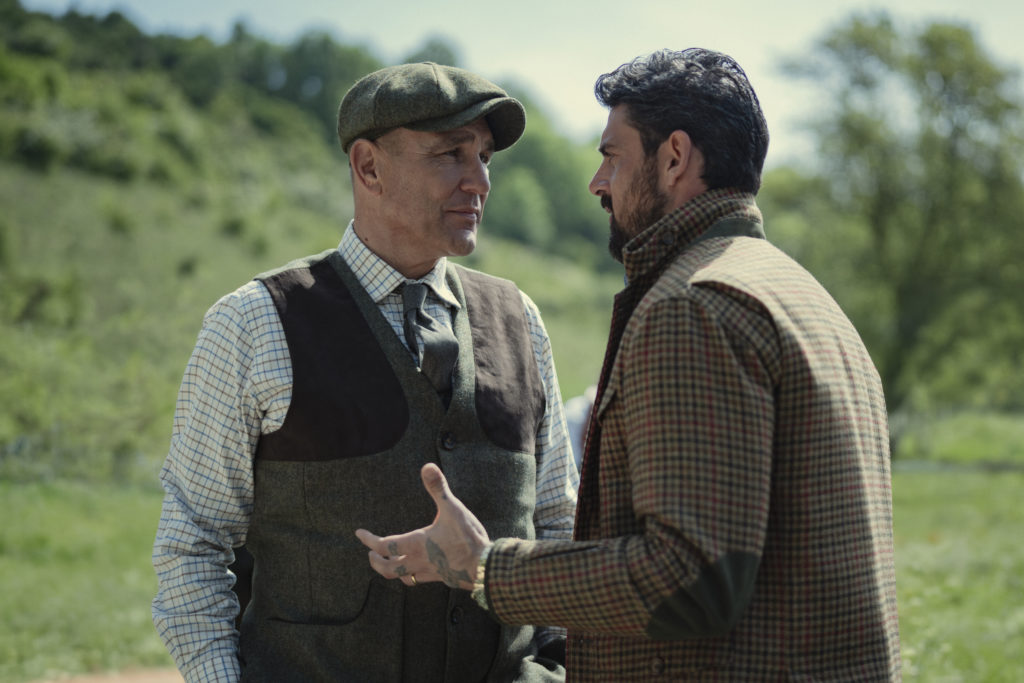
Vinnie Jones (Geoff Seacombe) and Michele Morrone (Cico Maldini) in The Gentlemen S2.
Matthew Read recalled Ritchie’s instruction in even more concise terms: they had to make it better. And he described the process with a less elegant but probably more illustrative expression: to “thicken the soup”, enriching every element.
This may well be the question that determines the reception of the second season, because The Gentlemen has such an immediately recognisable visual and tonal identity that its greatest strength can easily become its limitation. The immaculate suits, well-mannered criminals, aristocratic estates, choreographed violence, insolent dialogue and fascination with dangerous men who retain exquisite manners make for an enormously effective universe, but also one that Ritchie knows all too well.
The sharply divided response that accompanied the first season, and seems likely to extend to the second, can be explained precisely by this: for its defenders, The Gentlemen was Ritchie mastering his own language; for its detractors, Ritchie trapped within it. The second season appears aware of that dilemma.
A Chemistry That No Longer Needs to Be Built
Where the returning series clearly has an advantage is in the relationship between Theo James and Kaya Scodelario.
Scodelario explained that working together again has been easier precisely because they already know each other’s rhythm. They know how Eddie and Susie move, when they should look at one another, when to walk in step and when to introduce conflict. That familiarity has allowed them greater freedom in developing the banter between the two characters.
The press conference itself confirmed this. James and Scodelario interrupted, teased and joked with each other constantly, to the point that some of their answers seemed like improvised extensions of the dynamic between Eddie and Susie. When Scodelario praised the fluidity of their working relationship, James did not let her choice of word pass unnoticed; when the conversation turned to the possibility of a sexual relationship between the characters or to an art-auction scene, the pair quickly transformed conventional promotion into an exchange of barbs.
That complicity, including the sexual tension between them, will probably remain one of the series’ greatest strengths. But here, too, the season seems intent on introducing an element of poison. The more convincing they are together, the greater the impact when their ambitions begin to prove incompatible. This, ultimately, is the territory in which The Gentlemen wants to situate its second season: not so much discovering who holds the power as observing what power does to those who manage to possess it.
Eddie and Susie begin from a higher position: they are richer, more experienced and probably more dangerous. Italy expands the playing field, and Ritchie promises a series that is deeper, darker and more complex. What remains to be seen is whether that growth manages to transcend the formula or simply embellishes it with greater luxury.
Because making more The Gentlemen seems relatively easy. Making it better, as Ritchie himself demanded of his team, is another matter.



Nadie ha publicado ningún comentario aún. ¡Se tú la primera persona!