
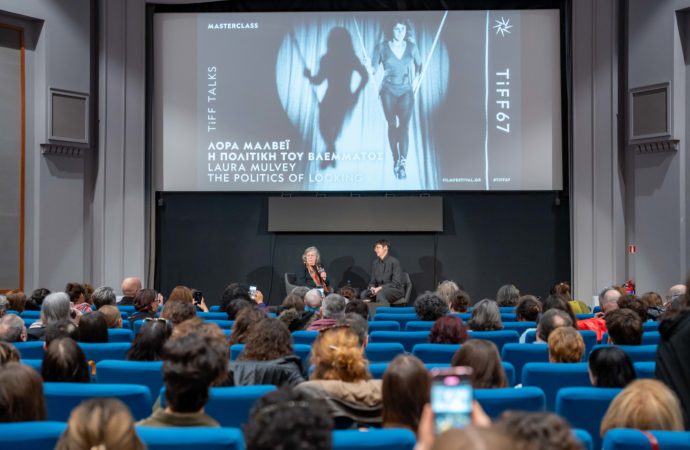

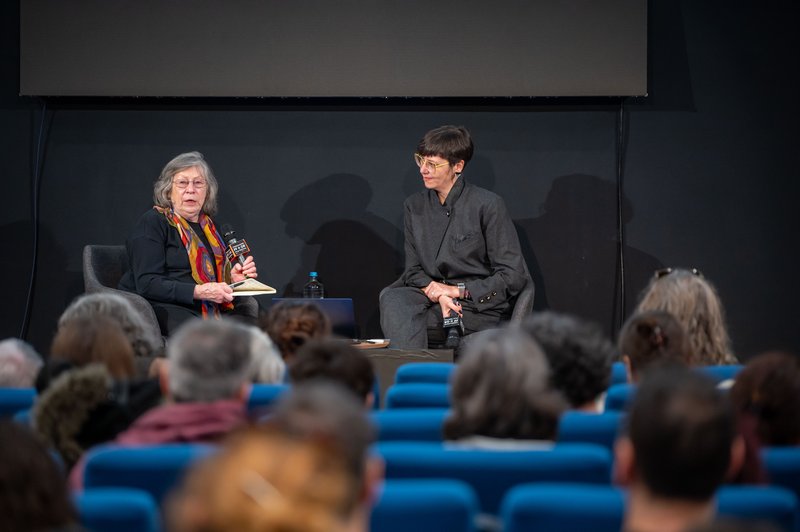
On November 12, Laura Mulvey, one of the most influential figures in feminist film theory, met with a packed audience at the Pavlos Zannas Theatre as part of a special tribute organised by the 67th Thessaloniki International Film Festival, curated in collaboration with Georgia Korossi, BFI Digital Content Editor and independent curator and producer.
Moderated by film researcher Geli Mademli, the discussion revisited the ideas that transformed the study of cinema following the publication of Mulvey’s landmark 1975 essay, Visual Pleasure and Narrative Cinema. More than half a century later, the British theorist continues to examine how cinema constructs desire, how spectators relate to images, and how technological change opens new possibilities for viewing and interpreting films.
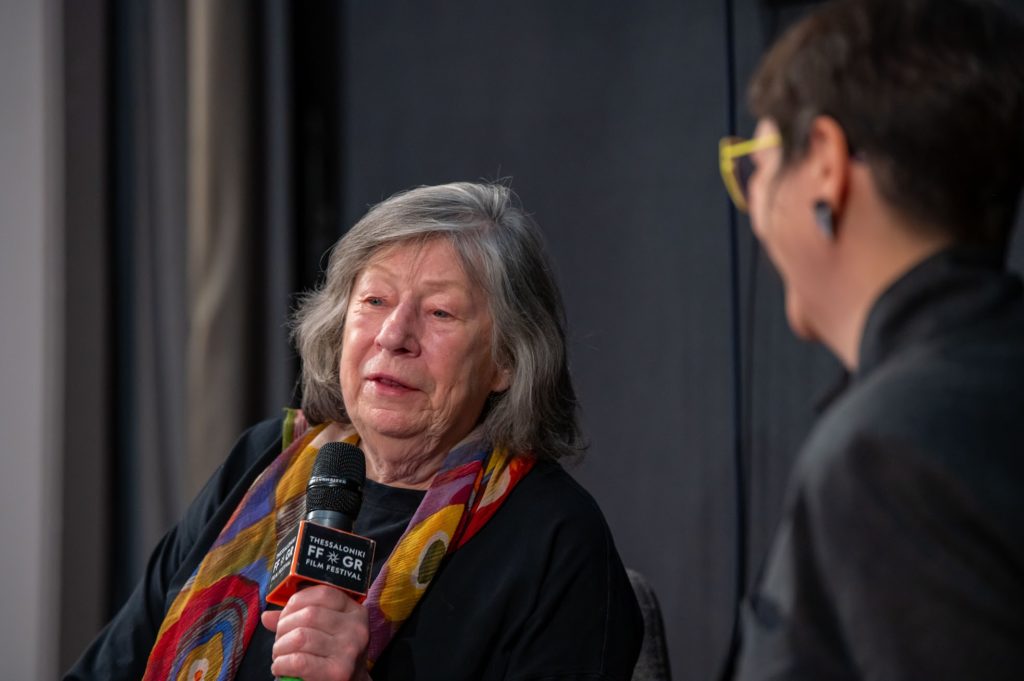
The Origins of the Male Gaze
Mulvey began by recalling the political circumstances in which her seminal essay emerged. Written under the influence of the women’s liberation movement, it was never intended as a conventional academic paper. «It was a rhetorical and political essay, and it is precisely in those terms that it should be read even today,» she explained.
At the time, film studies barely existed as an academic discipline in Britain. Her objective was to use psychoanalysis to expose the patriarchal structures embedded in classical Hollywood cinema.
Drawing on Freud, Mulvey examined how conventional cinematic representation positioned women as objects of visual pleasure while assigning men the active role of advancing the narrative.
She emphasised that her use of the masculine pronoun to describe the spectator had been deliberate. Classical Hollywood cinema, she argued, addressed its audience through a predominantly male perspective, just as the supposedly universal masculine pronoun reflected the conventions of language.
«Male gaze» appears only once in her original essay, despite subsequently becoming its most widely recognised concept.
Mulvey also acknowledged the historical limitations of her original analysis. Its binary understanding of gender reflected the cinematic conventions of the period, while queer perspectives and gender fluidity remained outside its scope.
Homosexuality, she recalled, was largely taboo in classical Hollywood. The emphasis on female beauty as spectacle was partly connected to the industry’s reluctance to present men themselves as objects of erotic contemplation.
Interestingly, Mulvey pointed out that the expression «male gaze» appears only once in her original essay, despite subsequently becoming its most widely recognised concept.
For her, another equally important idea was Hollywood’s masculine narrative drive: the expectation that male characters should act, control events and propel the story forward, while female characters were primarily presented as objects to be looked at.
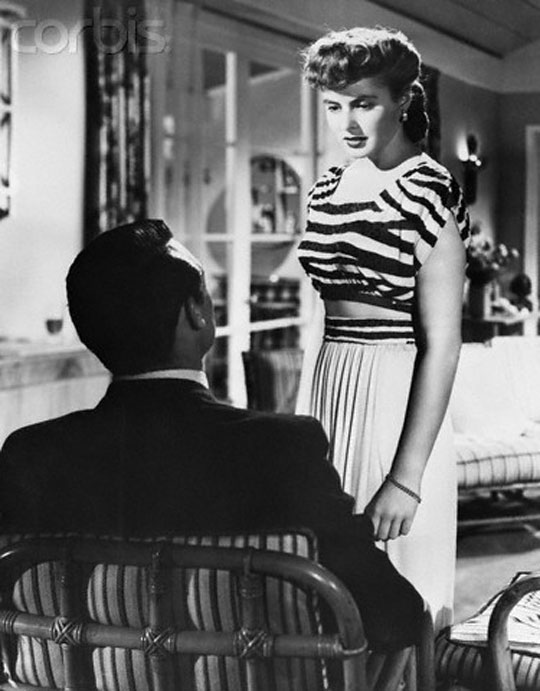
Notorious (Alfred Hitchock, 1946).
Hitchcock and the Mechanics of Looking
To demonstrate how these mechanisms function within cinematic language, Mulvey analysed the opening sequences of Alfred Hitchcock’s Notorious (1946).
The film begins with a camera, the instrument of looking itself, before introducing a group of male journalists and a man observing events through a partially open door. Only when someone announces the arrival of Ingrid Bergman’s character does the visual composition change. The female star becomes both the centre of attention and the driving force of the narrative.
Mulvey highlighted a subsequent composition featuring Cary Grant’s dark silhouette in the foreground while Bergman, brightly illuminated, moves in the background. Grant’s silhouette, she suggested, resembles a spectator obstructing our view in a cinema auditorium. Hitchcock effectively incorporates the experience of spectatorship into the image itself.
These examples demonstrate how consciously classical filmmakers could manipulate the relationship between looking, desire and narrative structure.
Digital Technology and the Emancipated Spectator
One of the most significant developments in Mulvey’s thinking concerns the transformation of spectatorship through digital technologies.
Where traditional cinema required viewers to surrender to the uninterrupted progression of images, digital viewing allows them to pause, repeat, slow down and examine individual moments.
Drawing on Jacques Rancière‘s The Emancipated Spectator, Mulvey argued that these possibilities fundamentally change the relationship between viewers and films.
Cinema, she suggested, is not merely a storytelling medium but also an art form uniquely capable of manipulating time.
There is no single prescribed way of looking, nor is there a ‘unified female aesthetic’.
Digital technology allows spectators to participate more actively in that manipulation, escaping the fixed temporal experience of the conventional screening. «With digital slowing down, the spectator is no longer identified as ‘he’, but rather as each one of us,» she observed.
For Mulvey, this transformation opens the way to a different kind of cinephilia, in which curiosity and play become central to the experience of images. The audience is no longer understood as a homogeneous subject but as a collection of individuals bringing different desires, identities and interpretations to the screen.
Curiosity as a Feminist Force
Curiosity occupies a central position in Mulvey’s theoretical work, particularly in her book Fetishism and Curiosity.
She explained that patriarchal culture has historically represented female curiosity as dangerous or transgressive, invoking familiar figures such as Pandora and the dismissive association of women’s conversations with gossip.
Yet curiosity can also become an instrument of knowledge and emancipation. Mulvey cited Agatha Christie‘s detective fiction, in which curiosity provides the means to uncover hidden truths and resolve mysteries. She also connected Freud’s understanding of fetishism with Marx’s concept of commodity fetishism. Both, she argued, depend on concealing something fundamental.
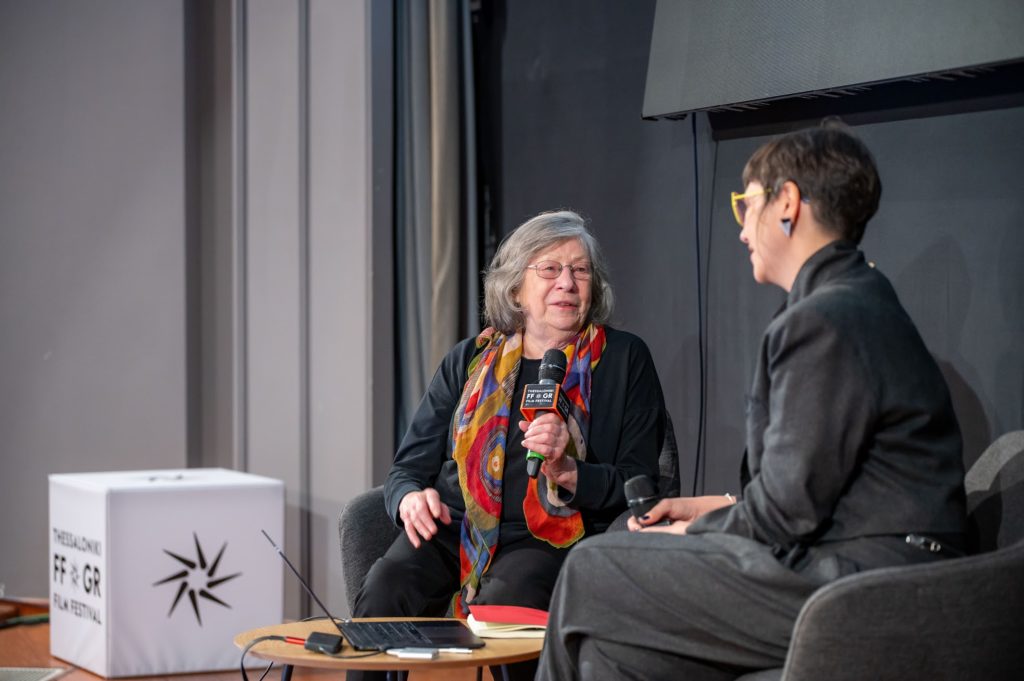
In Marx’s analysis, the commodity becomes desirable precisely because the labour involved in its production is hidden from the consumer. In Freud’s account, the fetish conceals an unsettling truth about the body.
What unites these mechanisms is the suppression of knowledge, making curiosity a potentially disruptive force. Mulvey recalled the words of feminist historian Sheila Rowbotham, who argued that the question of women’s liberation concerns society as a whole rather than women alone.
Women Filmmakers Beyond the Exception
Responding to an audience question about contemporary women directors, Mulvey welcomed what she described as a new momentum in filmmaking. While pioneering directors have always existed, their achievements were frequently treated as isolated exceptions within a predominantly male industry.
She recalled the feminist filmmaking of the 1970s, including the work of Chantal Akerman and Sally Potter, alongside her own experiments in cinema.
Today, she argued, the number and diversity of women filmmakers make it increasingly difficult to speak of individual exceptions. Importantly, Mulvey rejected the notion of a unified female cinematic aesthetic. «There is no single prescribed way of looking, nor is there a ‘unified female aesthetic’,» she stated.
What exists instead is the possibility of approaching cinema from different female perspectives, bringing previously marginalised stories and experiences into view.
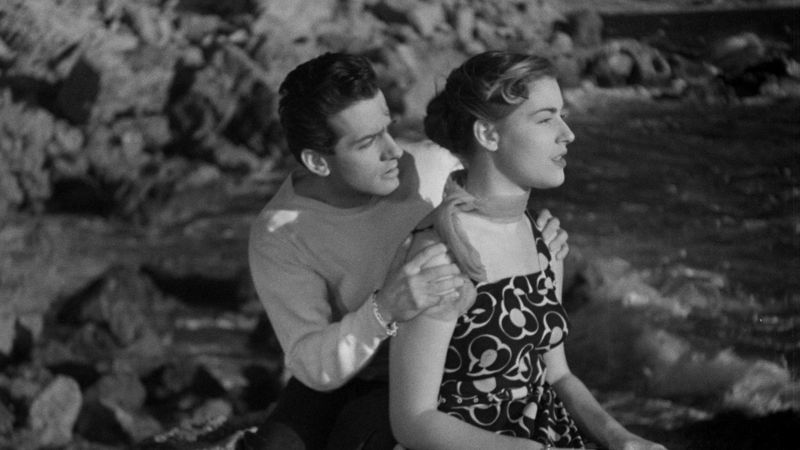
Eva (Maria Plyta, 1953).
Recovering the Forgotten History of Women in Cinema
The discussion also addressed the importance of film restoration, archival research and programming in recovering the work of overlooked women filmmakers.
The restoration of Eva, by pioneering Greek director Maria Plyta, provided an opportunity to revisit Mulvey’s involvement in one of the earliest retrospectives devoted to women directors.
In 1972, she participated in the Women’s Event at the Edinburgh Film Festival, where organisers encountered considerable difficulties locating prints of films made by women. It was during that period that Mulvey discovered the work of Dorothy Arzner, a pioneering Hollywood director whose Dance, Girl, Dance could be screened thanks to a surviving print held by the British Film Institute.
Similarly, Maya Deren‘s Meshes of the Afternoon (1943), already familiar to some American experimental film circles, remained largely unknown in Britain. These experiences revealed how much of women’s film history had been excluded from mainstream accounts of cinema.
Mulvey stressed that feminist archival work and curatorial practices have since helped bring this forgotten heritage back into circulation, revealing a much broader and more diverse cinematic landscape.
The restoration of Maria Plyta’s Eva, undertaken by The Film Foundation’s World Cinema Project and the Cineteca di Bologna in collaboration with Greek partners, represents a continuation of this process.
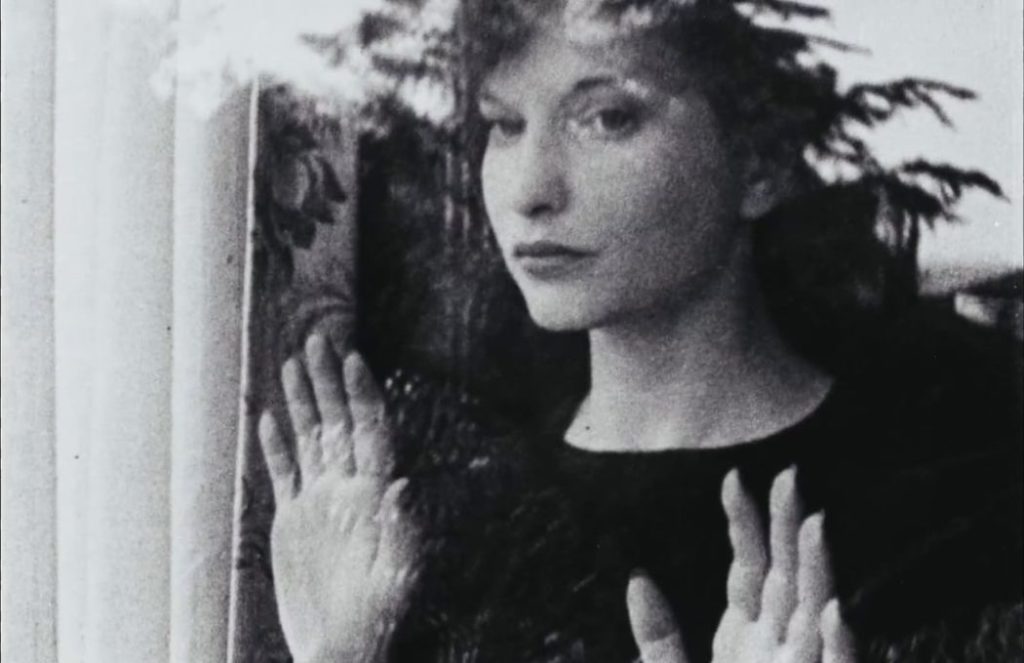
Maya Deren.
The Limits of Theory in the Age of Social Media
Towards the end of the discussion, Mulvey reflected on the challenges posed by contemporary digital culture, particularly the relationship between young women, self-image and online representations of femininity.
She identified violence against young women and the pressures associated with selfie culture as especially urgent concerns. However, she also acknowledged that theoretical frameworks developed around the binary gender structures of classical Hollywood may not fully explain these new phenomena.
Rather than presenting her 1975 essay as a universal interpretative model, Mulvey emphasised the need to recognise its historical context and limitations.
Asked about artificial intelligence and the recurring predictions that technological innovation will bring about cinema’s demise, she referred to Jean Baudrillard’s reflections on acceleration, repetition and the contradictory experience of time in technological societies.
Technology, she suggested, can accelerate the circulation of images and exchanges while simultaneously producing new forms of social inertia.
With characteristic humour, Mulvey admitted that the scale of contemporary digital transformation can sometimes feel almost incomprehensible to her, comparing herself to a medieval European suddenly confronted with the heliocentric theory.
A Theory That Continues to Evolve
More than fifty years after Visual Pleasure and Narrative Cinema, Laura Mulvey’s influence extends far beyond the concept of the male gaze.
Her work continues to raise questions about the structures of cinematic pleasure, the politics of representation, the relationship between images and desire, and the possibilities opened by new technologies.
The Thessaloniki discussion revealed a thinker willing not only to revisit her most influential ideas but also to acknowledge their limitations and reconsider them in relation to contemporary cinema.
From classical Hollywood to digital spectatorship, from feminist film archives to artificial intelligence, Mulvey’s central concern remains the relationship between images, power and the act of looking.
And if her early work sought to expose the ideological mechanisms behind cinematic pleasure, her more recent reflections suggest that curiosity itself may offer one of the most productive ways of challenging them.
Photos from the event courtesy of the Thessaloniki International Film Festival.


Nadie ha publicado ningún comentario aún. ¡Se tú la primera persona!