

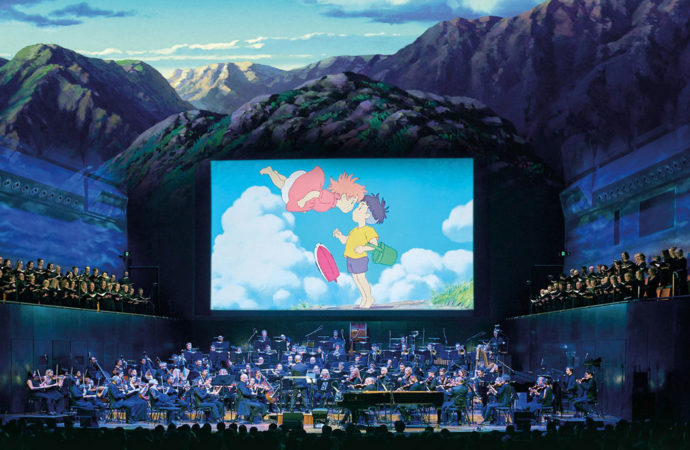

It is hard to imagine any of Hayao Miyazaki’s films without the melodies of the prolific composer Joe Hisaishi (born Mamoru Fujisawa). Decade after decade, their collaboration has gifted us with some of the most beautiful and unforgettable film scores. Their first encounter dates back to 1983, when a record company recommended Hisaishi to compose the music for Nausicaä of the Valley of the Wind. Since then, their artistic partnership—and friendship—has endured to this day.
Hisaishi is often referred to as the “Japanese John Williams,” due to his long-standing collaboration with Miyazaki. Much like the bond between Steven Spielberg and Williams, the connection between Miyazaki and Hisaishi remains remarkably close. Over the course of his career, Hisaishi has won the Japanese Academy Award for Best Music eight times, and his work appears in four of the eleven highest-grossing films of all time in Japan. In addition to numerous film awards, he received the Medal of Honor from the Japanese government in 2009 for his contributions to the arts, remarking: “I believe this award shows that I am appreciated, and that my work is appreciated. I could ask for nothing more in life.”
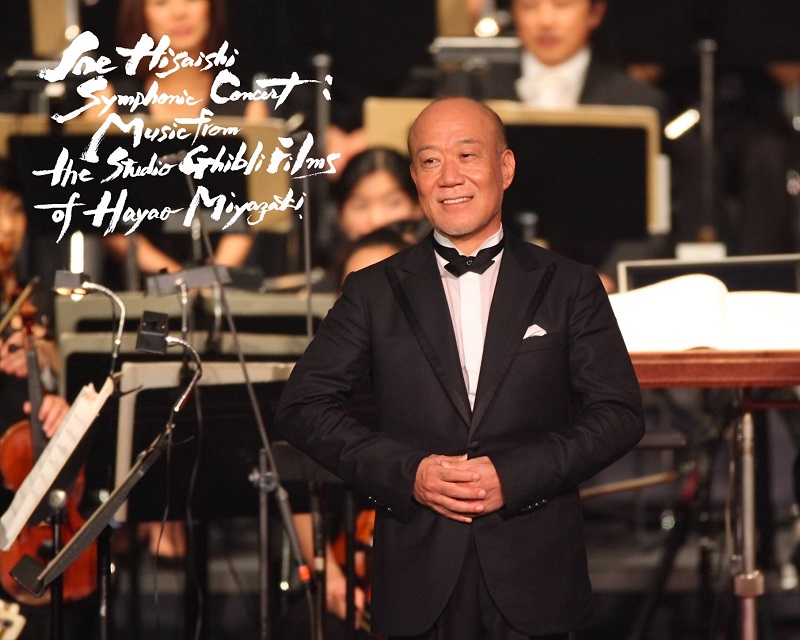
His compositions, often compared to those of Claude Debussy, evoke an impressionistic quality—suspended in time, inhabiting a peaceful and magical space. This defining element gives Miyazaki’s animation a singular and unmistakable identity, as becomes evident in a look back at some of his most notable films.
Nausicaä of the Valley of the Wind (1984)
At its core, Nausicaä carries a sense of grandeur, reinforced by its musical composition. In scenes where Nausicaä encounters the Ohmu —giant insects inhabiting a post-apocalyptic world— the score conveys, without words, their power, danger, and otherworldly nature.
Electronic music, composed with synthesizers, was booming in the 1980s, and Hisaishi incorporated it masterfully into the score at precisely the right moments.
Castle in the Sky (1986)
An adventure story brimming with imagination and sensitivity, for which Hisaishi composed melodies full of optimism. Every note underscores the dreamlike world above the clouds, with a magical soundscape and a delightful main theme.
My Neighbor Totoro (1988)
A true national anthem in Japan. So deeply embedded in the culture, it feels inseparable from it. In this tender story, the composer follows the two sisters closely through his music—to-to-ro, to-to-ro. When Hisaishi sits at the piano, it seems the world becomes a better place.
Kiki’s Delivery Service (1989)
One of Miyazaki’s most unjustly overlooked works. Though it may appear to be a simple children’s adventure, it is in fact a coming-of-age story with a melancholic undertone that Hisaishi translates into music, while maintaining a light, playful tone.
Porco Rosso (1992)
Perhaps the clearest precursor to The Wind Rises (2013). Beyond thematic and biographical parallels, both films share a sense of nostalgia and a classical Hollywood melodrama infused with Mediterranean undertones.
Princess Mononoke (1997)
The score of Princess Mononoke draws inspiration from the feudal era depicted in the film. In forest scenes, the music feels organic and natural. Its uniqueness lies in the interplay between magical, almost spectral melodies associated with nature, and the harsher tones reflecting the destructive impact of industrialization introduced by Lady Eboshi.
The opening ten minutes are particularly striking: the film moves rapidly from an idyllic setting to a violent, intense sequence, propelling the viewer to the edge of their seat as Ashitaka confronts a demonic boar spirit. This powerful transition owes much to Hisaishi’s composition.
Spirited Away (2002)
The score of Spirited Away is deeply moving and seamlessly integrated into every scene. It brings to the forefront many of Miyazaki’s recurring themes: tradition, excess, poverty, mischief, and retribution—concepts deeply rooted in Japanese cultural consciousness.
Some of the most memorable music appears in the bathhouse sequences.
Howl’s Moving Castle (2004)
The soundtrack differs significantly from previous collaborations, placing a strong emphasis on piano, often referencing European musical traditions. As the emotional states of the characters shift —from self-pity to profound intensity— Hisaishi’s music reflects every nuance.
Ponyo (2008)
The soundtrack of Ponyo is fleeting, playful, and joyful. While perhaps less memorable than some of Hisaishi’s earlier works, it perfectly captures the film’s gentle and charming tone.
The end credits song in the Japanese version, performed by eight-year-old Nozomi Ōhashi, became a major hit in Japan in 2008, ranking as the 14th best-selling single in the Oricon annual charts.
In 2015, celebrating the 25th anniversary of Studio Ghibli, Hisaishi performed a concert at Budokan featuring many of the scores discussed above.
Over more than 30 years, through image and music, Hisaishi has made us feel like children again, reminding us of the magic inherent in reality. If Miyazaki creates stories through his exquisitely crafted images, Hisaishi does so through each of his luminous, expressive notes.



Nadie ha publicado ningún comentario aún. ¡Se tú la primera persona!