
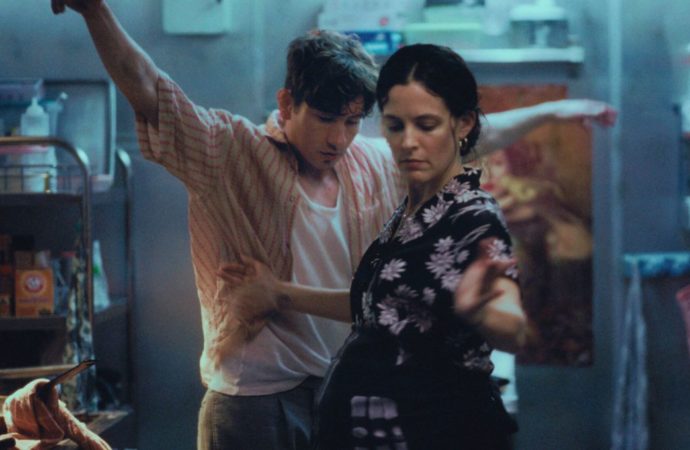

With Butterfly Jam, premiered in the Directors’ Fortnight at the 79th Festival de Cannes, Russian filmmaker Kantemir Balagov continues exploring the emotional wounds left by closed environments upon bodies and human relationships, although this time shifting his focus from the female universes of Tesnota and Beanpole toward masculinity and father-son relationships. Returning to Cannes after his two previous feature films screened on the Croisette —Tesnota won the FIPRESCI Prize in Un Certain Regard in 2017 (on whose jury I served), while Beanpole received the Best Director award in the same section in 2019— the new film by the Nalchik-born director confirms the coherence of a filmography obsessed with the pressure exerted by community, tradition and trauma on the construction of identity.
The film begins in medias res, throwing the spectator into a traumatic situation whose true scope gradually unfolds. The event alluded to in the opening minutes possesses brutal symbolic force and functions almost as a pessimistic thesis running through the entire narrative: even within this strange contemporary fairy tale about male tenderness and the desire for emancipation, the structural violence of community and inherited culture ultimately contaminates everything. From the outset, Balagov makes clear that the emotional fragility of his characters develops under the constant threat of destruction.
Balagov reflects on male emotional expression within a community deeply shaped by codes of harshness, pride and emotional silence.
Pyteh, a fifteen-year-old teenager, divides his life between wrestling training sessions and his family’s small Circassian restaurant in New Jersey, which stands on the verge of bankruptcy. What initially appears to be a story about immigration and cultural heritage gradually transforms into a far more complex reflection on male emotional expression within a community deeply marked by codes of roughness, pride and affective repression. Yet the genesis of the film followed the opposite path: Balagov relocated the story to Newark after leaving Russia following the invasion of Ukraine. Living in voluntary exile in Los Angeles, the director discovered there a Kabardian community that allowed him to transpose to the United States a story he had originally intended to shoot in the North Caucasus. However, as he himself has pointed out, the geographical displacement does not alter the essence of the conflict: filming it in Russia or in Newark would have been, emotionally, almost the same. At the same time, this new American dimension further intensifies the generational conflict between father and son.
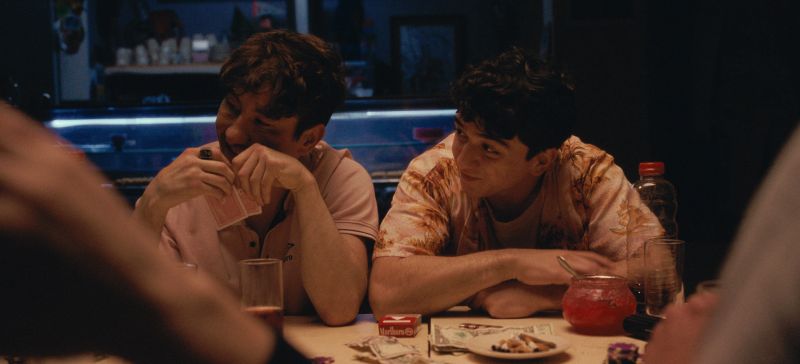
Pyteh’s father, Akik (Barry Keoghan), emigrated to the United States as a child and has retained a humble, resigned attitude toward life, while his son — a wrestling champion already born in America — still believes in the possibility of aspiring to something greater, constantly colliding with the weight of family and communal tradition. The emancipation to which the young man aspires, inseparable from his deep attachment to his father, also reflects Balagov’s own ambivalent relationship with the Circassian community from which he comes.
Trained in the school founded by Alexander Sokurov in Kabardino-Balkaria, Balagov once again constructs a universe where emotions appear trapped within rigid cultural structures, although here he introduces a new tone — unexpectedly tender and even luminous. The filmmaker, who co-wrote the screenplay with Marina Stepnova drawing on personal experiences, creates a kind of contemporary fairy tale about pride, heritage and male vulnerability. In this world, men fight physically with one another, but they also embrace, kiss and touch each other as an indirect and awkward way of expressing affection. Wrestling thus becomes a physical extension of repressed tenderness, a brutal choreography in which violence and affection cease to be opposites.
The emotional fragility of Balagov’s characters unfolds under the constant threat of destruction.
The story continuously oscillates between brutality, tenderness and emotional awkwardness. The characters remain trapped between their need for affection —and for expressing it— and their inability to verbalize it. Balagov seems interested in provoking a discussion about male vulnerability and about the historical difficulty of father-son relationships in contexts where showing weakness is perceived as a threat. Roughness, lack of communication and inherited emotional repression structure an ecosystem in which any gesture of affection acquires extraordinary intensity.
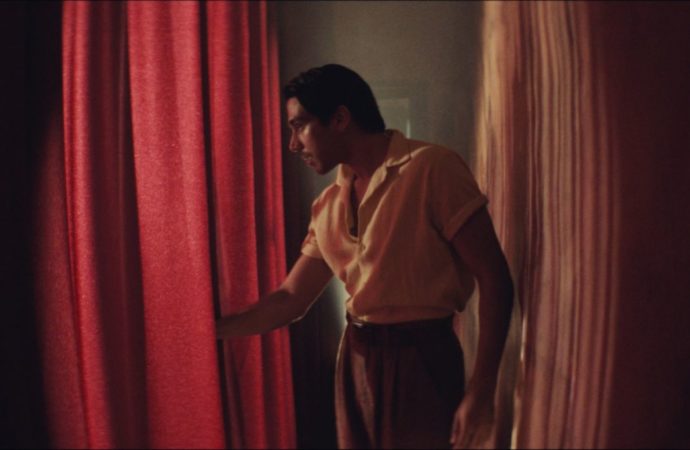
Formally, Balagov had already shown us in Beanpole that chromatic palettes can also speak, but in Butterfly Jam he expands his visual universe through a strange fusion of realism and fantasy. The cinematography constantly reveals this duality, with a saturated visual palette marked by the insistent presence of pink in certain scenes. Traditionally associated with femininity, pink here permeates everything: male bodies, domestic interiors, wrestling spaces and the communal environment itself. This chromatic contamination creates a feeling of poetic estrangement and latent vulnerability that dismantles traditional codes of masculine representation. In those moments, the almost unreal atmosphere distances the film from pure naturalism and transforms the Circassian community portrayed by Balagov into a suspended space.
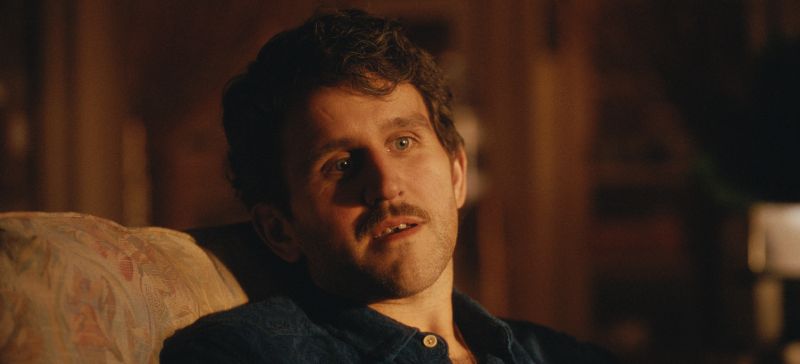
Even the appearance of Monica Bellucci —in a brief cameo inspired by an anecdote circulating within the Circassian community, which attributes that genealogical origin to her, as it supposedly did to Leonardo da Vinci’s mother— acquires symbolic value within the narrative: she represents the desire to become more than one is, the aspirational and almost legendary fascination that runs through the masculine fantasies of several generations.
The cast contributes decisively to this tension between vulnerability and violence. The young Kazakh-American actor Talha Akdogan sustains his part of the narrative not only through his physical presence, alongside Barry Keoghan (Azik), who, according to Balagov himself, contacted the director directly through Instagram to work with him and, in a certain sense, plays “Barry Keoghan” —fitting the character like a glove thanks to that uniquely his combination of menace, vulnerability and strangeness. Riley Keough (Zalya, Azik’s sister) shines in a deeply sensitive supporting role, while Harry Melling (Murat) proves impressively hypnotic, bringing unexpected emotional density to each of his appearances.
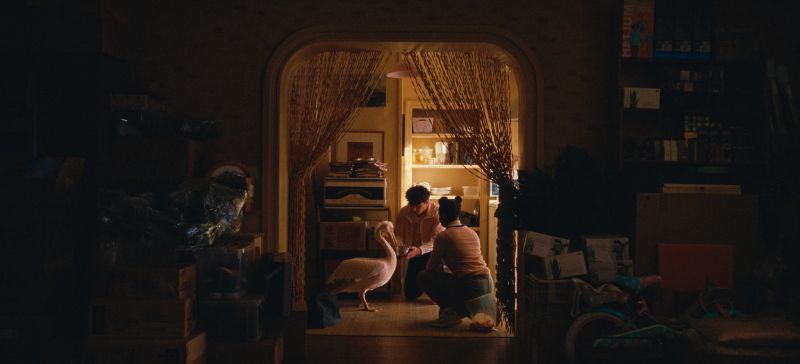
The film was shot between New Jersey and France —the latter location used for budgetary reasons— although the final result constantly preserves the sensation of a cultural territory closed in upon itself. As already happened in Tesnota and Beanpole, the motivations of the characters remain deliberately cryptic. Balagov forces the spectator to constantly reorganize the pieces of the emotional and narrative puzzle, moving completely away from any standardized or explanatory psychology. His characters do not seek to be immediately understandable, nor even especially empathetic. In Butterfly Jam, moreover, the incorporation of humour, fantasy and certain almost contemporary fairy-tale elements within a profoundly harsh drama may initially produce a certain sense of bewilderment. However, despite the obvious risk of making entry into the film more difficult, this tonal instability ultimately becomes one of its greatest virtues.
It is particularly admirable that Balagov has not listened to industrial siren songs nor softened his cinematic personality in this first film made outside Russia. Far from adapting his cinema to more international or accommodating models, the director remains radically faithful to his own talent: uncomfortable, elliptical, visually powerful and deeply interested in human contradictions rather than narrative conventions. After the devastating female portraits of Tesnota and Beanpole, Balagov now shifts his sensitivity toward a masculine territory where emotional awkwardness generates another form of silent tragedy. Butterfly Jam portrays men incapable of expressing love without resorting to force, while still leaving open the possibility — painful, imperfect and profoundly human — of finally learning how to do so.


Nadie ha publicado ningún comentario aún. ¡Se tú la primera persona!