
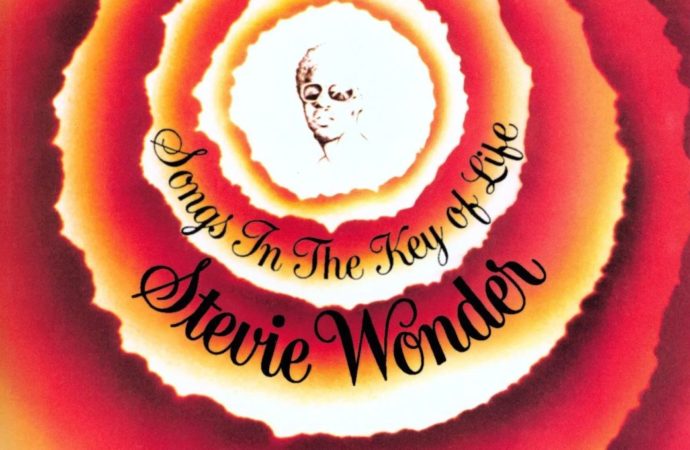

On February 28, 1976, at the Grammy Awards ceremony broadcast live across the United States, Paul Simon has just won Album of the Year for 1975 with Still Crazy After All These Years. It is his second triumph, following his previous win alongside Art Garfunkel for Bridge Over Troubled Water. His acceptance speech is one of gratitude: “Well, I’m very happy to win this. I want to thank Phil Ramone, who co-produced this with me. And Phoebe Snow, who sang with me on the album. And Art Garfunkel, who sang with me on ‘My Little Town’. And most of all, I’d like to thank Stevie Wonder for not releasing an album this year.”
In 1976, Stevie Wonder was not only the brightest star in American music, but also its most respected musician and composer. His two previous albums had won the Grammy for Album of the Year, he had placed nine singles in the Top 10 since the beginning of the decade, and he had just signed the most lucrative recording contract ever awarded to a musician. His new deal with Motown was worth nearly $37 million, including a $10 million advance—twice the combined value of the contracts signed by two of the decade’s biggest commercial stars, Elton John and Neil Diamond.
To say that anticipation for his next album was running high would be an understatement. It was arguably the most eagerly awaited record of the entire decade. And yet, when Stevie Wonder stepped onto the stage, just after Paul Simon had left it, to present the award for Record of the Year, he must have been thinking: You have no idea what’s coming. And he would have been absolutely right. Because Songs in the Key of Life—the title of that album everyone was waiting for—was destined to become his magnum opus, one of those landmark records that divide music history into a before and an after. Think Pet Sounds, Sgt. Pepper’s, What’s Going On, OK Computer or To Pimp a Butterfly.
The remarkable thing is that the album might never have existed at all, because Stevie Wonder seriously considered retiring. In March 1975, as his contract with Motown was coming to an end, Wonder held a press conference in Los Angeles announcing that he was leaving the music industry. He planned to give a farewell concert later that year, donating all the proceeds to charitable causes in Ghana. He was also considering moving to Africa.
Whether this was a negotiating tactic designed to secure a better contract or a genuine intention to retire remains unclear. What is certain is that Motown boss Berry Gordy was not about to sit back and watch his golden goose fly the nest. So he made Wonder an offer he couldn’t refuse: the record-breaking contract mentioned earlier. Wonder signed it in August 1975 and set to work on what would become his definitive album.
With Songs in the Key of Life, Stevie Wonder wanted to capture and express the many stages and dimensions of human existence, and he needed time to accomplish such a monumental undertaking. The singer had just turned 25, but he had been making music since the age of twelve. He felt he was entering a defining period of his life, a feeling reinforced by the knowledge that he was about to become a father.
As he would later explain: Bach and Chopin took years to compose their works. I had to live a little so I would have more things to sing about, more things to express. Stevie had set his sights on creating his most ambitious project yet, and the world began to wait impatiently.
Motown was desperate to have an album ready before the end of 1975, but Stevie Wonder was in the grip of a creative fever, with songs emerging spontaneously during seemingly endless recording sessions. There was no fixed schedule. For two years, Stevie would enter a studio—whether Crystal Sound in Hollywood, the Hit Factory in New York, or the Record Plant facilities in Los Angeles and Sausalito—and simply start playing and developing songs. Sometimes he would spend 48 hours straight recording, chasing inspiration while a rotating team of engineers and session musicians struggled to keep up with him.
When he couldn’t summon an entire orchestra, he turned to his favourite new toy: the Yamaha GX-1 synthesizer, which allowed him to create elaborate orchestral arrangements for songs such as “Village Ghetto Land” and “Pastime Paradise”.
By the time recording was complete, more than 130 people had contributed to the album, including Herbie Hancock, George Benson, ‘Sneaky Pete’ Kleinow and Minnie Riperton. And yet, most of the instruments and vocals on the record were performed by Stevie himself, who was also responsible for almost all the songwriting, arrangements and production.
Quite a marvel, our Stevie.
The fact is, he could hardly have been more prolific. During those sessions, he is believed to have recorded more than 100 songs—an astonishing output from which he eventually selected just 21: seventeen for a double album and another four for an accompanying EP. A monumental work worthy of a talent at the very peak of his powers.
Until now, he had never shared the outtakes from those legendary sessions. To mark the 50th anniversary, an EP featuring four of those previously unreleased songs has just appeared: “It’s Easier”, “My Life Story of Love”, “I Can See the Sun in Late December” and “I’m Into Livin”. And the quality is, quite simply, spectacular. It seems clear that Wonder could have given us a triple album without compromising the quality in the slightest.
The final recording session was devoted to “I Wish”, one of the album’s finest songs. After rewriting the lyrics to take a nostalgic journey through his childhood memories, Wonder called bassist Nathan Watts at three in the morning and asked him to come to the studio to record the track. His sister Renee Hardaway also contributed, delivering that unforgettable line: You nasty boy!
Everyone involved knew they were sitting on a masterpiece, and Gordy was beginning to suspect that his multimillion-dollar deal had turned out to be something of a bargain after all. The album had everything: social consciousness intertwined with personal memories, and a veritable encyclopaedia of sounds encompassing gospel, jazz, soul, funk, Bach and an extraordinary range of musical fusions.
Naturally, it also contained several songs with enormous potential as singles. “I Wish” and “Sir Duke” gave Wonder two more number-one hits, helping to make Songs in the Key of Life one of the best-selling albums of all time and cementing Stevie Wonder’s status as the biggest star of the 1970s.
For once, commercial success went hand in hand with critical acclaim. The album opened with the powerful “Love’s in Need of Love Today”, a kind of gospel-infused soul that established one of the record’s defining qualities: the song stretched beyond seven minutes without a single second feeling superfluous, with Stevie delivering a truly majestic vocal performance.
“Have a Talk with God”, for which his brother helped write the lyrics, plunged into the murky, gritty funk of Sly & The Family Stone’s There’s a Riot Goin’ On. Then the Yamaha GX-1 evoked Bach on “Village Ghetto Land”, a song inspired by The Beatles’ “Eleanor Rigby” and one that would earn the approval of its composer, Paul McCartney, who would go on to collaborate with Stevie Wonder a few years later.
“Contusion” was an instrumental jazz-rock jam in which Wonder flirted with progressive music. It sounded like the band warming up before launching into the glorious “Sir Duke”, a magnificent celebration not only of the great figures of jazz, but of music itself. Duke Ellington would surely have given his wholehearted approval to an arrangement bursting with swing and groove.
“I Wish” boasts one of the most irresistibly addictive riffs in the history of funk (Will Smith would later make money from it), and is one of the album’s most explosively joyful songs. Next came one of those piano ballads that only Stevie Wonder, at the height of his golden period, could have written: “Knocks Me Off My Feet”.
The Yamaha then returned to imitate a string section on another of the album’s most memorable tracks, “Pastime Paradise”, which would enjoy a second wave of popularity in the 1990s when Coolio used it as the basis for “Gangsta’s Paradise”. Indeed, the nearly two hours of music on Songs in the Key of Life have provided one of the most inexhaustible sources of samples for hip-hop producers.
These 21 songs offer perhaps the most irrefutable proof that Stevie Wonder is one of the very few musicians in the history of pop for whom the word genius is no exaggeration. Just listen to “As”, one of the most extraordinary soul songs of all time: that bass line, the keyboards, the incredible melody, the call and response, the magnificent chorus of voices and, above all, Stevie Wonder’s voice doing absolutely whatever it pleases.
Unsurprisingly, the album caused a sensation when it was released on September 28, 1976, debuting at number one on the charts—the first time an American artist had achieved that feat—and remaining at the top for 13 consecutive weeks. It went on to become the second best-selling album of 1977 in the United States.
And, of course, on February 19, 1977, Stevie Wonder proved Paul Simon’s joke prophetic when he once again collected the Grammy for Album of the Year.
But far beyond sales figures and awards, what endures is the legacy of an album that stands as one of the great cathedrals of twentieth-century popular music. Even if it had not sold a single copy upon its release, it would still be remembered for what it is: the pinnacle of Stevie Wonder’s career and one of the greatest albums of all time—the greatest, according to many, including Paste magazine, which crowned it number one on its list of the 300 greatest albums of all time less than two years ago.


Nadie ha publicado ningún comentario aún. ¡Se tú la primera persona!