
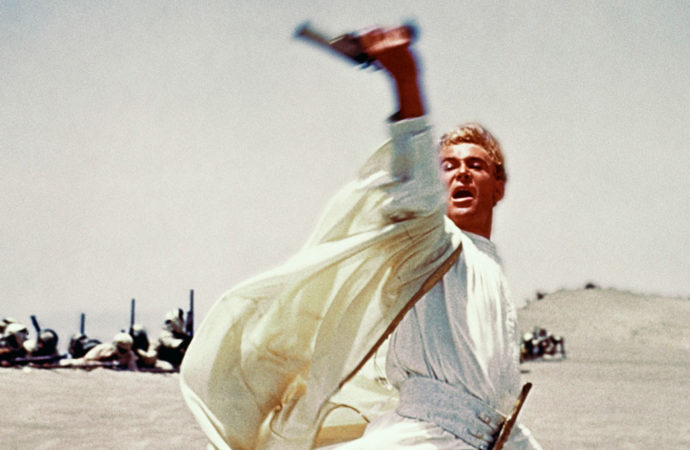

When the British Film Institute conducted its landmark poll in 1999 to determine the 100 greatest British films of the twentieth century, three of the top five positions were occupied by works directed by David Lean. No other filmmaker was represented more frequently on the list: seven of his films were included, with five of them ranking among the top thirty. Lean remains, in many ways, the quintessential British director—especially when one considers that figures such as Alfred Hitchcock and Charlie Chaplin spent most of their careers in the United States.
To understand the magnitude of Lean’s achievement, it is important to remember his beginnings as a film editor. Hitchcock may have been the more visually daring and innovative filmmaker, whereas Lean was fundamentally a master craftsman rather than a cinematic revolutionary. Yet his editorial background gave him an extraordinary command of cinematic transitions, arguably producing some of the finest cuts in film history, whether achieved through visual association or sound. The most famous example remains the match struck by Lawrence that dissolves into the blazing desert sun in Lawrence of Arabia, one of the most celebrated transitions ever committed to film.
The second thing to bear in mind is that Lean’s career can be divided into two distinct periods. The first, largely in black and white, helped define post-war British cinema through a series of precise and brilliantly crafted dramas. The second, filmed in Technicolor, redefined the epic tradition associated with Cecil B. DeMille, combining spectacular scale with an equally meticulous attention to character.
To borrow a phrase from Gloria Swanson, Lean made big films at a time when cinema had already become small. He was neither a rebel nor a visionary, yet few filmmakers possessed his visual talent. His own preferences were clear enough: “I think people remember the images in films, not the dialogue. That’s why I like movies.”
To examine this giant of world cinema, I will focus on his five undisputed masterpieces: Brief Encounter, Great Expectations, The Bridge on the River Kwai, Lawrence of Arabia and Doctor Zhivago.
Brief Encounter (1945)
David Lean is remembered above all for his great epics, yet the finest film he ever made—perhaps rivalled only by Lawrence of Arabia—may well be this extraordinary work, running little more than ninety minutes. His fourth feature as a director, it adapts a one-act play by Noël Coward, and not a single frame is wasted in what remains one of the greatest films ever made.
The film begins almost like cinema itself: a train arrives at a station, accompanied by Rachmaninoff’s music. A railway employee enters the station café and begins chatting with its owner. Yet they are not the people who interest us. A subtle camera movement reveals a nearby table where a man and a woman sit speaking sadly. We do not hear them; instead, Lean keeps our attention on the banal conversation taking place in the foreground. Only when a talkative acquaintance approaches the couple does the camera finally move closer. They seem visibly uncomfortable at the interruption.
What we are witnessing is, in fact, the end of the story. It is the woman, through a magnificent voice-over, who begins to tell us how they arrived at this moment.
Everything is told with the same subtlety and brilliance that characterises this opening sequence. A housewife, trapped in a marriage that is happy yet emotionally stagnant, meets a man who is equally married and equally dissatisfied. They fall in love and begin an affair, but the conventions of the time leave little room for extramarital relationships, especially when children are involved.
“I think people remember the images in films, not the dialogue. That’s why I like movies.”
Lean delivers a masterclass in concision and elegance. It helps that the screenplay strips away the clichés usually associated with such stories—the woman’s husband, for instance, is neither cruel nor neglectful but kind and understanding. Instead, the drama is built from tiny gestures: a hand resting briefly on a shoulder, a speck of dust caught in an eye. Through these seemingly insignificant details, Lean creates perhaps his most emotionally devastating film. He would go on to make works far more ambitious in scale, but he would never again equal this extraordinary ability to capture a fragment of life in its purest form.
Great Expectations (1946)
Quite possibly the finest screen adaptation ever made of a Charles Dickens novel. Although Lean is not entirely faithful to the original text, and despite a cast in which several actors appear noticeably older than their literary counterparts, he succeeds brilliantly in capturing Dickens’s spirit. Above all, he preserves the novelist’s acute social criticism: his portrait of a society in which people are born with their fate already determined, where those who begin life in the mud have every chance of remaining there forever.
It is obvious where both Dickens and Lean place their sympathies. Compare the decency of characters such as Joe Gargery, the blacksmith who becomes Pip’s adoptive father, or Abel Magwitch, the convict who offers him a second chance, with the embittered Miss Havisham, who manipulates the lives of those less fortunate at her whim. The film’s finest sequences take place inside her decaying mansion, where Lean demonstrates that he could have been a superb director of horror, emphasising both the ghostly atmosphere and the story’s underlying romanticism.
The Bridge on the River Kwai (1957)
This film marks a clear dividing line in Lean’s career. From his directorial debut in 1942 until this point, he had made eleven films. From The Bridge on the River Kwai onwards, and until his death on April 16, 1991, he would direct only five more features. They were all large-scale epics running close to three hours in length: The Bridge on the River Kwai (1957), Lawrence of Arabia (1962), Doctor Zhivago (1965), Ryan’s Daughter (1970) and A Passage to India (1984).
The first of these established the template for everything that followed. Lean’s films became visually spectacular and dramatically powerful, unfolding on an immense canvas without ever losing sight of the characters at their centre. Here he once again examines the sense of superiority associated with the British upper classes, embodied by Colonel Nicholson, brilliantly portrayed by Lean’s favourite actor, Alec Guinness. Consumed by his own notions of honour and grandeur, Nicholson ultimately ends up building a magnificent bridge for the enemy, determined to demonstrate to his nemesis, the Japanese Colonel Saito—whose character has more in common with his own than either man would care to admit—the supposed superiority of the British way.
In a film where everything works to perfection, one can clearly see the enormous influence Lean would have on Steven Spielberg, perhaps his most obvious cinematic heir. From the magnificent use of music—it is almost impossible to watch the film without leaving whistling the famous Colonel Bogey March, a tune dating from 1914 that Lean adopted after discovering that the extras were unable to march in step—to the action sequences, the location shooting and the fluid camera movements, the film anticipates many of the qualities that would later define Spielberg’s cinema.
The film won seven Academy Awards, including Best Picture, Best Director and Best Actor for Alec Guinness, and became a tremendous box-office success. Its triumph gave Lean the freedom to embark on his most ambitious project yet: Lawrence of Arabia.
Lawrence of Arabia (1962)
If The Bridge on the River Kwai inaugurated David Lean’s epic period, it was completely overshadowed by the sheer magnitude of Lawrence of Arabia. Everything about the film is colossal: its running time (222 minutes), its direction, its score, its performances, its visual beauty. Lawrence of Arabia has two protagonists: the man who gives the film its title, portrayed by Peter O’Toole in the role of a lifetime, and the desert itself.
The desert becomes the film’s mythical landscape, the force that shapes its hero and a character in its own right. Nowhere is this more evident than in its legendary introduction, when Lean cuts from Lawrence extinguishing a match to the blazing sun rising over the Arabian sands. Within these majestic landscapes, the director finds the perfect metaphor for the tortured soul of his protagonist. The vast emptiness, the beauty and the cruelty of the desert all mirror the contradictions of Lawrence himself: visionary and narcissist, liberator and conqueror, idealist and opportunist. Few films have ever fused landscape and character so completely.
Lean inspired an entire new generation of filmmakers to step behind the camera, Steven Spielberg and George Lucas among them, through his depiction of the endlessly fascinating T.E. Lawrence. This is one of the grandest and most beautiful films ever made, and Lean understood exactly how to exploit its possibilities, working on an immense canvas comparable in some ways to the great nineteenth-century novels of Tolstoy or Stendhal. It is a film conceived to be experienced on the largest screen possible.
It is impossible not to highlight Maurice Jarre’s score, the first of his collaborations with Lean. From this point onwards, Jarre would become for Lean what Morricone was for Leone, Rota for Fellini, Herrmann for Hitchcock and, later, Williams for Spielberg: the musical voice inseparable from the director’s cinematic imagination.
Doctor Zhivago (1965)
This was Lean’s most ambitious undertaking, a film that in many ways sought to combine the two sides of his artistic personality: the intimate romanticism of Brief Encounter and the epic scale of Lawrence of Arabia. On paper, it should have been his definitive masterpiece. Yet, while utterly captivating, it never quite reaches those heights.
The film excels as a romance, thanks largely to the luminous chemistry between Omar Sharif and Julie Christie, but it is less successful in its treatment of history. Tsarist Russia, the Revolution, the First World War and the ensuing Civil War often feel less like fully realised historical forces than as backdrops against which the passionate relationship between Yuri Zhivago and Lara unfolds. The great political upheavals of the era become a series of striking tableaux, beautiful and evocative, but ultimately secondary to the love story at the film’s centre.
Even so, its imagery remains utterly mesmerizing. Lean’s background as an editor is nowhere more evident than here, in a film that contains some of the most beautiful transitions ever committed to cinema. He directs in such a way that each shot seems destined to be assembled only one way. Once again, sound and Maurice Jarre’s magnificent score merge seamlessly with Lean’s impeccable visual composition.
Like Lawrence of Arabia, this is a film that ignores the limitations of television despite being released in 1965. It was made for the cinema, for the largest possible screen, where a tiny train can be seen disappearing into the immensity of a frozen landscape. It may not be the most rigorous historical reconstruction of revolutionary Russia, but Lean once again succeeds in entering the inner world of his protagonist, revealing the soul of a tormented poet.
It is easy to imagine that Lean saw something of himself in Yuri Zhivago. Perfectionism defined both men. In Lean’s case, that relentless pursuit of excellence would mean directing only two more films during the final twenty-five years of his life.


Nadie ha publicado ningún comentario aún. ¡Se tú la primera persona!