


Menotti brings his comedy to a close in just over twenty minutes with clockwork precision: Ben wants to propose to Lucy, but the telephone —that object that never stops interrupting— gets in the way time and again, until the device itself paradoxically becomes the means by which the proposal finally succeeds. The score is indebted to the post-Puccini tradition, with lucid melodic writing and nods to Italian farce, originally conceived as a light counterweight to the darkness of Menotti’s other, better-known opera, The Medium.

Elisa Balbo and Alen Boxer in Trouble in Tahiti. © Gianpaolo Parodi.
Five years later, Bernstein reverses the premise: here, it is no longer a matter of declaring love, but of confronting what remains when marital communication has broken down. Sam and Dinah, a bourgeois couple trapped in routine and social propriety, allow their frustrations to accumulate without ever naming them directly, while a vocal trio comments on the action like a Greek chorus disguised as a radio jingle, amplifying the gulf between the advertising-driven optimism of American society and the domestic unhappiness that such optimism cannot put into words.
It is worth remembering that Bernstein would not abandon these characters: three decades later, he would revisit them in A Quiet Place, an opera that incorporates Trouble in Tahiti in its entirety as a flashback within an even darker family story, confirming that this couple represented a long-standing obsession for the composer, rather than a mere youthful exercise.

The Telephone. © Gianpaolo Parodi.
And it is precisely this ambition that makes Trouble in Tahiti the musically richer score of the double bill: its composite musical language, in which jazz, musical theatre and operatic writing coexist, offers a timbral and dramatic complexity that Menotti’s clarity, delightful but more limited in its intentions, cannot match.
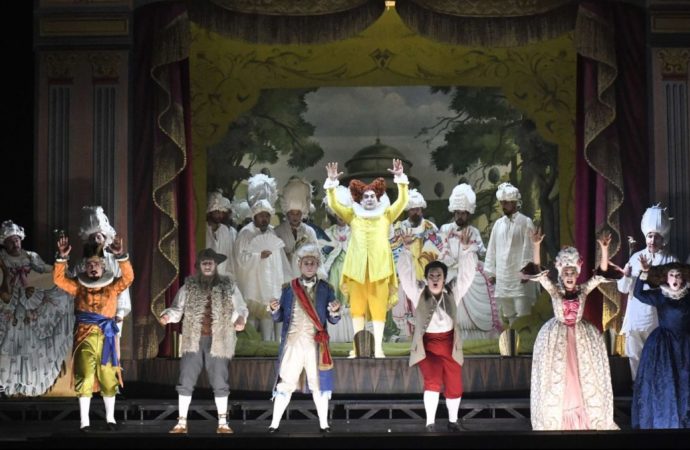
The introduction of the death of a child as the original wound in the couple’s relationship — an element absent from the original libretto — is a decision by stage director Gianmaria Aliverta that provides a concrete motivation for the breakdown in communication between Sam and Dinah, though not without a cost: such an explicit explanation risks diminishing the ambiguity surrounding conformity and the unfulfilled promises of the American Dream, which constituted much of the work’s original power. All of this is aptly represented by Elena Zamparutti’s set design and the costumes (also by Aliverta), based on the blues of the sky with unreal white clouds.

Elisa Balbo in Trouble in Tahiti. © Gianpaolo Parodi.
On the podium, Jacopo Brusa skilfully and versatilely navigates the transition between two distinct sound worlds, drawing a flexible response from the Orchestra del Teatro La Fenice, capable of shifting between Menotti’s lyricism and Bernstein’s hybrid musical language. The Goldoni, however, does not favour the undertaking: the absence of an orchestra pit and the considerable size of the orchestral forces create imbalances that the poorly managed amplification of Bernstein’s vocal trio does little to resolve, compromising the clarity of an essential dramaturgical element.

Elisa Balbo in Trouble in Tahiti. © Gianpaolo Parodi.
Elisa Balbo and Allen Boxer, who perform in both operas, moving from Lucy to Dinah and from Ben to Sam, carry the evening with remarkable commitment on stage. Balbo stands out above all for her acting vitality, brilliant and effortless in Menotti’s comedy, more restrained and sorrowful in Bernstein. Boxer proves an effective baritone, although the hall’s acoustic conditions work against him: on more than one occasion, his vocal projection is simply swallowed up by the orchestra, his voice failing to emerge with the clarity the character requires.
The result is nevertheless a lively production, well executed on stage, but one that ultimately suffers from a certain monotony of tone in its central section, as though the dramaturgical approach itself — so coherent on paper — were flattening on stage the rough edges that made both scores interesting in their own right.

Nadie ha publicado ningún comentario aún. ¡Se tú la primera persona!