
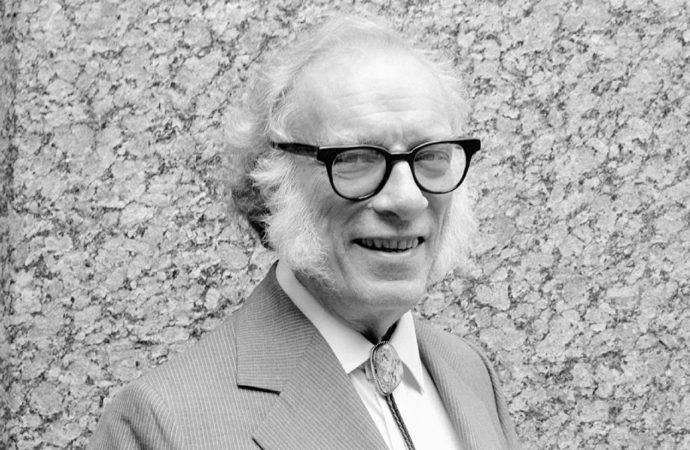
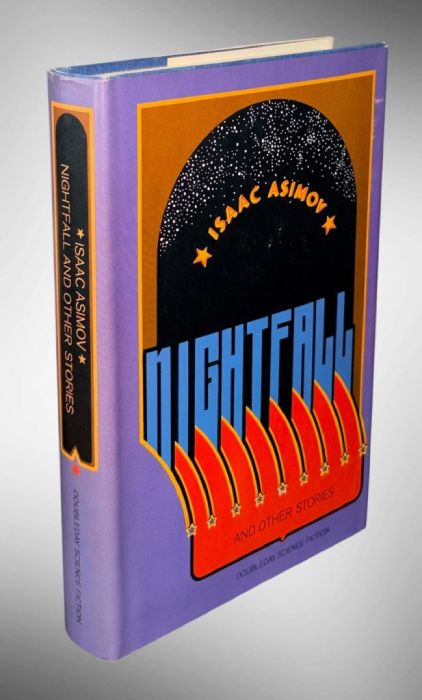
In March 1941, an unknown writer of pulp science-fiction magazines named Isaac Asimov was juggling his postgraduate studies in chemistry with work at his family’s grocery store. Asimov had been born in 1920 in Petrovichi, near the Belarusian border, during the interregnum between a crumbling Tsarist Empire and a Union of Soviet Socialist Republics still in the process of taking shape. Just three years later, his parents had managed to move to New York to experience the American Dream first-hand. Asimov had no memories of Petrovichi, but he was always proud of the Big Apple.
Isaac devoted what little free time he had to imagining the worlds he had discovered in the science-fiction magazines scattered across the display racks of the family store. It was a race against time and against the boredom of the neighbourhood kids who had 20 cents to spare on buying them. Asimov was fortunate enough to live through a kind of first golden age of the genre, when a whole range of publications of varying quality emerged and, every so often, treasures could be found among them.
At the age of eighteen, Asimov crossed the imaginary line separating reader from author. His creative efforts were focused on breaking into the regular stable of writers at Astounding Science Fiction, the market-leading magazine, edited by John Wood Campbell, Jr., the shrewdest mind of his time and field, and the finest talent scout when it came to discovering and recruiting writers who could make his publishing empire even greater.
Asimov was twenty-one in 1941, and since 1938 he had managed to place only three stories in Astounding. Undeterred, and with no greater ambition than to publish regularly, he admitted that the road towards his goal was proving very long indeed. His stories were entertaining fragments indebted to the work of others, filled with the kinds of mistakes made by any beginner. No one had yet touched them with the magic wand that could galvanise them—or, at the very least, bring them to a satisfying conclusion.
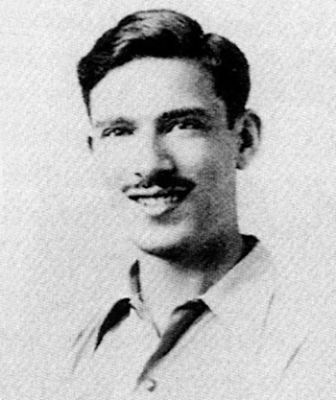
Campbell’s rejection letters were manuals of advice on how to abandon verbal tics and affectations that obscured the process. The editor saw something in Isaac, although he still did not know exactly what. He was none the wiser when, on 17 March, he saw him walk into the offices of Astounding, as he often did, simply to spend some time talking with its editor.
That morning, Campbell had been turning over in his mind a quotation by the poet Ralph Waldo Emerson that began: If the stars should appear one night in a thousand years, how would men believe and adore? It was a stimulating starting point, and from it emerged an exchange of ideas centred mainly around one question: What would a total eclipse produce on a world where it was always daytime?
Asimov shrugged: People would probably go mad. Campbell said nothing, but he had spent the whole morning waiting for the right person to walk through the door and give him an answer like that. There’s your story.
That afternoon, the unknown young writer set to work. First, he needed to create the right setting, and in searching for it he came up with an inverted solar system in which Lagash, the planet where the story took place, had not one but six suns. With so many stars, every point on the planet was always illuminated by at least one of them, and therefore night did not exist there. Darkness was confined to caves and underground spaces; electric light was an abstraction, rendered unnecessary by circumstance.
The catalyst for the plot was a wandering celestial body that the astronomers of Lagash had failed to detect, constrained as they were by their immutable cosmology of six suns and a single planet. This eighth passenger had the peculiar characteristic of passing in front of the smallest star in the system every 2,000 years, at precisely the moment when that star was the only source of light illuminating one hemisphere of the planet. The body was large enough for the resulting eclipse to last several hours, constituting Lagash’s only period of darkness in two millennia.
Asimov had created the night; now he had to find the right way to reveal it to the rest of the world. He worked on the story for three weeks and, on 9 April, considered the process complete. He called it Nightfall, as he had agreed with Campbell. At 68 pages, it was almost long enough to qualify as a novella. He did not know that he had written far beyond what he thought himself capable of, but he was pleased with the story’s pacing and its inexorable countdown structure.
And it is precisely this countdown to the arrival of night that has captivated several generations of readers for the past 85 years. The single setting of the astronomical observatory, determined to record the phenomenon while remaining oblivious to its consequences; the intrusion of an intrepid journalist in search of a scoop he does not entirely understand, since he does not believe a word of the scientists’ explanations—in fact, he considers the whole eclipse business a hoax; and, in the midst of it all, the revelations of a millennia-old sect whose mantra warns of the imminent arrival of “the stars.”
As the eclipse progresses, the connections holding together known reality begin to unravel. The journalist discovers, much to his dismay, that his willpower and independence are not enough to confront something so immense and unknown. The residents of the observatory, led by a textbook fundamentalist, discover that even their wildest theories had fallen terrifyingly short. As it does every two millennia, Lagash ends up descending into madness, desperately seeking any source of light that might restore its familiar state of affairs. It chooses the simplest solution: setting its entire civilisation ablaze, driven not only by fear of the darkness but also by the appearance in the sky of hundreds of thousands of unknown “stars.”
Lagash is unaware that it has found the answer to the mystery of its origins. Barbarism arrives as abruptly as the story ends—a story that, in theory, will repeat itself every 2,000 years, when the unexpected visitor returns to disrupt a civilisation unprepared for the extraordinary celestial alignment brought about by its arrival.
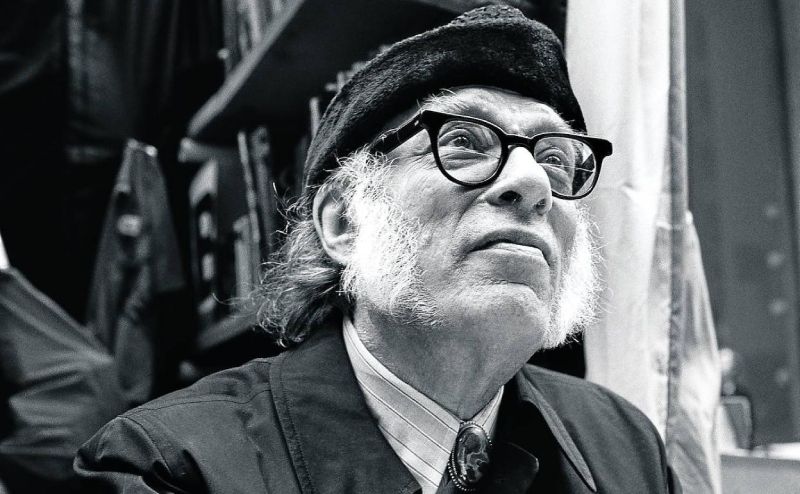
Asimov could never have imagined the impact his creation would have. If a little voice had told me that I was possibly writing the greatest science-fiction story of all time, I would never have got past the first line, he later recalled. Campbell, however, immediately recognised the jewel he had on his hands. For the first time, he gave Asimov the magazine’s cover story and paid him an additional bonus. From aspiring to be the second or third choice at the table, the unknown young writer became one of the mainstays of Astounding Science Fiction. With the first stories in his Foundation series, he achieved the status of a leading science-fiction author of the 1940s. By the end of the decade, he discovered that Arthur C. Clarke, Robert Heinlein and himself were beginning to be referred to as “the Big Three.” And so they remained for the rest of their lives.
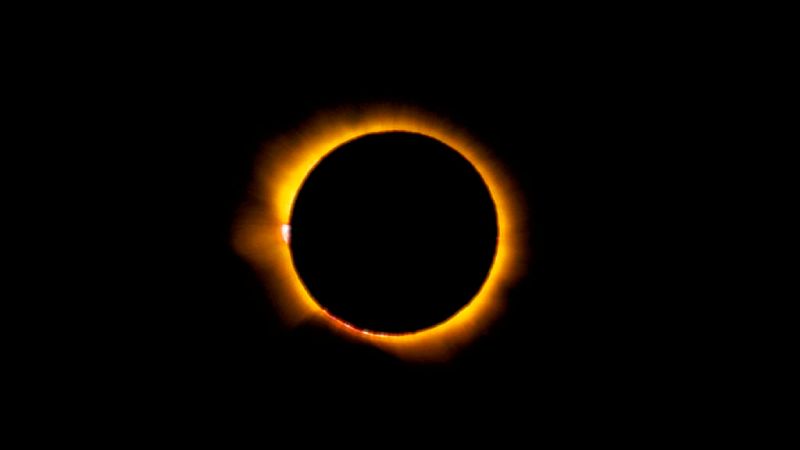
Eclipse. Photo: ©Miguel Macián.
The fame of Nightfall grew exponentially. Its perfect clockwork mechanism regularly earned it a place near the top of anthologies collecting the finest works in the genre. In 1968, it was voted the best science-fiction short story written up to that point. Campbell lived just long enough to see his judgement vindicated, dying barely three years later. In 1990, by then himself not far from sharing his mentor’s fate, Asimov agreed, in something of a testamentary gesture, to collaborate with his colleague Robert Silverberg in turning Nightfall into a novel, adding a first and third act that explored in greater detail the causes and consequences of the eclipse, as well as the first signs of rebirth among the ruins of a destroyed civilisation.
A curiosity for anxious readers who had spent decades waiting for a more extensive conclusion to the fate of Lagash and its inhabitants, Nightfall (1990, Bantam-Doubleday) added nothing to the glory of the original story. Nor did a series of unfortunate film adaptations, which demonstrated that a good eclipse does not necessarily translate well to the screen, and that a good story often works best the less it is tampered with.
Isaac Asimov himself might have been eclipsed in that same year of 1941, the setting of his greatest triumph, when the Nazis entered Petrovichi and left not a single Jew alive. A series of coincidences and circumstances that had followed him since childhood led him, in that very year, to create an almost perfect story, one that would ultimately change his future and reveal to us the author who would put his name to some five hundred books, as well as the great populariser of science who devoted himself to bringing history and science closer to us and, through them, leading us away from every form of obscurantism.



Nadie ha publicado ningún comentario aún. ¡Se tú la primera persona!