
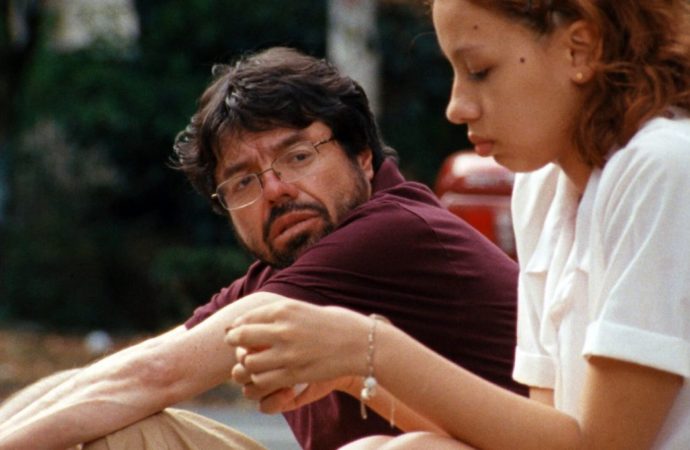

A Poet, which premiered in the Un Certain Regard section of the latest Cannes Film Festival, where it won the Jury Prize, marks another triumph for its director, Simón Mesa Soto, confirming him as one of the most distinctive voices in contemporary Latin American cinema. He is no stranger to the Croisette: after winning the Palme d’Or for Best Short Film with Leidi in 2014 and gaining recognition at Critics’ Week with Amparo (2021), his new film once again consolidates a vision that oscillates between the harsh and the deeply human. Since its premiere, the film has been selected as Colombia’s submission to the Academy Awards and was also nominated for Best International Film at the Spirit Awards.
At the center of the narrative is Óscar Restrepo (Ubeimar Ríos), a poet in Medellín who embodies, with precision, the absurd in the Camusian sense: the conflict between the human desire for meaning and a world that responds with indifference. Óscar does not fit in, does not produce, does not move forward. He lives trapped in economic precarity, the result of his stubbornness and blind faith in a talent he has long ceased to cultivate, rejecting a teaching job because he sees it as a betrayal of his vocation. Only necessity, and a daughter he has failed to care for, ultimately forces him to give in. Yet even that gesture is tainted by the inertia of failure, from which he seems to derive a perverse sense of identity.
The character constantly borders on caricature: disheveled, awkward, inhabiting a body that seems unable to find its place in space, Óscar clings to the idea of the misunderstood genius. But Simón Mesa Soto never lets him fall—nor does he redeem him. He never abandons him, accompanying his descent with a lucidity that is deeply moving. The poet compares himself to José Asunción Silva, whom he considers unfairly overshadowed by Gabriel García Márquez, in a discourse that reveals both sharpness and self-deception. He has not published since the age of twenty-five, yet continues to inhabit a narrative of greatness that the world refuses to validate. The film’s greatest achievement lies in turning this uncomfortable figure into someone profoundly believable.
The turning point arrives with Yurlady (Rebeca Andrade), a young student with unusual poetic talent. In her, Óscar invests an unexpected generosity, a mentoring impulse that contrasts sharply with his own inability to escape stagnation. Their relationship is one of the film’s greatest strengths: far from paternalistic, it unfolds as an inverted mirror in which her maturity, intuition, and determination expose his fragility and drift. The fact that neither performer is a professional actor only heightens the authenticity of their performances, marked by a striking naturalness.
A Poet renders a deeply honest portrait of a man who, unable to inhabit the world, turns his failure into his only way of being in it.
Structured in four parts and shot on grainy 16mm by cinematographer Juan Sarmiento, the film constructs a visual universe fully aligned with its subject: a dim, almost suspended Medellín, where Óscar’s life unfolds without the possibility of redemption. Comedy and tragedy coexist without emphasis; the mere act of observation is unsettling enough. The protagonist’s precarity is neither aestheticized nor justified—it simply exists, repeats, and deepens.
In parallel, Yurlady’s rise introduces a line of contrast that the director uses to articulate a subtle yet incisive critique of the cultural system: festivals, readings, circuits where talent begins to function as currency. Against this emerging recognition, the figure of the failed poet acquires an almost ethical dimension, as if his inability to integrate into such a system were itself a form of resistance—even if it stems more from personal sabotage than conscious choice.
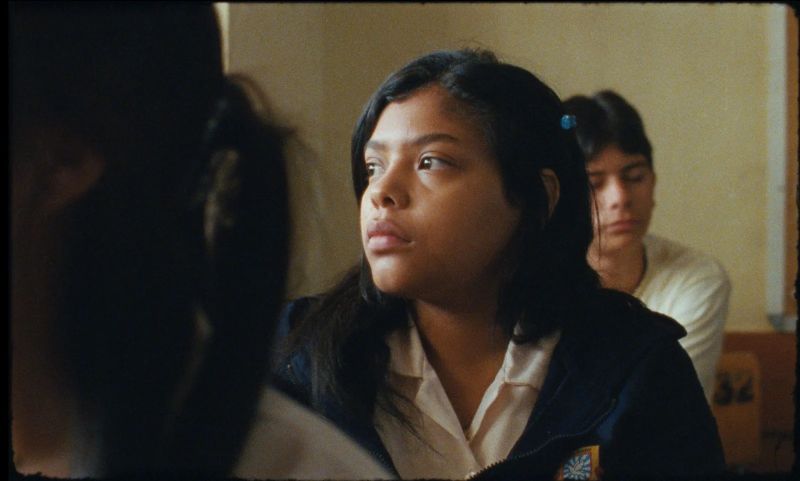
A Poet offers neither redemption nor consolation, there is no hope. Even when a possibility of meaning appears through the relationship with Yurlady, Óscar’s life remains stuck, trapped in a logic where creativity and misery seem inseparable. The film finds its strength in refusing to resolve the irresolvable, in accepting that some lives do not progress, do not transform, but simply endure.
Between initial repulsion and the tenderness that ultimately prevails, the film renders a deeply honest portrait of a man who, unable to inhabit the world, turns his failure into his only way of being in it.

Nadie ha publicado ningún comentario aún. ¡Se tú la primera persona!