
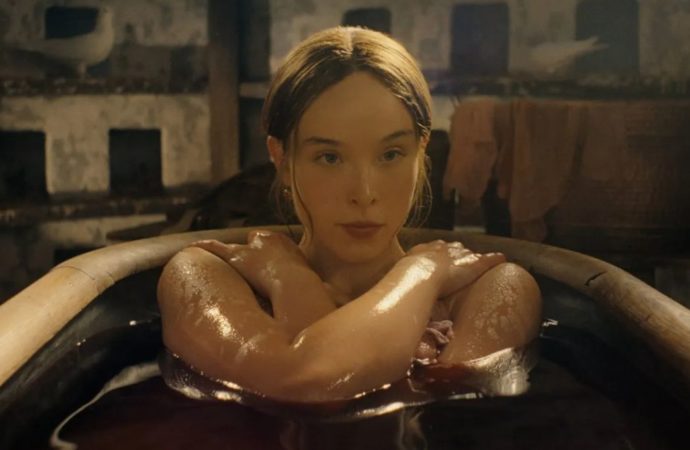
More than 130 years after Andrew and Abby Borden were found brutally murdered in their home in Fall River, Massachusetts, Lizzie Borden continues to occupy a prominent place in the American criminal imagination. She was charged and subsequently acquitted, but the justice system never managed to erase public suspicion. Her story survived, becoming legend, a children’s rhyme, the subject of books and films, and an inexhaustible source of true crime fascination.
Now, Monster: The Lizzie Borden Story, released on Netflix on 17 September, returns to the case from a very specific perspective: an attempt to understand the forces capable of turning a person into what society ultimately calls a monster.
During the series’ international press conference, its creator and showrunner, Ian Brennan, was far less ambiguous than the judicial record: he believes Lizzie did it. “I could be wrong, but it’s definitely what I think,” he acknowledged. The series considers different possibilities, but Brennan believes that a screenwriter must examine what remains in the historical record and, at some point, make choices. For him, reconstructing those blank spaces is not a betrayal of the facts, but an inevitable condition of any narrative about the past.
Women in Cages
The key to this new season, however, does not lie solely with Lizzie Borden. The series establishes connections with two other women separated by centuries: Elizabeth Báthory and Aileen Wuornos.
Ian Brennan found the same common thread running through all three: social repression. Women trapped in different kinds of “cages”, whose resentment ultimately turns into violence. For Max Winkler, director and executive producer, that concept was present from the very beginning. The expression he uses to define the series is unequivocal: female rage.
The issue takes on a more complex dimension: Monster presents oppression as a moral absolution for its characters. What it seeks to explore is the way certain social, familial and emotional structures contribute to the production of violence.
Rebecca Hall, who plays Abby Borden, extends this idea even to the character destined to become a victim. Abby is part of the oppressive system surrounding Lizzie, yet at the same time she is herself subject to many of the restrictions imposed on women of her era. For Hall, there is no contradiction: there is causality. Abby, too, is the product of a particular form of oppression; she simply channels her frustration into sadism. The violence changes direction, but it emerges from a similar emotional territory.
Actor Charlie Hunnam even finds something of that imprisonment in Andrew Borden, whom he plays. After portraying the protagonist of the previous instalment of Monster, devoted to Ed Gein, Hunnam now moves to the other side of the crime: he plays a victim. Albeit with some important qualifications. “I wouldn’t say Andrew is particularly innocent,” he admits.
The actor sees him as capable of monstrous behaviour, but also found a certain tenderness in him: a man trapped in a cage of his own making, marked by grief and by a life incapable of bringing him happiness. The result is a character who directs his frustration and rage towards those around him. The boundary between monsters and victims is thus blurred once again.
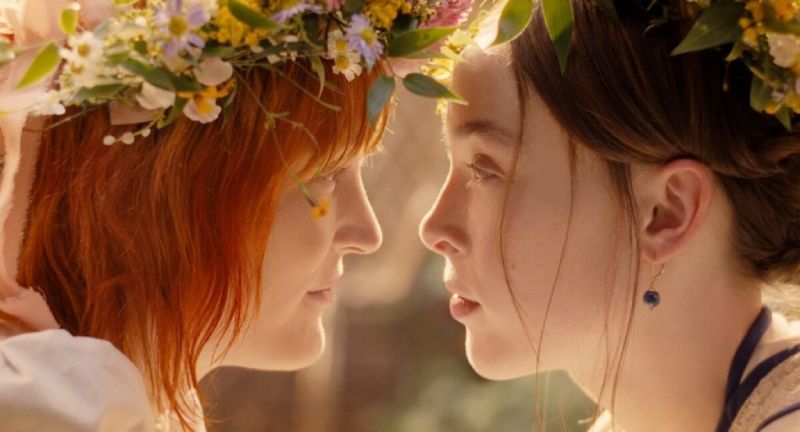
Ella Beatty and Vicky Krieps in Monster: The Lizzie Borden Story.
Building Lizzie Borden
Ella Beatty —a breakout actress and the daughter of Warren Beatty and Annette Bening— approached the character through a combination of research and invention. She read The Trial of Lizzie Borden, but soon had to decide how much of the woman who would appear on screen would come from the known facts and how much would be dramatic creation. Working with movement specialist Julia Crockett, she set about translating biographical details into physical traits: how Lizzie walks, how she listens, how she breathes, how she holds herself.
“How does this person dream?” Beatty recalls asking herself. Fear was also part of the process. She acknowledges that taking on a character who has occupied a place in American mythology for more than a century was intimidating. Her response was simple: to do it while afraid.
Rebecca Hall took almost the opposite approach. Faced with the scarcity of information about Abby Borden, she decided not to do any research. She wanted to preserve the freedom to make the character her own, allowing herself to make Abby strange, excessive and unpredictable.
The paradox encapsulates one of the fundamental challenges of Monster: when historical records are insufficient to reconstruct a person, fiction must inevitably occupy the space they leave empty.
.
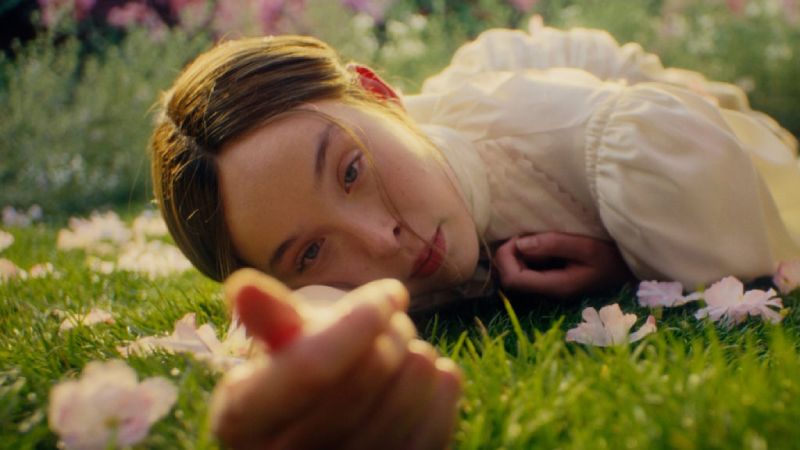
Ella Beatty in Monster: The Lizzie Borden Story.
A 19th Century That Doesn’t Smell of Dust
Formally, too, Brennan and Winkler wanted to avoid the stiffness associated with certain period recreations. Brennan sums it up with a particularly vivid image: he did not want the series to feel stuffy and mildewy.
His approach was to study Victorian vocabulary and use it as a constraint within which to retain a contemporary style of writing—sharp, irreverent and full of humour. The result allows even domestic insults to acquire an unexpected comic edge.
Music serves a similar purpose. The series uses contemporary songs within its historical setting, although Winkler acknowledges the risk: done badly, it can feel like an overly obvious attempt to appeal to modern audiences.
A song by Kate Bush ultimately provided the key to finding the tone of the pilot episode. Subsequent musical choices were structured around desire and longing, particularly those of people rebelling against the conventions of their time.
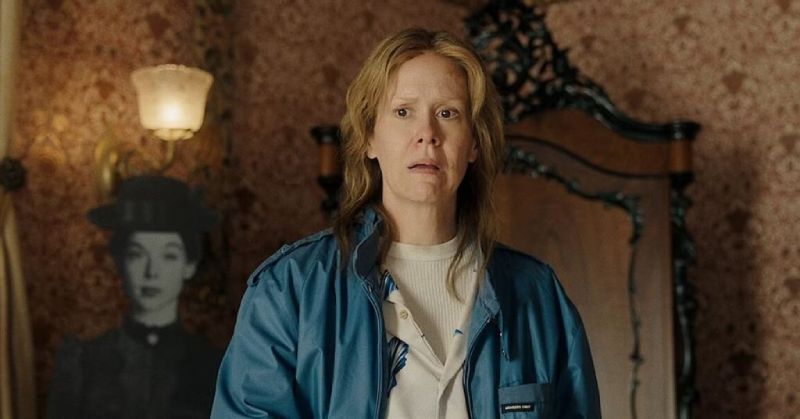
Sarah Paulson in Monster: The Lizzie Borden Story.
Visually, Winkler also looked to other films for inspiration. Among his references, he cites The Heiress, The Age of Innocence, The Red Shoes, and the films of Powell and Pressburger. Yet the humour in the script prevented Monster from simply reproducing the conventions of period melodrama. The challenge lay precisely in bringing together emotion, violence, fear, trauma and a surprisingly persistent comic streak.
Why Does a Woman Who Kills Unsettle Us?
Perhaps the most revealing question at the press conference was also the one that transcended the Borden case: why does violence committed by women continue to exert such a particular fascination?
Ella Beatty believes that part of this fascination stems from the desire to understand why. Violence and femininity remain concepts that, culturally, we do not associate as readily as violence and masculinity. It is precisely this friction that turns figures such as Lizzie into subjects of psychological inquiry.
Winkler takes the reflection further. The traditional image of women as mothers, caregivers, homemakers and sources of security turns female violence into a kind of betrayal of the cultural expectations placed upon them. Failing to see a woman as a complete human being, capable of rage and violence too, is itself a form of reduction.
Monster: The Lizzie Borden Story attempts to look inside the cage once again.
Ian Brennan puts it in even more elemental terms: all human beings are capable of killing; the difference is that some of us do not. That is the essence of Monster. It is not about determining Lizzie Borden’s guilt or innocence, but about asking why we need to turn certain criminals into exceptional creatures in order to keep them at a comfortable distance from ourselves.
Once the episodes had been written, Brennan even discovered unexpected parallels with another story already explored by the anthology: that of the Menendez brothers. Families marked by years of unhappiness, contradictory accounts and enormous gaps between what happened and what can later be proven.
For the creator, simply reproducing the established facts would not solve that problem either. The cases of Lizzie Borden and Ed Gein are elliptical narratives, filled with unknowns. “The only way to approach these stories honestly,” Brennan argues, is precisely to try to fill in those gaps.
The paradox is considerable: to move closer to a possible truth, one must resort to fiction. Lizzie Borden died almost a century ago, yet there can be little doubt about her cultural survival. The mystery remains. Somewhere between reality and imagination, culture created a monster.

Nadie ha publicado ningún comentario aún. ¡Se tú la primera persona!