




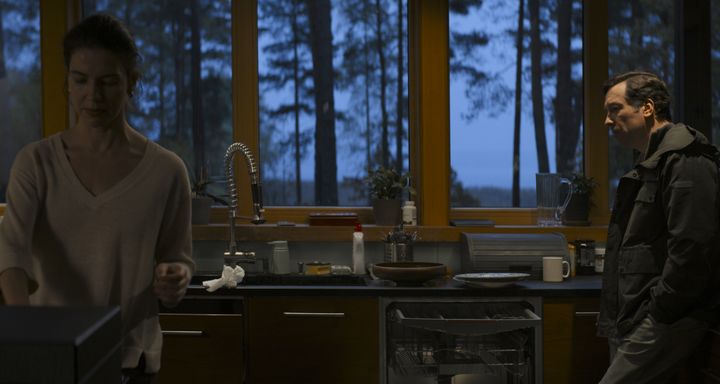
The protagonist is Gleb (Dmitriy Mazurov), the owner of a thriving transport company, married to Galina (Iris Lebedeva), whose emotional dissatisfaction has led her into an affair with the young photographer Anton (Yuriy Zavalnyouk). Alongside them is Seryozha (Boris Kudrin), the couple’s teenage son and the potential heir to a world built on privilege, favours and structural violence. From its opening scenes, the film sketches a society whose rules are designed to benefit those already occupying the top of the pyramid.
The war in Ukraine never stands at the centre of the narrative, yet its presence is constant throughout. Forced conscription, administrative corruption, the arbitrariness of authority and the vulnerability of ordinary citizens permeate the entire story. The title therefore acquires a particularly revealing dimension. According to Greek mythology, Athens was required to periodically send fourteen young people to the Minotaur as an expiatory sacrifice. In the film, the local municipality demands that Gleb’s company provide fourteen recruits for the war effort. As befits a man accustomed to manipulating the rules to his own advantage, he quickly devises a way to meet the quota without sacrificing any of his own employees. The sacrifice is always someone else’s.
The analogy works with devastating precision. The Minotaur here is not a creature trapped inside a labyrinth, but an entire system built upon the sacrificial logic of power. Businessmen protected by their political connections function as modern feudal lords in a Russia where democratic institutions have been replaced by networks of influence, patronage and obedience. Wealth depends on proximity to power, and survival depends on the usefulness each individual has for those who rule.
Zvyagintsev portrays this ecosystem with the clinical precision that characterises his entire filmography. Across the screen pass desperate wives, young lovers destined to replace the previous wives, easily corruptible policemen, disposable employees and protective mothers trapped within a social order that leaves them little room for agency. Women continue to be defined primarily through their relationships to men — fathers, husbands, employers and sons — while men are defined by their ability to exercise power over others.
Minotaur is a bitter parable about who today’s monsters are, and who continues to be delivered into the labyrinth.
Gleb is arguably one of the most unsettling creations in Zvyagintsev’s recent cinema. He is neither an obvious monster nor a caricatured villain. His authority stems from an absolute conviction that he deserves the position he occupies. He holds excellent cards in the economy of favours, can indirectly determine who lives and who dies, manages to keep hold of his wife despite everything, and passes on to his son the idea that power renders certain individuals virtually untouchable. Bullying wrapped in expensive suits becomes both a philosophy and a way of life.
As a thriller, Minotaur unfolds with admirable restraint. Nothing feels rushed. Every revelation arrives precisely when it should. Every tension is allowed to develop at its proper pace. The intimate scenes between Gleb and Galina—minimalist boudoir conversations—gradually reveal her emotional exhaustion and his stubborn refusal to accept loss on any of the many chessboards on which he conducts his personal battles. The crime of passion functions less as a narrative trigger than as a symptom of a far deeper moral sickness.
The screenplay, co-written with Simon Lyashenko, finds an exceptional ally in the cinematography of Mikhail Krichman, Zvyagintsev’s long-time collaborator. The visual coherence is remarkable. The colour palette, the elegant interiors, the emotionally distant atmosphere and the extraordinary precision of the shot design transform every frame into an extension of the film’s moral narrative. Rarely does visual composition seem so closely intertwined with the power relationships the story depicts. Spaces constantly magnify those who dominate while diminishing those who depend on them.
And then comes the final image. Crete emerges beneath a vast ocean of clouds. It is, in the literal sense, the warrior’s resting place, but also the metaphorical battlefield where contemporary sacrifices continue to be made. As in Zvyagintsev’s finest films, the specific story gradually opens onto a broader reflection on the human condition, moral responsibility and the invisible structures that organise our societies.
With Minotaur, Andrey Zvyagintsev returns precisely to the territory he left behind: observing how power transforms human relationships and how modern societies continue to require sacrificial victims to sustain their privileges. It is a precise, elegant and deeply political thriller, but above all a bitter parable about who today’s monsters are—and who continues to be delivered into the labyrinth.

Nadie ha publicado ningún comentario aún. ¡Se tú la primera persona!