
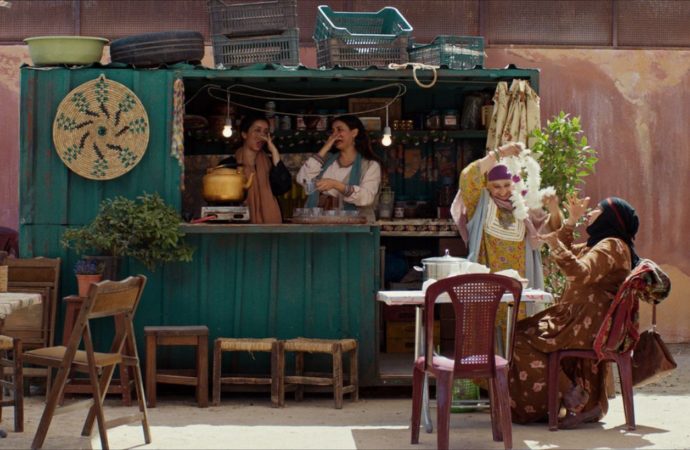

In The Station (Al Mahatta, 2026), Yemeni-Scottish director Sara Ishaq constructs a strange oasis of female resistance amid the devastation of the Yemeni civil war. Presented in the Semaine de la Critique at the 79th Festival de Cannes, the film transforms a women-only petrol station into something far beyond a physical space: a fragile territory of freedom, care, and emotional survival within a country where violence has colonized even everyday life.
Shot in Jordan due to the security risks and practical difficulties of filming in a country still ravaged by war, The Station, co-written by the director alongside Nadia Eliewat, is inspired by real events and continues Ishaq’s commitment to portraying Yemen through a complexity rarely visible in the West. The filmmaker had already explored the consequences of the conflict in her documentaries Karama Has No Walls —nominated for both an Academy Award and a BAFTA— and The Mulberry House, but here she turns to fiction in order to find, in her own words, a creative freedom that would allow her to protect the real people who inspired the story.
The Station reveals the intimate strategies of resistance women develop in order to continue existing within disaster.
The result is a film concerned less with war itself than with its invisible consequences: the fragmentation of families, the militarization of childhood, the permanence of fear, and, above all, the intimate strategies of resistance women develop to continue existing within disaster.
Layal runs a petrol station where the rules are simple: no men, no weapons, no politics. That small enclave becomes an improvised refuge for women who come not only for fuel for their generators and cars, but also to breathe, talk, “go shopping,” or simply exist away from male surveillance. Every morning, the station is transformed almost clandestinely into an open-air salon where tea, secret shisha sessions, and confidences circulate freely. In the middle of a destroyed country, Ishaq imagines a small female utopia sustained through everyday complicity.
The film thus acquires an unexpectedly warm, even humorous dimension. A declared admirer of Elia Suleiman, Ishaq introduces touches of absurdity and a delicately burlesque humour that soften — without ever neutralizing — the harshness of the situation. At times, the tone recalls Bagdad Café: a border-space suspended outside time, where wounded characters, still capable of redemption, attempt to reconstruct fragile forms of community while collapse continues all around them.
Yet beneath that appearance of suspended refuge, the threat remains constant. Yemen, fractured by civil war, has also separated the two sisters at the centre of the story after the death of another brother. Together, they now try to save the youngest member of the family, still a child, from forced recruitment. From the age of twelve onward, avoiding military enlistment requires paying an exemption fee beyond the reach of most families. Each sister confronts that struggle from opposing positions: one through direct activism and confrontation; the other through care, attempting to preserve an emotional bubble within the horror.
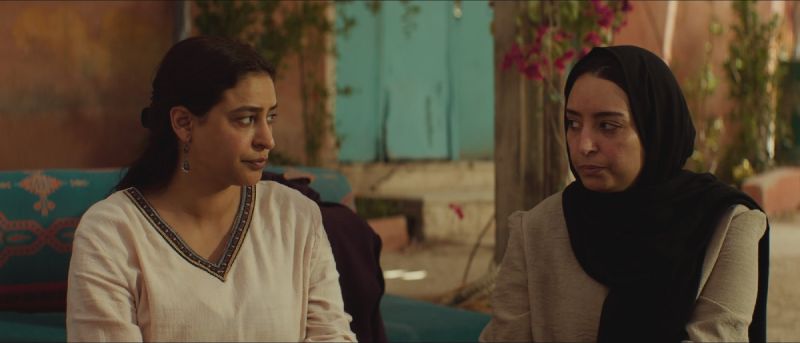
The movement through military checkpoints, the desperate negotiations, and the small acts of cunning required to protect the boy ultimately reveal not only the contrasting personalities of the two sisters, but also the ways in which women must constantly reinvent forms of survival within authoritarian and deeply violent structures.
As for the cast, Ishaq combines experienced performers with non-professional actors from Yemen, Egypt, and Jordan —including Manal Al-Mulaiki, Abeer Mohammed, Rashad Khaled, Saleh Al-Marshahi, Fariha Hassan, and Amal Esmail— seeking precisely the mixture of spontaneity and everyday humanity that runs throughout the film. The camera observes its characters with a warm proximity, carefully avoiding any exoticization of tragedy. As the director herself has explained, she wanted “to show Yemenis as complex and dignified human beings whose lives are full of culture, humour and love.” And therein lies perhaps the film’s greatest achievement: its refusal to reduce Yemen to a mere landscape of destruction.
The Station ultimately offers a deeply contradictory vision of a country where women and children seem condemned always to lose, yet where spaces of affection, desire, and solidarity still survive. With deliberately simplistic villains, a slightly unreal atmosphere, and moments of unexpected humour, the film constantly reminds us how cruel, absurd, and violent the world can be, even as it manages to make us smile.


Nadie ha publicado ningún comentario aún. ¡Se tú la primera persona!