

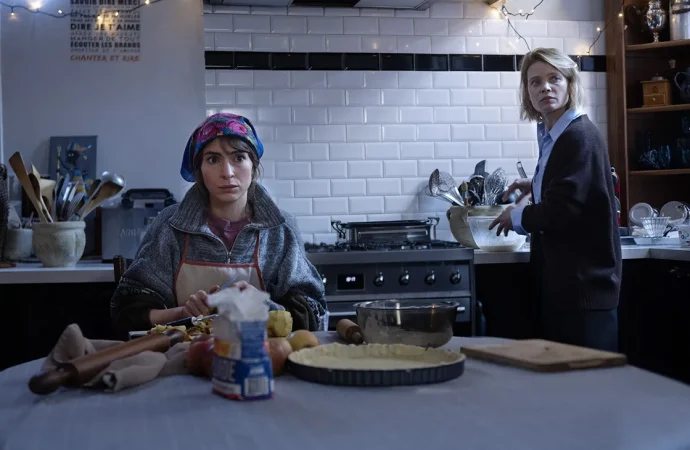

With Diary of a Chambermaid (Journal d’une femme de chambre), presented in the Directors’ Fortnight at the Festival de Cannes, Radu Jude once again proves himself to be one of the most lucid, free and creative — as well as prolific — European filmmakers working today. Freely adapting Le journal d’une femme de chambre by Octave Mirbeau, first published in 1900 and previously brought to the screen by Jean Renoir in 1946, Luis Buñuel in 1964 and Benoît Jacquot in 2015, Jude deliberately distances himself from the tradition of adaptation. During the Q&A following the premiere, he acknowledged that he preferred to regard Mirbeau’s work merely as a starting point and even admitted that he dislikes all the previous versions, despite the obvious points of contact between his own cinema and Buñuel’s. What attracted him was the novel’s expansive potential: the possibility for each story to open onto other stories, for every situation to unfold into new historical, political or cultural layers.
The film — the first shot in French by the Romanian director — functions precisely in this way: as the result of his desire to create a montage film in the most Eisensteinian sense of the term, where meaning emerges from the collision between heterogeneous materials. Jude once again deploys his distinctive ability to blend registers, formats and references, constantly moving between two spaces, two languages and two realities: between theatre and cinema, between France and Romania, between representation and exploitation, between the child of others whom she cares for and the daughter of her own whom she leaves behind.

The “chambermaid” is Gianina, a Romanian immigrant working as a live-in maid in Bordeaux for a bourgeois progressive intellectual couple — the inevitable French BoBos — played by Vincent Macaigne and Mélanie Thierry. Bordeaux is far from an innocent choice: a city marked by its slave-trading past, it functions as the perfect backdrop for this reflection on contemporary, sophisticated and apparently civilized forms of exploitation. Gianina cooks, cleans, looks after the family’s child and silently absorbs all the moral contradictions of her employers, who remain constantly willing to place their comfort and economic interests above any genuine ethical sensitivity.
Jude captures with devastating precision the slightly theatrical hypocrisy of Europe’s cultivated classes.
The film unfolds through deeply ambiguous relationships. The bond between Gianina and her employers constantly oscillates between apparent respect, latent hostility, paternalism and social contempt. Jude captures with devastating precision the slightly theatrical hypocrisy of Europe’s cultivated classes, capable of superficially admiring the popular culture of the other without truly accepting what it entails. One of the film’s most brilliant moments arises precisely when the family enthusiastically celebrates Gianina’s talent as a storyteller of traditional Romanian tales, until the story takes on a traumatic tone for young Louen and they ask her to change the ending. Folklore is acceptable as long as it remains domesticated and decorative, but the moment it reveals its violence or darkness, rejection immediately resurfaces.
Jude’s characteristic black humour finds an extraordinary vehicle in Vincent Macaigne. His dialogues with Gianina constantly reveal a class guilt incapable of transforming itself into genuine respect. Macaigne, an actor deeply associated with a certain intellectual and neurotic imaginary of contemporary French cinema, also brings an additional layer of meaning to the film. Jude knows the French cultural ecosystem perfectly and brilliantly, deliberately uses the cinematic memory attached to his performers: the presence of Marie Rivière inevitably evokes the young woman from Le Rayon vert (1986) by Éric Rohmer, while other characters and references gradually open connections to French colonial history, the intellectual left, the failure of the spirit of ’68 and Europe’s broader cultural inheritance.
Formally, the film once again demonstrates Jude’s extraordinary freedom as a filmmaker. After displaying radical versatility in technique and format across two films shot in the same year — taking visual risks in Dracula and adopting an apparently more classical form in Kontinental ’25 — the director here constructs a work that only appears traditional on the surface. The shots of Gianina working in the kitchen directly evoke Jeanne Dielman, 23 quai du Commerce, 1080 Bruxelles, while the theatrical device introduced in the second half pushes the film toward far more extreme territory.
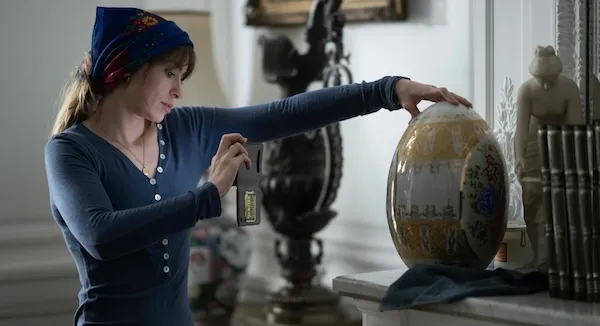
The university play prepared by the characters — a theatrical adaptation of Le Journal d’une femme de chambre performed by real immigrants — becomes one of the film’s fiercest achievements. Jude pushes artifice toward an extreme close to commedia dell’arte: beneath the appearance of progressive inclusivity, the performance reproduces exactly the same relations of exploitation it claims to denounce. The immigrants stylistically perform their own condition before a bourgeoisie that consumes political consciousness as part of its cultural capital.
The art direction is equally brilliant. Every detail of the bourgeois mansion — the display cabinets overflowing with antiques, the dinners with friends, the exaggerated Christmas decorations, the accumulation of objects inherited over generations — functions as a satirical commentary on a social class obsessed with appearing modern, ethical and open-minded while continuing to sustain itself upon deeply intact structural privileges.
Alongside Vincent Macaigne and Mélanie Thierry, special mention must also go to Ana Dumitrescu and the extraordinary Ilinca Manolache, already unforgettable in Do Not Expect Too Much from the End of the World.
With Diary of a Chambermaid, Radu Jude once again shines by using irony, collage, black humour and social satire to dismantle the moral fictions of contemporary Europe and speak about precarious labour, migration, exploitation, class guilt and cultural representation, but also about the impossibility of truly reconciling privilege with a clear conscience.




Nadie ha publicado ningún comentario aún. ¡Se tú la primera persona!