

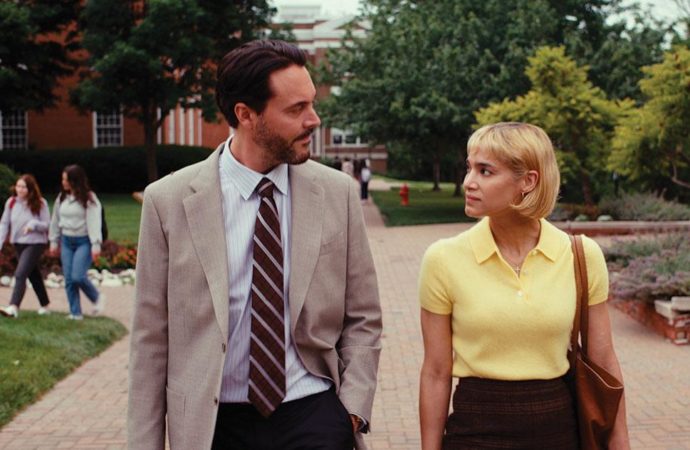

Paul Schrader proves to be at the top of his game with The Basics of Philosophy, a moral tale as fluid as it is profound, in which Jack Huston plays a philosophy professor forced to confront something that no system of thought can resolve for him.
For more than half a century, Paul Schrader has been trapping men within themselves, placing them in different rooms, changing their professions and their forms of atonement, while one question has persisted throughout his filmography: what does a man do with the part of himself he cannot bear? In The Basics of Philosophy, presented in Venice Open Out of Competition at the 83rd Venice Film Festival, that man is John Jorissen (Jack Huston), a philosophy professor at a small liberal arts college in the American Midwest.
He is writing a book on Spinoza, shares his life with Becca (Sofia Boutella), a fellow professor, and her adolescent son, and possesses, at least on the surface, all the intellectual tools necessary to examine a life. Except, perhaps, the ability to confront his own with complete honesty.
Schrader has described The Basics of Philosophy as an exploration of transgressive behaviour and the “architecture of conscience”.
The death of his father, Melvyn (Bill Pullman), and the appearance of Miguel (Daniel Zovatto), a figure from a past that Jorissen believed safely sealed away, open a crack in this orderly existence. We need know little more. Schrader dispenses information with precision, turning what happened into something more interesting than a secret waiting to be revealed: material through which to observe the strategies we develop to keep living in the aftermath of our own actions.
Philosophy as Refuge
This time, Schrader finds in a philosophy professor a new and particularly compelling incarnation of his recurring protagonist. His characters have traditionally sought some form of discipline to impose order on their inner chaos: religion, manual labour, routines, writing. Jorissen has something even more tempting at his disposal: a system of thought through which to interpret the world and, by extension, himself.
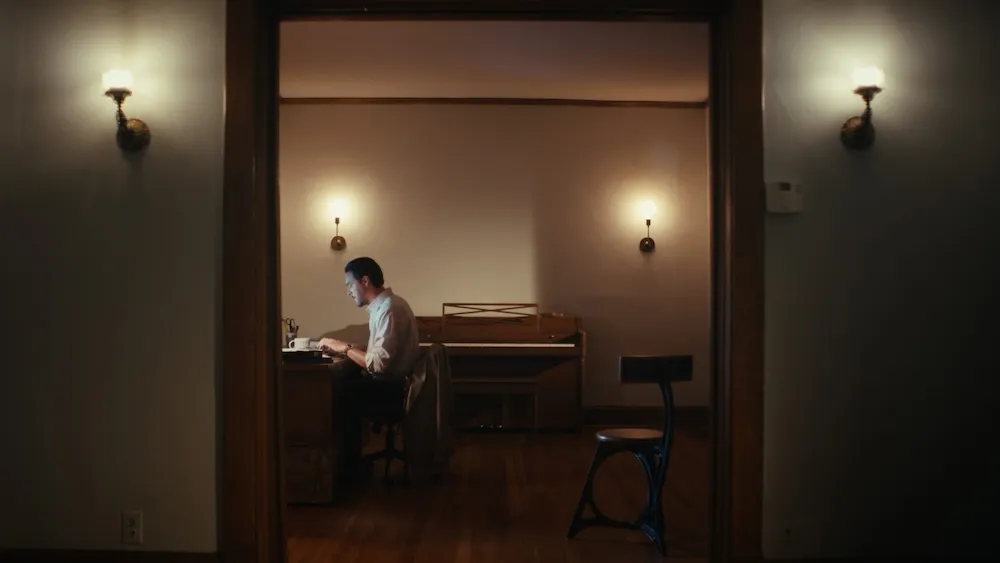
However, understanding the mechanisms of conscience does not necessarily mean obeying them. From there, the screenwriter of Taxi Driver forces us to confront an even more crucial question: does intelligence bring us closer to the truth, or can it provide us with increasingly sophisticated arguments for keeping it at a distance?
Spinoza thus takes on a function that goes far beyond lending the character intellectual prestige. Jorissen is working on a philosopher who questions free will and rejects the idea of a personal God who judges, punishes and forgives. For someone tormented by responsibility for his own actions, this hardly seems an innocent choice.
Schrader knows the other side of this conflict well. From the outset, his cinema has been permeated by his Calvinist upbringing and by concepts such as sin, guilt, punishment and redemption. Setting this religious foundation against Spinoza’s rationalism allows The Basics of Philosophy to pose its moral question without having to resolve it. If there is no higher authority capable of absolving us, what do we do with that which we cannot forgive in ourselves?
Schrader at the Top of His Game
Most remarkable is that all this conceptual density does not, fortunately, turn the film into a treatise. At this stage in his career, Paul Schrader — whose creative energy and intellectual curiosity have not diminished in the slightest — has no need to overemphasise what he already masters, and The Basics of Philosophy moves with an agility that never comes at the expense of the depth of the questions it raises.

The successive twists in the screenplay alter our perception of Jorissen and those around him without turning the film into a suspense mechanism or exposing its narrative scaffolding. Information arrives precisely when it should, and the story flows with surprising naturalness within a pared-down style, almost entirely free of digressions or ornament.
This economy is particularly effective because Schrader is working with material that could easily have become overly discursive. There is philosophy, guilt, desire, self-deception and moral responsibility, yet the film never stops to turn them into a thesis. Instead, it allows them to circulate through the characters. Depth never slows the narrative, nor do the twists trivialise its complexity, because both move forward simultaneously.
Jack Huston also understands that Jorissen does not need to externalise his conflict at every turn. He builds the character through restraint, allowing academic respectability and intelligence to coexist with an opacity that becomes increasingly intriguing. Sofia Boutella provides the necessary counterpoint to this withdrawal, while Daniel Zovatto’s presence introduces something that no amount of reasoning can neutralise: the existence of the other. Bill Pullman, as Jorissen’s father, completes a structure in which the family past is equally bound up with the forms of silence the film interrogates without passing judgement.
The Architecture of Conscience
Schrader has described The Basics of Philosophy as an exploration of transgressive behaviour and the “architecture of conscience”. The phrase is particularly apt for a character who seems to have constructed his own through watertight compartments: profession, relationship, family, past. The problem begins when the walls separating them cease to be impermeable.

Schrader once again asks whether transformation is possible. Not simply whether a man deserves to be forgiven, but whether someone can truly become different from who he once was. The distinction is substantial. Forgiveness can come from another person; change requires, in some way, breaking the continuity with oneself.
After decades of exploring variations on the same male archetype, the director himself has evolved. He no longer needs to reinvent it through excess, but rather to refine it. Jorissen belongs unmistakably to his universe and yet never feels like the mechanical repetition of an earlier character; instead, he embodies one of the virtues of Schrader’s late-period cinema.
That is why, in the narrative precision of The Basics of Philosophy, in its fluidity and in the way each new revelation is carefully introduced, we sense the confidence of a filmmaker who knows his obsessions intimately and still finds new ways to put them to the test.
Philosophy may offer Jorissen arguments with which to explain the world, and even to explain himself, but Schrader leaves us with a reflection that ultimately belongs to the realm of ethics: understanding perfectly what we have done does not necessarily make us better people.




Nadie ha publicado ningún comentario aún. ¡Se tú la primera persona!