

The 2026 edition of the Festival de Cannes opens on May 12 with La Vénus Électrique, directed by Pierre Salvadori, written by Robin Campillo, and starring Pio Marmaï and Anaïs Demoustier, launching a program that, through May 23, reveals — beyond names and numbers — a clear shift in the geopolitical balance of contemporary cinema.
A New Balance in the Global Film Landscape
In an international context shaped by the policies of major American studios — increasingly focused on awards-season strategies centered around the Oscars — Cannes reasserts its position as the epicenter of a cinema that now finds in Europe, and particularly in France, a privileged space for production and co-production.
That shift is reflected in an Official Competition, with only five women directors selected, overwhelmingly dominated by Europe. Of the 22 feature films in competition, 16 come from the continent. Spain contributes four names —Pedro Almodóvar, Rodrigo Sorogoyen, and the duo Javier Ambrossi–Javier Calvo— while France further consolidates its weight with five filmmakers. They are joined by directors from Germany, Romania, Hungary, Poland, Austria, Belgium, and Russia, shaping a competition map clearly tilted toward the old continent.
Against this European dominance, international representation appears more limited: Asia is represented by five filmmakers — including Asghar Farhadi, Hirokazu Kore-eda, and Ryusuke Hamaguchi, while North America is reduced to the presence of Ira Sachs.
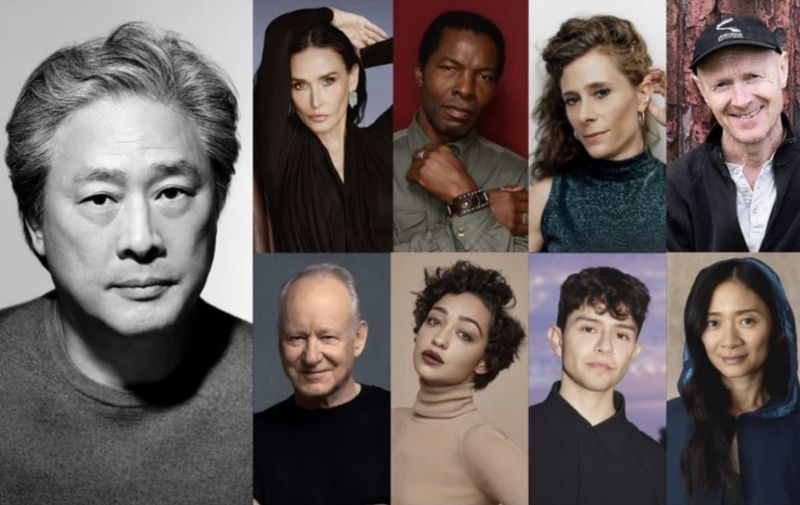
Park Chan-wook, Demi Moore, Isaach De Bankolé, Laura Wandel, Paul Laverty, Stellan Skarsgård , Ruth Negga, Diego Céspedes and Chloé Zhao (© Festival de Cannes).
Cannes Film Festival
Parallel Sections and the Festival’s Commitment
Cannes Film Festival
This selection, drawn from 2,541 feature films submitted from 141 countries, reflects — as every year — a clear curatorial stance. As festival delegates Thierry Frémaux and Iris Knobloch emphasized, the commitment to theatrical exhibition, diversity, and creative freedom has become more necessary than ever in “a world that is growing darker and losing its bearings.” Cannes responds to that challenge by defending its identity: a space where cinema is not merely screened, but also questioned, reconfigured, and ultimately resisted. Yet the proliferation of side parties, charity galas organized by foundations, and the increasingly aggressive trade in invitations to gala screenings — complete with makeup, limousines, and exclusive parties — continues to reshape that sanctuary of cinema in another direction, turning it ever more into an opportunistic showcase where films, and above all film critics themselves, risk becoming little more than décor.
79th Festival de Cannes Official Selection
Competition
Amarga Navidad – Pedro Almodóvar
La bola negra – Javier Ambrossi, Javier Calvo
La Vie d’une femme – Charline Bourgeois-Tacquet
Coward – Lukas Dhont
Histoires parallèles – Asghar Farhadi
Nagi Notes – Koji Fukada
Paper Tiger – James Gray
The Dreamed Adventure – Valeska Grisebach
All of a Sudden – Ryusuke Hamaguchi
L’Inconnue – Arthur Harari
Garance – Jeanne Herry
Hope – Na Hong-jin
Sheep in the Box – Hirokazu Kore-eda
Gentle Monster -Marie Kreutzer
Notre salut – Emmanuel Marre
Fjörd – Cristian Mungiu
Histoires de la nuit -Léa Mysius
Moulin – László Nemes
Fatherland – Pawel Pawlikowski
The Man I Love – Ira Sachs
El ser querido – Rodrigo Sorogoyen
Minotaur -Andrey Zvyagintsev
Un Certain Regard
Teenage Sex and Death at Camp Miasma – Jane Schoenbrun (opening film)
Elephants in the Fog – Abinash Bikram Shah
Le corset – Louis Clichy
Ben’Imana – Marie-Clémentine Dusabejambo
Congo Boy – Rafiki Fariala
Club Kid – Jordan Firstman
Memoria de chica – Judith Godrèche
Ulya – Viesturs Kairišs
Titanic Ocean – Konstantina Kotzamani
La más dulce – Laïla Marrakchi
El deshielo – Manuela Martelli
Ulysse -Laetitia Masson (closing film)
Siempre soy tu animal materno – Valentina Maurel
Yesterday the Eye Didn’t Sleep – Rakan Mayasi
I’ll Be Gone in June – Katharina Rivilis
Quelques mots d’amour – Rudi Rosenberg
Victorian Psycho – Zachary Wigon
Everytime – Sandra Wollner
All the Lovers in the Night – Sode Yukiko
Cannes Première
La Troisième Nuit -Daniel Auteuil
The Match – Juan Cabral, Santiago Franco
Marie Madeleine – Gessica Généus
Aqui – Tiago Guedes
Orange-flavoured Wedding – Christophe Honoré
Kokurojo: The Samurai and the Prisoner – Kiyoshi Kurosawa
The End of It – Maria Martínez Bayona
Si tu penses bien – Géraldine Nakache
Visitation – Volker Schlöndorff
Propeller One-Way Night Coach – John Travolta
Out of Competition
La Vénus Électrique – Pierre Salvadori (opening film)
De Gaulle: L’Âge de Fer – Antonin Baudry
Karma – Guillaume Canet
Diamond – Andy Garcia
L’Abandon – Vincent Garenq
L’Objet du délit – Agnès Jaoui
Her Private Hell – Nicolas Winding Refn
Midnight Screenings
Full Phil – Quentin Dupieux
Sanguine – Marion Le Corroller
Roma Elastica – Bertrand Mandico
Jim Queen – Marco Nguyen, Nicolas Athané
Colony – Yeon Sang-ho

Nadie ha publicado ningún comentario aún. ¡Se tú la primera persona!