




Oppenheim sets the action at a particularly significant moment: immediately before the arrival of the iPhone and the gradual disappearance of so-called appointment television, when gathering millions of viewers in front of their televisions at a specific time still conferred extraordinary power.
There is no need, however, to be familiar with the original programme to enter the world of Primetime. Although To Catch a Predator belongs to a distinctly American television context, its mechanism is immediately recognisable: reality TV, public humiliation, the promise of access to something forbidden and, above all, the transformation of justice into spectacle. What begins as a warning about a real danger inevitably becomes subject to the rules governing any successful television product: if it works, it has to be repeated; and if it is repeated, each new instalment has to offer something more than the one before it.

Reality as Spectacle
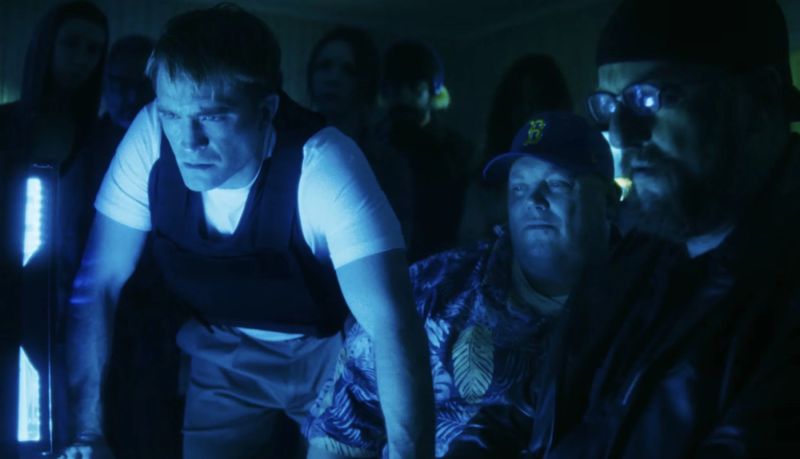
Oppenheim understands that a film about this kind of television could hardly adopt a conventional form. Primetime is constructed as a visually saturated, hyperactive and increasingly hallucinatory object, a kind of intensely coloured nightmare in which the boundaries between information, representation and entertainment begin to blur. The director himself describes the film as more of a fever dream than a biopic, and acknowledges his interest in blending reality and fiction in the same way that the programme used fake houses, decoys and staged devices to produce entirely real consequences.
The choice is consistent with what the film is trying to convey, but that consistency does not prevent it from ultimately becoming exhausting. As was the case with Danny Boyle’s Ink, the film ends up formally reproducing the very mechanism it seeks to analyse: the need to keep the viewer permanently stimulated. The camera, editing and accumulation of stimuli effectively convey the excitement of a television machine that needs to surpass the impact of the previous week, but the device loses force precisely through repetition.
The film becomes more interesting when Oppenheim momentarily turns his attention away from Hansen and observes those involved in that machinery, because Primetime is not solely the story of its presenter. The other characters have conflicts of their own and begin to question what parts of themselves they are sacrificing to keep the spectacle alive.
The producer (Merritt Wever) must decide how long she is willing to remain in a job where she feels her contribution is not being recognised. More significant still is the figure of Decoy Dan (Skyler Gisondo), forced to adapt emotionally to a rather unusual job: playing a minor in order to serve as bait for men who believe they are arranging a sexual encounter with a child. It is hardly surprising that Oppenheim and screenwriter Ajon Singh ultimately came to regard the relationship between Chris and Dan as the true heart of the film.
Robert Pattinson Becomes Chris Hansen
Pattinson constructs an openly histrionic Hansen, with little room for nuance, but manages to sustain a performance that could easily have slipped into caricature. The actor spent hours studying the real presenter’s appearances in order to reproduce his distinctive voice and mannerisms, while Oppenheim ultimately filmed him almost as though he were still working with one of the subjects of his documentaries, adapting the staging to what Pattinson was doing in front of the camera.
There is also something particularly fitting about turning Hansen into a character who is constantly performing himself. The journalist sets out to combat an unequivocal evil, but at the same time he has to make television. And the more successful the programme becomes, the harder it is to determine where the journalist ends and the performer begins.
This is where one of the more problematic aspects of Primetime emerges. The film constantly engages with what people need to conceal and with the power acquired by whoever manages to uncover it. Paedophilia can lead to public punishment; infidelity, to blackmail. These are transgressions of radically different natures and degrees of seriousness, yet the film places them within the same logic of secrecy, exposure and threat without always establishing clearly enough the moral distance that separates them.
The contradiction is significant because Hansen constructs his world precisely around rigid categories: innocent and guilty, victims and monsters. The film seeks to problematise these binaries — the very conception of the character ultimately begins to erode them — but at times it seems to become trapped within them.
“We’ll Use That”
It is the unexpected and tragic ending that takes this logic to its ultimate conclusion. What has happened could bring the machinery to a halt, impose silence, perhaps even force those responsible to reconsider what the programme has become. But the reaction is different: “We’ll use that.”
There is no great reflection afterwards, nor does one seem necessary. The phrase serves as the culmination of everything that has come before: not even the gravest event can exist outside the spectacle; it too can be turned into content.
That is the image that encapsulates Primetime. Oppenheim is less interested in deciding whether Chris Hansen is a hero or an opportunist than in observing the process by which an initially legitimate intention becomes subject to the logic of the audience. The problem is no longer simply to determine whether what we are watching is journalism, justice or entertainment, but to ask what happens when the three become impossible to separate.
Primetime works best when it observes that voracity rather than when it attempts to penetrate psychologically the man at its centre. Its aesthetic coherently reproduces the world it portrays, although it ultimately suffers from the same problem: it needs to keep us constantly stimulated. But when something finally happens that could bring the spectacle to a halt, the response brutally sums up the entire mechanism. That, too, can be used.




Nadie ha publicado ningún comentario aún. ¡Se tú la primera persona!