
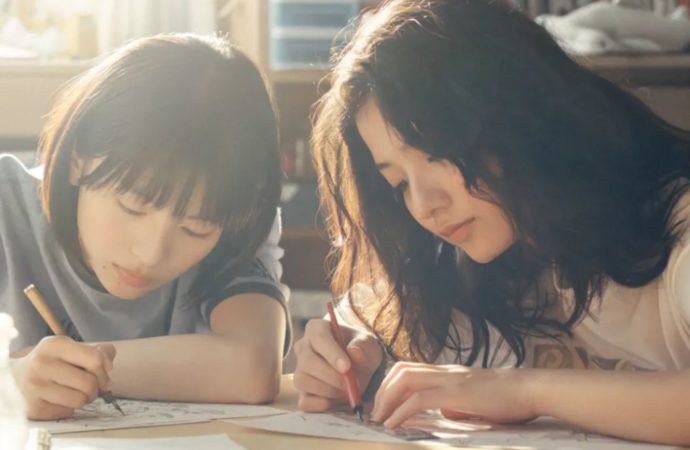

The decision by Hirokazu Kore-eda to adapt Look Back, Tatsuki Fujimoto’s manga of the same name, already made into an animated film in 2024 by Kiyotaka Oshiyama, is perfectly consistent with his filmography. In the hands of the director of Monster (2023), the story of two girls brought together by drawing enters familiar territory: childhood observed not as a prelude to adulthood, but as a complete world in itself, with its own hierarchies, desires, disappointments and ways of relating to others.
Look Back, which premiered at the 83rd Venice Film Festival, is, above all, a film devoted to childhood and its innocence. And, as so often in Kore-eda’s cinema, children are not merely passive recipients of adults’ decisions, but active agents in their own stories. Parents all but disappear from the narrative: in Kyomoto’s case, we never even see them, while Fujino’s family remains a peripheral presence, available and protective but never truly intervening in what shapes their daughter’s life.
This absence does not imply abandonment. On the contrary, it allows Kore-eda to grant the girls a degree of emotional autonomy that cinema does not always afford children.
Two Girls and a Room
We first meet Fujino (Furi Nanase) when she is in the fourth grade. Confident in her talent and obsessed with manga, she draws with the satisfaction of someone who has not yet found a reason to doubt herself — until Kyomoto (Rokka Okada) appears, a hikikomori classmate who does not attend school and whose skill at drawing calls that confidence into question.
The paradox is that while Fujino sees her as a rival capable of threatening her sense of superiority, Kyomoto regards her from afar with genuine admiration. When, at her teacher’s request, Fujino finally makes contact with the reclusive girl, the imagined rivalry begins to turn into something else. Their shared passion for manga, and later their companionship, will nurture and transform both girls in decisive ways.
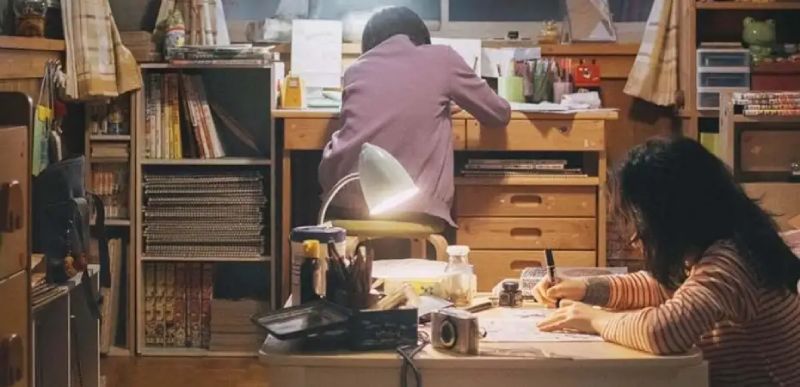
Kore-eda knows that he does not need to turn this friendship into a succession of major events. Very much in keeping with his own style, he builds it precisely through the repetition of everyday life. The endless sessions in which the two friends draw almost entirely in silence, accompanied only by the sound of pencils moving across paper, are almost hypnotic, and their relationship deepens without needing to be put into words, because the creative act already functions as a language between them.
Fujino does the main drawings; Kyomoto, the backgrounds. Working together is not simply a matter of combining two sets of skills, but of discovering that creativity can be enhanced once it ceases to be conceived as an exclusively individual form of self-assertion.
Learning to See the Other
For Fujino, this interaction is particularly important, since her pride had come close to jeopardising the very thing she was trying to protect. When she realises that she may not be able to attain the level of excellence she demands of herself, she considers giving up drawing altogether and simply enjoying manga as a reader. Meeting Kyomoto transforms this competitive relationship with talent. Drawing becomes pleasurable again because it is no longer exclusively about proving that she is the best.
It is at this point in Look Back that Kore-eda’s central thesis first emerges, an idea as simple as it is fertile: interpersonal support does not diminish individual talent, but can instead set it free. The generosity and joy that come from working with another person become transformative forces.
And the movement works in both directions. If Kyomoto restores Fujino’s pleasure in creating, Fujino gradually draws her friend out of the enclosed space from which she has been observing the world. Their relationship allows her to venture beyond the shell of her isolation until, inevitably, the moment comes when she wants to go even further, beyond the protective wing of her best friend.
Kore-eda avoids turning this evolution into an explicit lesson; as always, observation is enough. Friendship does not magically save either of them, nor does it remain frozen in the ideal form it assumed during childhood. It moves them forward. And growing up also means accepting that the person we helped discover the world may eventually want to explore it without us.
The Quiet Work of Time
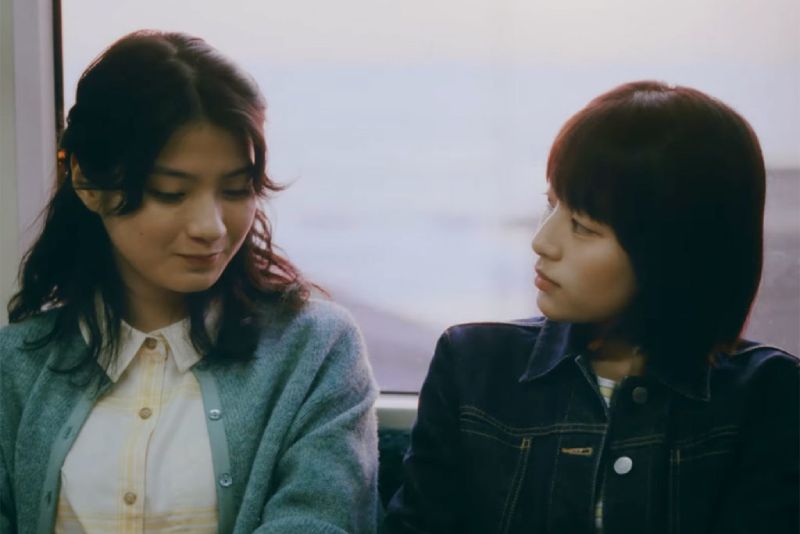
Everyday life and perseverance take on an especially beautiful dimension through Senzo Ueno’s high-contrast cinematography. The passage of time reveals itself in the changing seasons, in the natural world surrounding the town, in spaces that slowly evolve and, above all, in the accumulated hours spent inside Fujino’s bedroom-studio.
These seemingly light images gradually leave their mark. By the time the girls become young adults and the film approaches the denouement of their friendship, Kore-eda has no need to explain how much time has passed or how much they mean to one another, because we have experienced it alongside them.
This is precisely the strength of his characteristically unhurried rhythm. Look Back moves slowly and calmly, with no apparent urgency, yet beneath that serenity Kore-eda sets in motion a narrative mechanism that works like clockwork. Every repetition, every season and every silence prepares us for something we will only fully understand later.
Yuta Bandoh’s delicate score accompanies this process without imposing on the images an emotion they already contain. Kore-eda knows how to wait for feeling to emerge through accumulation, which is precisely why it can become so much more powerful when it finally surfaces.
Looking Back
The immense respect Kore-eda has always shown towards childhood in his cinema finds another of its most lucid and empathetic expressions in Look Back. His camera understands children’s and adolescents’ dreams of personal fulfilment without condescension, but also their fears, insecurities and self-imposed obstacles. Fujino can be proud, competitive and selfish; Kyomoto, vulnerable and dependent. None of this reduces them. They are children before they are symbols.
And perhaps that is precisely why the emotional blow awaiting us in the film’s final stretch is so powerful. Not because Kore-eda has constructed an overwrought melodrama — Look Back is far from that — but because, for much of its running time, he has allowed us to share something as modest as the time two people spend together.
The film ends with an implicit and inevitable reflection on what remains when we look back and consider the decisions we have made, the possibilities we have abandoned and the lives that might have been different. But it also raises a much more concrete question concerning artistic creation: why do we continue to create when creating hurts, when it demands perseverance, and when what we love becomes forever bound to someone we have loved?
Look Back is one of Kore-eda’s most moving films, one in which he observes two pencils moving across paper, two girls growing up and a friendship transforming. And, as so often in his cinema, he lets time do the rest.



Nadie ha publicado ningún comentario aún. ¡Se tú la primera persona!