
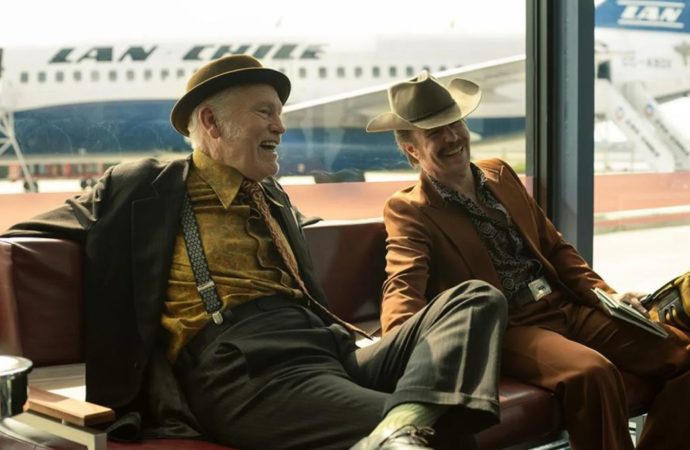
Presented in competition at the 83rd Venice Film Festival, Wild Horse Nine, written and directed by Martin McDonagh, takes the British-Irish filmmaker to Chile in 1973, confronting him with territory that, at first glance, might seem far removed from his usual cinematic universe.
Yet in the latest film from the director of The Banshees of Inisherin — starring John Malkovich and Sam Rockwell, alongside Steve Buscemi, Mariana Di Girolamo, Ailín Salas, Tom Waits and Parker Posey — it takes only a few minutes to recognise his recurring themes: morally questionable yet inevitably human characters, razor-sharp dialogue in which not a single word is wasted, violence, guilt, a male friendship that defies easy definition and, above all, that dark humour capable of making the terrible and the absurd coexist without neutralising either.
The opening, with documentary footage of the crowds celebrating outside La Moneda following Salvador Allende’s rise to power, accompanied by Mercedes Sosa singing Gracias a la vida, inevitably brings a lump to the throat. The sequence works as a swift and effective overture: the collective hope of those celebrating what they believe to be the beginning of a new era unfolds before an audience that already knows how it will end. McDonagh soon reveals the other side, what those celebrating could not have foreseen: the US operations aimed at destabilising the Chilean government and the shadow of the CIA over a process that would culminate in the 1973 coup d’état.
From there, Wild Horse Nine takes another turn, moving into a more personal territory that gradually draws us in. Without abandoning History, McDonagh decisively fictionalises his characters, inviting us to witness something far more intimate, emotional and purely cinematic.
Two agents far removed from the archetype
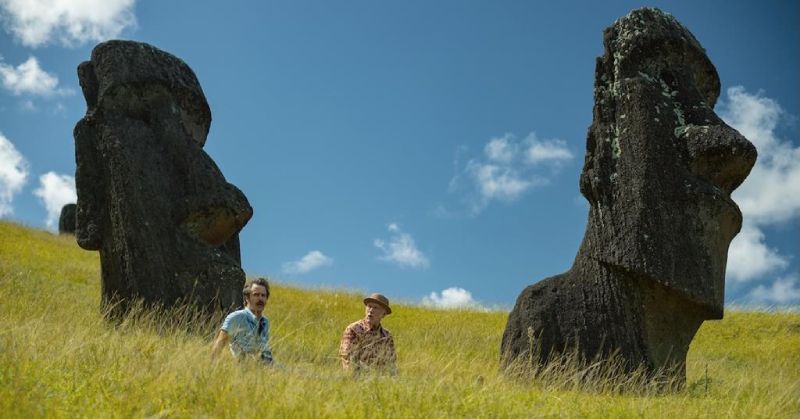
Chris (John Malkovich) and Lee (Sam Rockwell) are two veteran CIA agents stationed in Santiago, Chile, who travel to Easter Island two months before the coup, under the supervision of their superior, MJ (Steve Buscemi). There, among the moai and the isolation of Rapa Nui, their past —as veterans of geopolitical destabilisation, implicated in the assassinations of Kennedy and Lumumba— begins to overlap with the conspiracies of the present, in 1973.
From the outset, McDonagh resists turning them into predictable secret-agent archetypes. Chris is around seventy and speaks about his profession and his own record with a disconcerting lack of either filter or discretion. Malkovich builds the fascination of a distinctive, fully realised character around this very contradiction: a man who belongs to an organisation defined by secrecy yet seems to have lost any need to conceal himself.
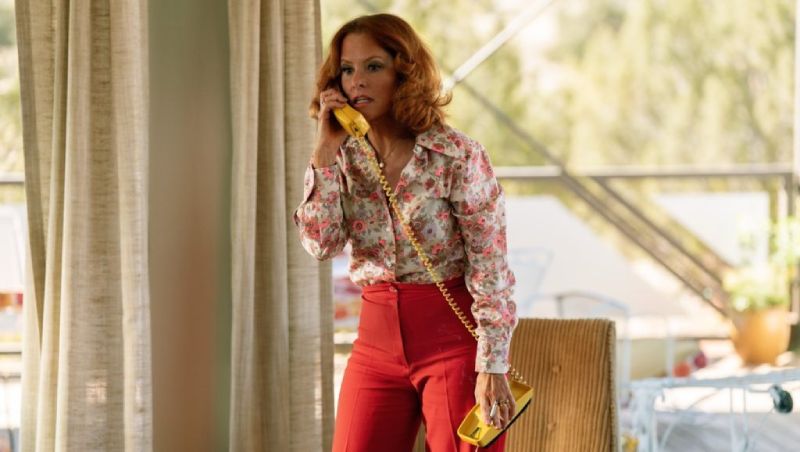
Lee, meanwhile, maintains a long-distance marriage that could practically sustain a film of its own. Here Parker Posey appears as Marge, and her few minutes on screen are pure gold. The actress manages to give a relationship built across a distance and through brief conversations a life that extends far beyond its limited screen time. Posey and Rockwell, who both appeared in the third season of The White Lotus without sharing any scenes, make the most of this opportunity —in which, curiously, they once again never actually come face to face.
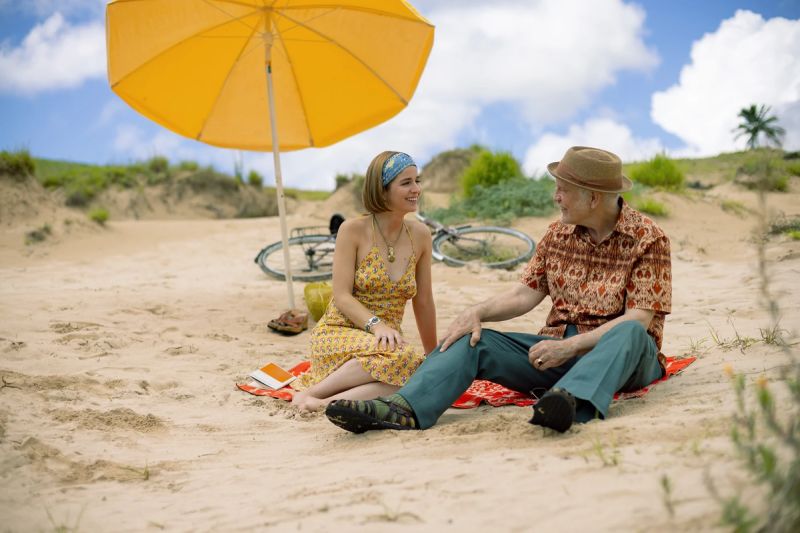
Buscemi, as MJ, completes another point in this peculiar structure of power. McDonagh gradually uncovers the different layers of his characters while simultaneously revealing the multiple levels of a plot that becomes more complex than its initial premise might suggest.
And here we arrive at one of the enduring strengths of McDonagh’s cinema: his excellent screenwriting.
Humour versus History
The dialogue is brilliant. McDonagh comes from the theatre and has never concealed how much he trusts in the power of words, but his best films do not use dialogue simply to convey information: they turn it into action. A single sentence can alter a relationship, expose a vulnerability or transform our moral perception of a character.
In Wild Horse Nine, moreover, dark humour performs a particularly delicate function. It does not diminish the gravity of the historical context, but rather confronts it with a lucidity that is not without cynicism. The film manages to make us laugh with characters embedded in a political machinery whose consequences we already know, without ever asking us to forget who they are or what they are part of.
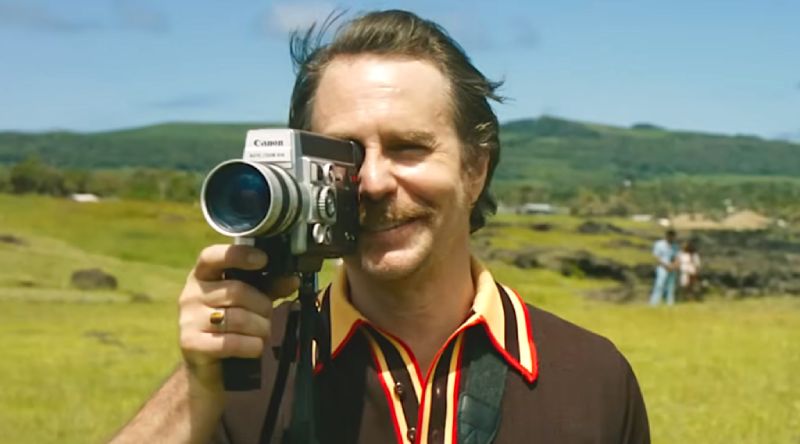
McDonagh uses these two men to explore individual responsibility within systems of power far greater than themselves, placing humanisation and absolution in tension with one another. To what extent can an individual be separated from the institution he has served? Is personal redemption possible when guilt is also political and historical?
The film thus acquires a resonance that reaches into our present. Without resorting to simplistic parallels, beneath its recreation of the 1970s runs a thread that extends towards the future of US relations with other countries and the contradiction between the public defence of democracy and certain forms of foreign intervention. McDonagh himself acknowledged in Venice the unexpected contemporary relevance the film has acquired in light of recent geopolitical events.
Malkovich and Rockwell: a perfect pairing
Wild Horse Nine depends to a great extent on the chemistry between its two leads. McDonagh has described Chris and Lee as a kind of old married couple, two men who have been together for so long that much of what they know about each other no longer needs to be put into words, revealing itself instead through compassion, complicity and even condescension.
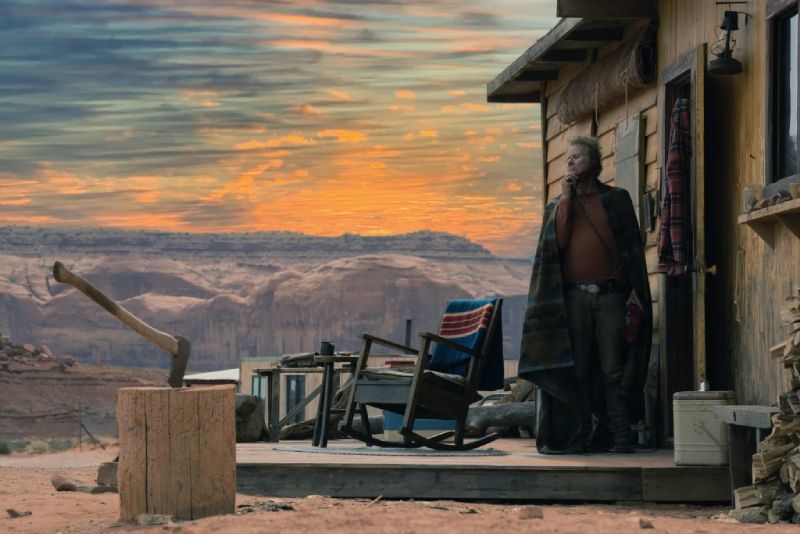
Malkovich and Rockwell developed that chemistry before filming began: the two actors and McDonagh rehearsed for several weeks at New York’s Public Theater. As Rockwell told me at the press conference, their rapport emerged through tirelessly repeating the dialogue again and again. Paradoxically, the result can be felt most strongly in what remains unsaid. There is a whole history preceding the film in the silences, irritations and familiarity between them.
For Rockwell, the film also continues an especially fruitful creative relationship with McDonagh following Seven Psychopaths (2012) and Three Billboards Outside Ebbing, Missouri (2017), for which he won the Academy Award for Best Supporting Actor. If their theatrical collaboration on A Behanding in Spokane is also taken into account, Wild Horse Nine is in fact their fourth project together.
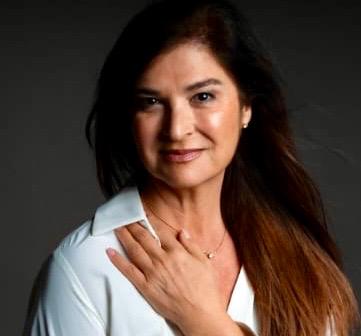
Opposite these two men burdened by the past are two young women played by Ailín Salas and Mariana Di Girolamo, the latter internationally known for her performance in Ema (Pablo Larraín, 2019). The relationship Chris develops with both women introduces another generation and another perspective into a story that might otherwise have remained confined within the American consciousness of its protagonists.
The Impossibility of Escaping History
Nor is it accidental that McDonagh moves much of the action to Rapa Nui, one of the most geographically isolated places on the planet. The landscape allows the director to construct a paradox around the impossibility of escaping what has been done.
McDonagh visited the island in the early 2010s and had wanted to shoot there for years, fascinated by its history, mystery and spiritual dimension. In Wild Horse Nine, that physical isolation ultimately becomes a moral space, also framed through the language of the Western, with its wild horses. In this sense, Tom Waits’ cameo from Monument Valley, in a terse telephone conversation with his brother Chris, works both as a homage and as a reflection of these uncompromising, stoic and morally questionable characters.
McDonagh’s cinema has always been fascinated by men trapped between what they have done and what they might still become. This was true in In Bruges, in Three Billboards Outside Ebbing, Missouri and, in a different way, in The Banshees of Inisherin. Here, however, guilt acquires another dimension because it is no longer exclusively private: it also belongs to History.
Over its 118 minutes, Wild Horse Nine constructs a political film without sacrificing its characters to its thesis, and an outstanding black comedy without using humour to trivialise its subject. Malkovich and Rockwell sustain the complex balance between the comic and the painful, while a cast at the top of its game ensures that even characters with only brief appearances — particularly the magnificent Parker Posey — leave us wanting more.

Nadie ha publicado ningún comentario aún. ¡Se tú la primera persona!