
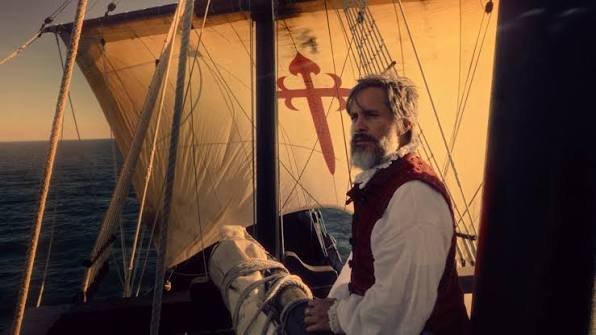

Time, memory, and history converge in Magellan, making it a singular work in the hands of Lav Diaz, as one might expect. One of the key figures of contemporary slow cinema, the Filipino filmmaker has spent more than two decades building a unique body of work defined by marathon running times, contemplative imagery, and a profound engagement with the political and cultural traumas of his homeland. Winner of the Golden Lion in Venice for The Woman Who Left (2016), the Silver Bear in Berlin for A Lullaby to the Sorrowful Mystery (2016), and the Golden Leopard in Locarno for From What Is Before (2014), Diaz now turns his attention to one of the foundational narratives of the Western imagination with Magellan, one of the most ambitious productions of his career.
Premiered in the Cannes Première section and later awarded the Golden Spike at the Valladolid International Film Festival (SEMINCI), the film arrives in Spanish cinemas on July 3. To mark its release, The Hype is presenting an exclusive clip from this remarkable historical reappraisal starring Gael García Bernal.
Far removed from a conventional historical reconstruction, Magellan approaches the Portuguese navigator from a distinctly Filipino perspective. Diaz is less interested in the legend of the first man to circumnavigate the globe than in the cultural, spiritual, and political consequences of the encounter between East and West that permanently transformed the Philippine archipelago. The arrival of Christianity, the construction of national myths, and the persistence of historical narratives are all subjected to critical re-examination, challenging many inherited certainties.
The film follows Ferdinand Magellan after his break with the Portuguese Crown and his alliance with Spain in pursuit of the legendary islands of the East. What begins as an enterprise driven by ambition and the spirit of exploration gradually turns into an obsession with conquest and religious conversion. Hunger, mutiny, and cultural conflict steadily erode the protagonist, leading him towards an almost spiritual acceptance of a fate he knows is unavoidable.
This psychological descent is anchored by one of the most complex performances of Gael García Bernal’s career. The Mexican actor fully embraces Lav Diaz’s radical method—built around extended takes and minimal corrective intervention—to create a Magellan who evolves from idealistic dreamer into a man haunted by a tragic awareness of his own mortality. The result is a character defined by contradiction, far removed from both the traditional hero and the one-dimensional villain.
The revisionist impulse extends to the film’s Filipino historical figures. Characters such as Humabon and Lapu-Lapu, celebrated as a national hero, are presented in a new light, reflecting one of Diaz’s central concerns: the ease with which societies construct myths capable of replacing reality itself. It is a reflection that the filmmaker links to much more recent political phenomena and to the ongoing necessity of re-examining history with a critical eye.
Spirituality also occupies a central place in the film. Ancient animist beliefs, the arrival of the Santo Niño and the rapid spread of Catholicism all become part of a broader exploration of the Philippines’ relationship with the sacred and with the very idea of community. More than a story of conquest, Magellan ultimately becomes a meditation on cultural encounters and their long-term consequences.

Formally, the film represents something of an exception within Lav Diaz’s recent body of work. Shot in colour and running a comparatively concise 156 minutes—brief by the standards of a filmmaker whose works often extend beyond eight or even ten hours—it nevertheless retains the essential hallmarks of his cinema: patient observation, the interplay between professional actors and non-professionals, and the pursuit of a truth that emerges through duration and through the unrepeatable event captured by the camera.
There is also a lesser-known intimate dimension to the story. The figure of Beatriz, Magellan’s wife, barely mentioned in the historical record, assumes a crucial role here. Reimagined as the explorer’s spiritual centre, she embodies the longing for homecoming and the idea of home as a refuge from ambition and conquest. It is a narrative thread that Diaz intends to develop fully in a future nine-hour version of the film.
With Magellan, Lav Diaz once again affirms his conception of cinema as both a space for contemplation and a tool for revisiting the grand narratives that shape our collective memory. More than a maritime epic, the film becomes a meditation on the construction of myth, on faith, and on the fragility of historical truths.




Nadie ha publicado ningún comentario aún. ¡Se tú la primera persona!