
Richard Wagner’s Lohengrin presents a compelling contradiction in dramaturgical terms. A Romantic opera that paradoxically unfolds as a fantastical tale with a tragic ending, yet framed within the conventions of historical drama. The story of the knight borne by a swan—central to the legend of Lohengrin, son of Parsifal—is one of those mythical narratives that condense, into a single image, the deeply rooted dream of salvation through miracle. Wagner intervened in what he considered a “poor” and “insipid” epic action, enriching it with magical and fantastical elements—thus shifting the medieval legend away from its historical grounding toward a more overtly mythical dimension.
At its core, Lohengrin revolves around a simple yet profound idea: the “ideal” that arrives from another realm to rescue those in extreme need is destined to vanish the moment doubt is cast upon it. Any staging of Lohengrin must therefore underline the separation between the earthly, social sphere and the supernatural one—already clearly distinguished by Wagner’s musical language—if it is to avoid a stylistic uniformity that would constitute a serious dramaturgical flaw.
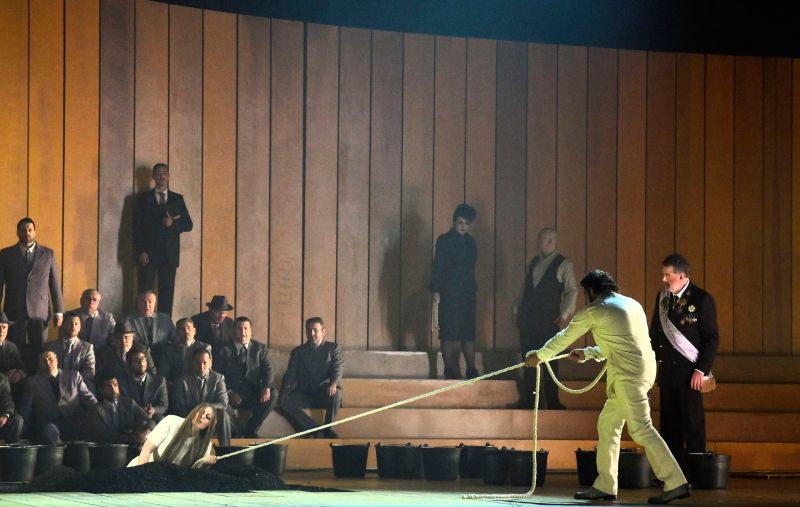
Brian Jagde and Dorothea Herbert in the first act of Lohengrin © Michele Crosera.
With this premise, Lohengrin returned to the Teatro La Fenice in Venice after decades of absence (its last appearance featuring a young Christian Thielemann and a celebrated staging by Pier Luigi Pizzi), now in the already familiar production by Damiano Michieletto, premiered in Rome last November. A production that, despite moments of undeniable visual power—the symbolic insistence on enigma, the obsessive image of origin—ultimately succumbed to its own conceptual ambition.
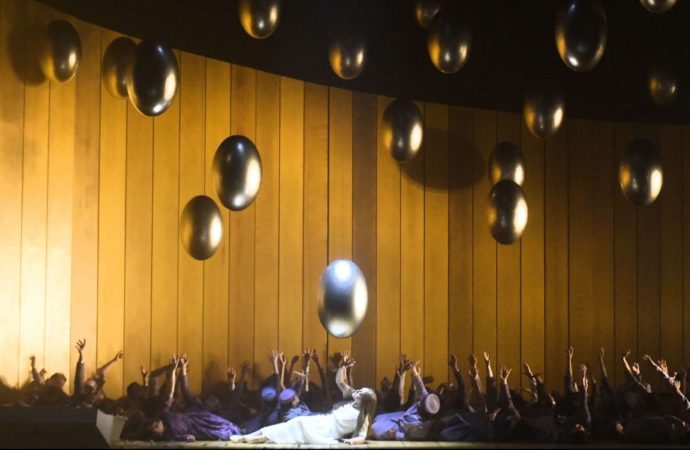
Michieletto’s staging unfolded within an abstract space designed by Paolo Fantin, dominated by a large curved wooden wall—more a mental container than a true dramatic setting—enhanced by the refined lighting of Alessandro Carletti and the restrained, contemporary costumes by Carla Teti.
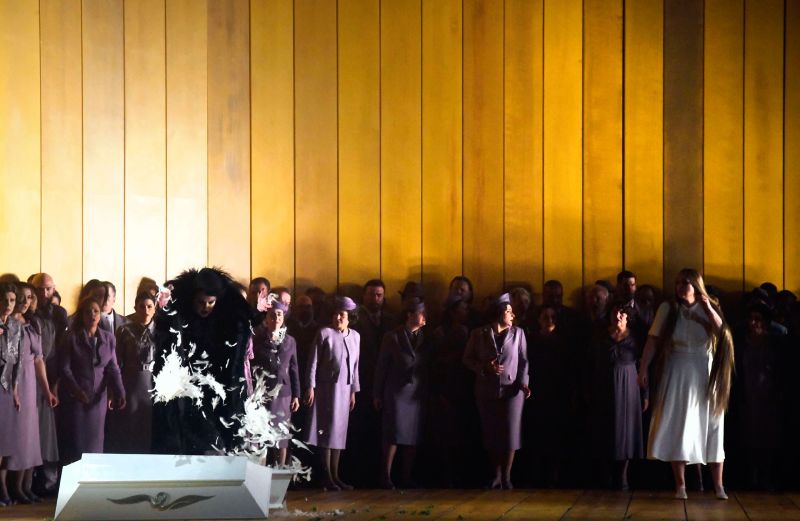
Chiara Mogini and Dorothea Herbert in the third acto of Lohengrin. © Michele Crosera.
Within this environment, a limited number of elements—the bathtub echoing the presumed death of Gottfried, the small white box filled with swan feathers—acquired strong symbolic resonance, centered above all on the obsessive presence of the egg, a metaphor for origin and mystery. Around this symbol, the production constructed its core reading: Lohengrin as an enigma that must not be revealed.
The insistence on “opening” that mystery translated into a form of violence that inevitably leads to destruction, suggesting an irreconcilable tension between love and knowledge. A compelling idea, partially realized, yet developed through a language that often felt overly insistent and not always resolved in dramaturgical terms. The staging thus oscillated between genuinely striking moments and surprising banality, with an excessively cryptic vocabulary that ultimately disrupted the delicate balance between text, music, and drama. Where Wagner demands a clear dialectic between the human and the supernatural, this production dissolved both spheres into a continuous ambiguity that felt, dramaturgically, somewhat outdated.
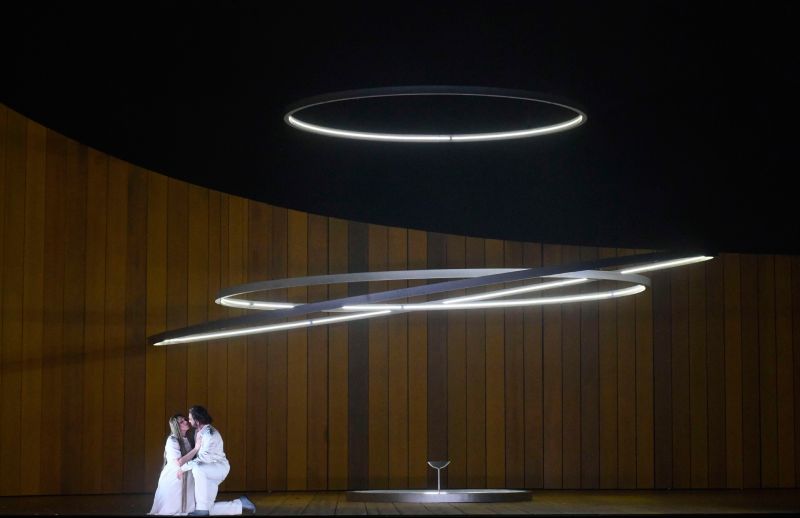
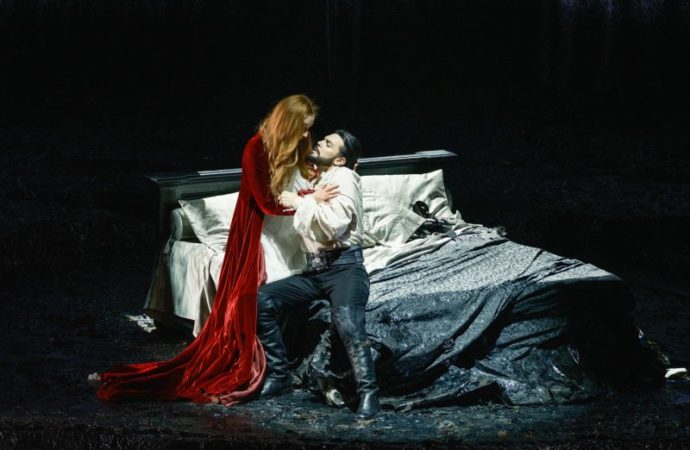
Brian Jagde and Dorothea Herbert in the third act of Lohengrin © Michele Crosera.
In the pit, Markus Stenz offered a reading of considerable density, perhaps overly heavy in the first act, which progressed with a certain rigidity. The interpretation gradually gained more breathing space in the following acts—though without ever reaching full excellence—as the musical line became more flexible and the discourse more organic, allowing the Romantic lyricism of the score to emerge more clearly.
More problematic was the construction of the protagonist. Brian Jagde delivered a Lohengrin defined by muscular singing, supported by solid projection but lacking nuance. This emphasis on sheer vocal force—approaching a raw Heldentenor approach—left little room for the ethereal and mysterious dimension that defines the character. The result was a knight more earthly than ideal, less a messenger of transcendence than a hero shaped by overly human contours.
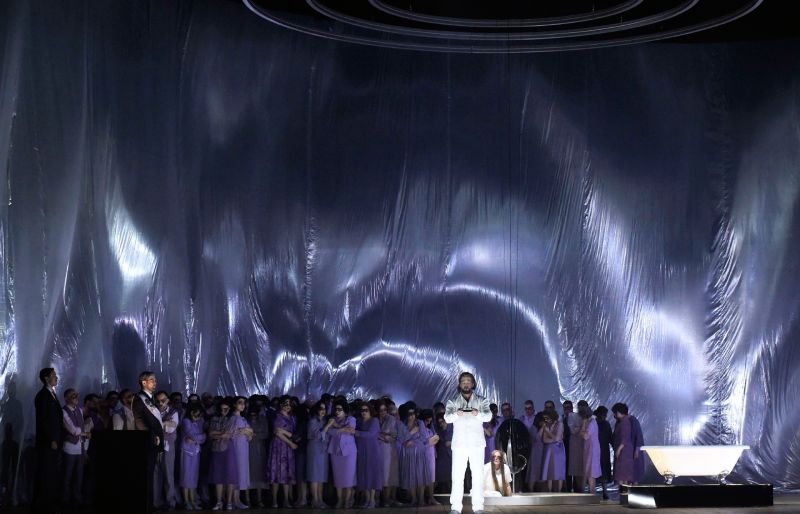
Brian Jagde in the third act of Lohengrin. © Michele Crosera.
The rest of the cast offered uneven results, with stronger dramatic presence than vocal refinement. Dorothea Herbert’s Elsa proved convincing in her more intimate and dreamlike dimension, sustained by a flexible vocal line, though showing signs of fatigue in the final act. More debatable was the Ortrud of Chiara Mogini, conceived with excessive force: her emission, hard and inflexible, featured uncovered high notes that tended to spread, detracting from the refinement of the line despite its undeniable stage impact.
Similarly, Claudio Otelli’s Telramund relied on energy and projection, though with a somewhat limited expressive palette. Andrea Silvestrelli, as Heinrich der Vogler, showed strain in the upper register, compromising the homogeneity and nobility of the vocal line, while Äneas Humm’s Herald brought elegance, stylistic awareness, and a refined line, despite a timbre leaning closer to tenor than the traditional baritone role. Despite these reservations, the evening concluded with notable public success: a full house at La Fenice and a warm, enthusiastic reception.
Nadie ha publicado ningún comentario aún. ¡Se tú la primera persona!