

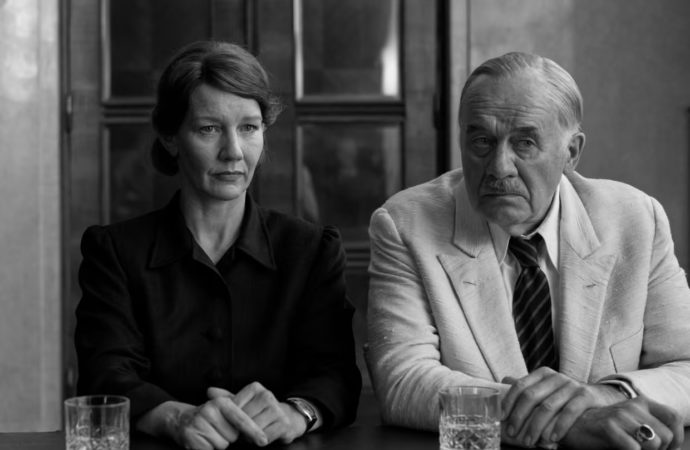

With Fatherland, Pawel Pawlikowski returns to the moral and emotional territories that already permeated Ida and Cold War: European memory, ideological fracture, wounded identities and the impossibility of reconciling inherited and acquired values. For his latest film, premiered at the 79th edition of the Festival de Cannes, the Polish director —who devoted his postgraduate studies at Oxford to German literature— turns to a real historical figure, the novelist Thomas Mann, at an extraordinarily delicate moment: his return to Germany in 1949 after years of exile that began in 1933 and a trajectory that took him from Switzerland and France to the United States, where he attained an almost mythical stature as an anti-fascist intellectual, filled auditoriums of up to 3,000 spectators during his countless lecture tours, and became a neighbour of Albert Einstein in Princeton before eventually settling in California.
The film follows Mann —played with restraint and gravity by Hans Zischler— during that journey through a defeated, divided Germany eager to symbolically appropriate his figure. But Pawel Pawlikowski avoids the conventional biopic and transforms the Nobel Prize winner’s return into a far more complex meditation on homeland, filiation, guilt and moral ambivalence. The title itself already contains a declaration of intent: Fatherland refers to the German notion of Vaterland, a homeland conceived in masculine terms, historically associated with authority, severity and judgment, far removed from the maternal and protective representations that other cultures have projected onto the nation. This paternal dimension of Germany finds its direct mirror in the relationship between Thomas Mann and his son Klaus Mann (August Diehl), himself also a writer.
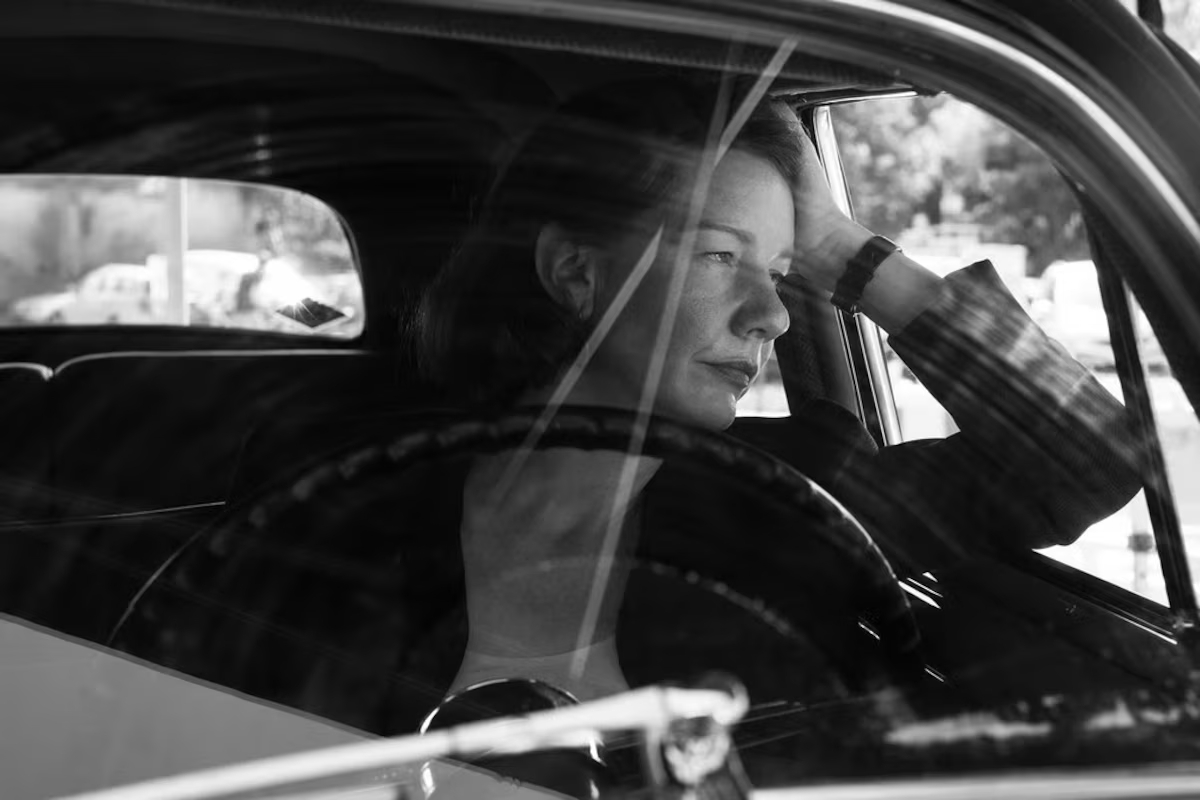
From its very first scenes, Pawel Pawlikowski situates the conflict within that intimate territory where the political and the familial contaminate one another. The film opens with Klaus Mann emotionally shattered in a hotel room in Cannes — the city where he would die only a few days later — speaking at dawn on the telephone with his sister Erika (Sandra Hüller), who tries to convince him to join their father’s visit to Frankfurt and Weimar. The sequence functions as the interpretative key to the entire film: Thomas Mann returns to Germany as a son of his homeland, but also as a father whose shadow emotionally crushes Klaus. Here, the homeland acquires a concrete and painfully human face. Klaus does not want to return to Germany because his father himself embodies his Vaterland: an emotional homeland that is severe, castrating and relentlessly demanding.
Love and resentment run through Fatherland in multiple directions. Pawlikowski constructs a hall-of-mirrors structure in which duality constantly permeates relationships: father and son in open conflict, father and daughter suspended between admiration and incomprehension, Thomas Mann and a Germany split between East and West. The political ambiguity of the writer himself also emerges. Unlike his brother Heinrich Mann, who was far more explicitly committed to socialist activism, Thomas Mann maintained an unequivocally anti-fascist position that was nevertheless perceived by some as insufficiently militant. That tension runs throughout the film and turns every official tribute into deeply uncomfortable territory.
In Frankfurt, Goethe’s birthplace and a symbol of West Germany, Mann receives an award that instrumentalizes his cultural prestige as a symbol of democratic legitimacy. There, the descendants of Richard Wagner also attempt to persuade him to support the reopening of the Bayreuth Festival. The writer’s refusal, firm and unambiguous, reveals the depth of wounds that remain painfully open. In one of the film’s most explicit scenes, Erika slaps the actor and former protégé of the Nazi regime Gustaf Gründgens (played by Joachim Meyerhoff), her first husband before later marrying W. H. Auden, and the very figure who inspired Klaus to create the protagonist of Mephisto. The sequence brilliantly encapsulates the impossibility of separating culture, opportunism and collaboration in postwar Germany.
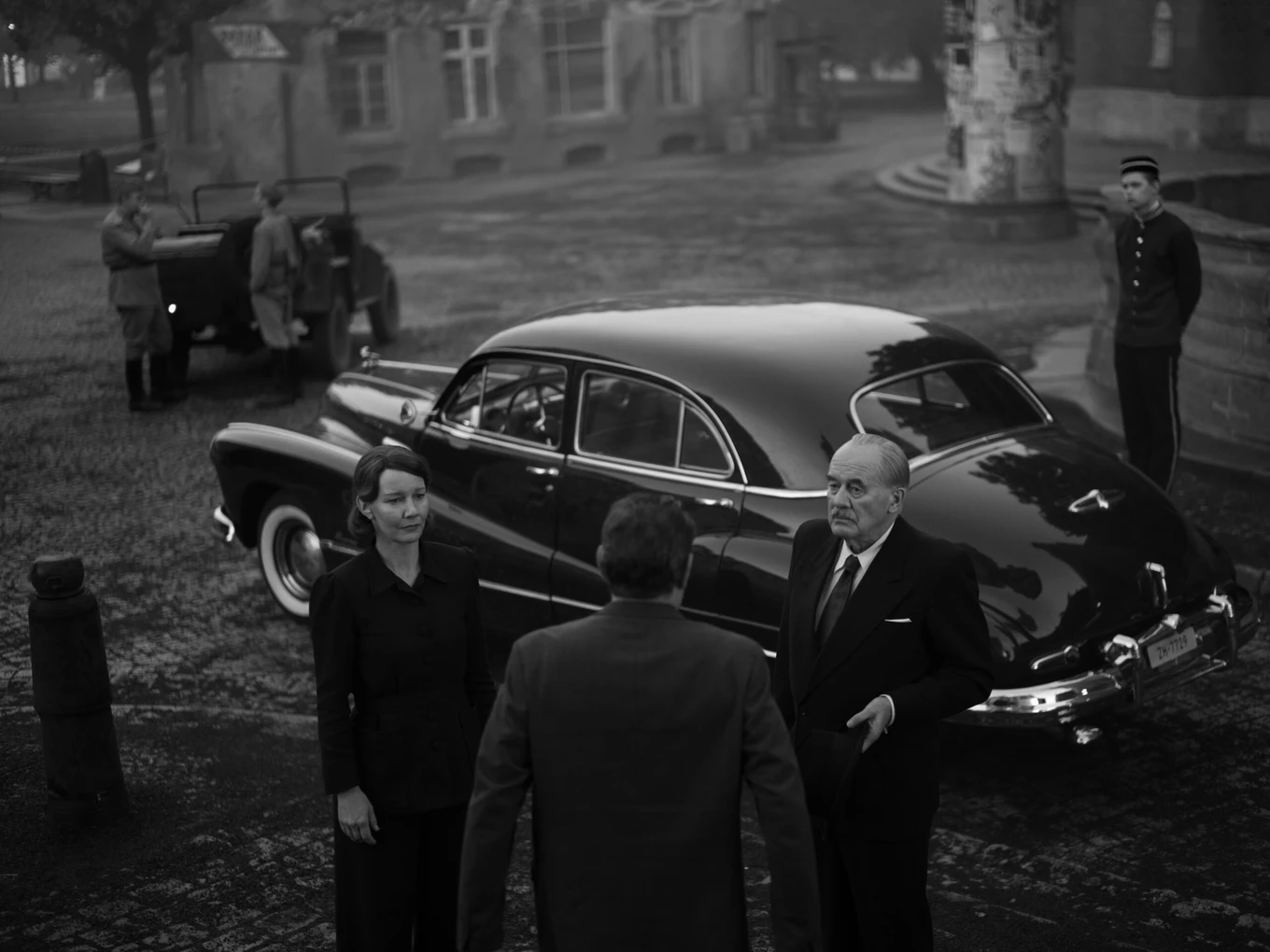
In Weimar, already under Soviet control, instrumentalization takes another form: Mann is asked to preside over East Germany’s highest cultural institution, an offer he likewise refuses. Mann thus becomes a symbol contested by two opposing political systems seeking to appropriate his moral authority. Pawlikowski films this tension with extraordinary precision, avoiding any ideological simplification. He contrasts the dialectical sophistication and philosophical erudition of the Soviet military authorities in the region with the anonymous, servile mayor of Frankfurt, while also confronting the Nobel Prize winner with the reality of the Buchenwald camp, where those persecuted under the new order have now taken the place once occupied by the victims of Nazism.
Fatherland shows how the political invades the personal and how collective history becomes embedded within family relationships.
Visually, Fatherland extends the formal austerity that characterizes the cinema of the Polish director. Shot in magnificent black and white by Łukasz Żal —nominated for the Academy Award for Ida and Cold War— the film transforms the spaces of postwar Germany into moral landscapes of ruin, distance and uprootedness. The cinematography possesses a spectral density: interiors (the hotel scenes, the visit to Goethe’s house) turn every frame into an image suspended between memory and mourning, even when filming receptions or nightclubs where life has returned with an anxious desire for repair. At the same time, symmetry and mise-en-scène reveal elsewhere, through their rigidity, an entire system and hierarchy. The score by Marcin Masecki, a regular collaborator since Cold War, adds a melancholic and restrained dimension that perfectly accompanies the tone of the narrative. Even the brief cameo by Joanna Kulig seems to function as a ghostly echo of Pawlikowski’s previous cinematic universe.
The final scene constitutes perhaps one of the most beautiful moments in the entire film. Without words, allowing the music of Johann Sebastian Bach to finally occupy the emotional space repressed throughout the entire running time, Pawel Pawlikowski allows to emerge what his characters are barely capable of verbalizing: the impossibility of fully recovering what has been lost, the futility of belated remorse and, at the same time, the persistence of beauty as one of the few remaining refuges still possible.
In Fatherland, the director reveals the power of roots, loyalties, responsibilities and commitments; of how the political invades the personal and how collective history becomes embedded within family relationships. Pawlikowski thus constructs a profoundly European film, traversed by exile, guilt and moral ambivalence, where the homeland ceases to be the abstraction of exile or memory and instead prevails as an open wound within both the intimate and the social spheres.
Nadie ha publicado ningún comentario aún. ¡Se tú la primera persona!