
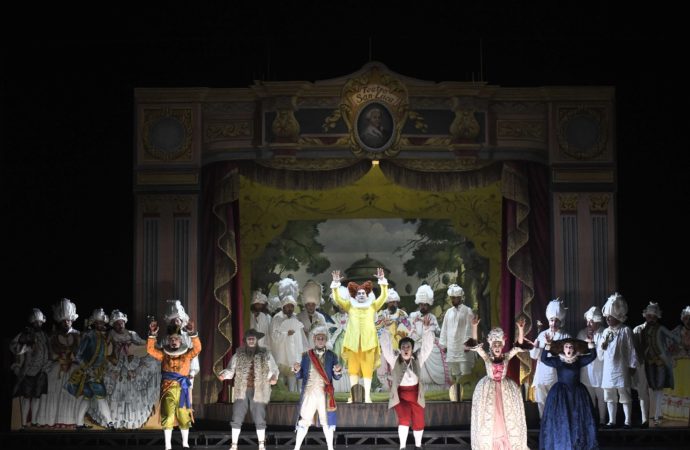
The first complete opera by Gaetano Donizetti to reach the stage, Enrico di Borgogna, premiered in Venice on 14 November 1818 at the Teatro San Luca (today’s Teatro Goldoni), marking the public debut of the twenty-one-year-old composer from Bergamo, supported by his friend and librettist Bartolomeo Merelli. The future impresario of La Scala would later be the same man who encouraged Verdi to write Nabucco at a time when the composer was devastated by personal tragedy and the loss of his family.
The plot of Enrico di Borgogna unfolds through a tangle of usurpations, thwarted love affairs, and dynastic restoration in accordance with the conventions of heroic opera. Its opening pages reveal a technical mastery that is remarkable for a debut work, with occasional flashes of an already distinctive voice. Yet the promise soon fades: as the score progresses, Donizetti retreats into an overly faithful adherence to Rossinian models, to the point that the most interesting ideas heard at the outset remain largely undeveloped.
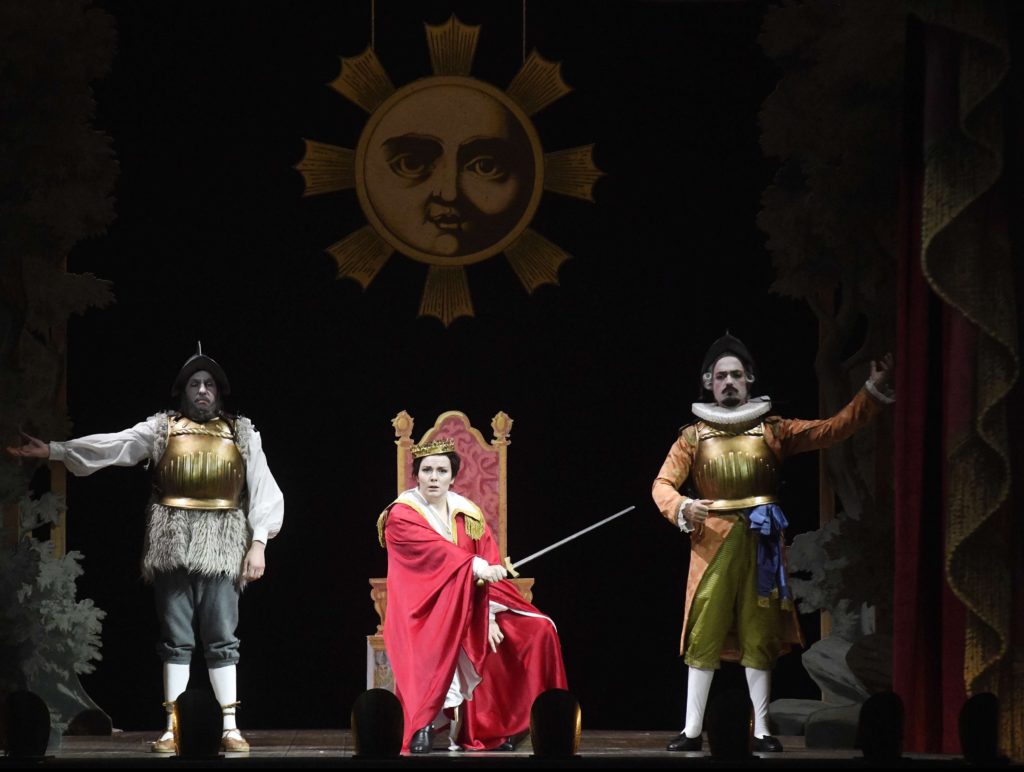
Teresa Iervolino in the second act of Enrico di Borgogna © Michele Crosera.
Enrico di Borgogna returns “home” this season to Teatro La Fenice. For the occasion, the Teatro Malibran revives the production co-produced with the Donizetti Opera Festival and staged by Silvia Paoli at Bergamo’s Teatro Sociale in 2018. The central concept—a theatre within the theatre, presenting the opera during its own Venetian premiere and exposing the full range of mishaps, rivalries and vanities that accompany the world of performance—is hardly new. In the specific case of the Venetian revival, moreover, it was realized with limited variety of means.
Paoli multiplied comic devices indiscriminately, and the result was an accumulation of gags that collide with one another without any real dramatic progression. The excess of gestures and stage business, presented in this manner, generates a constant visual confusion that distracts more than it illuminates: the audience is pushed from one joke to the next without allowing the relationship between text and music the space to breathe.
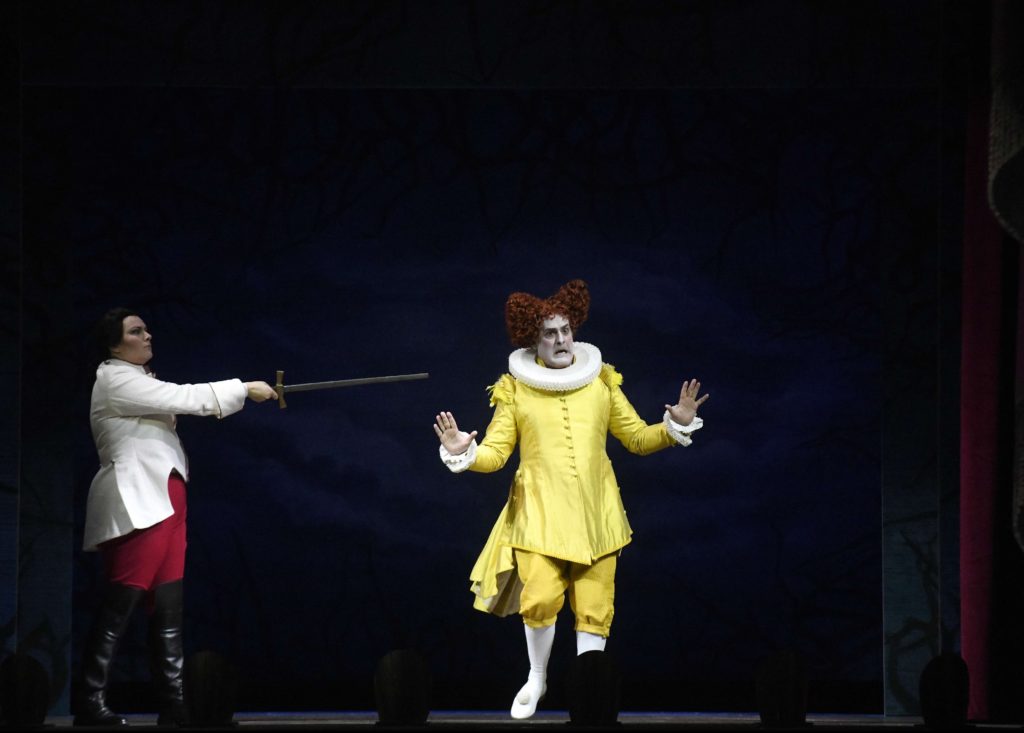
Teresa Iervolino and Omar Montanari in the second act of Enrico di Borgogna. © Michele Crosera.
The metatheatrical element, which might have provided a genuine interpretative key, thus became little more than a pretext for piling one idea upon another, and the dramaturgical weaknesses of this youthful work were not so much absorbed as buried beneath a stage machinery incapable of pause or silence. Neither Andrea Belli’s revolving miniature theatre with its shifting backdrops, nor Valeria Donata Bettella’s colourful period costumes, nor Fiammetta Baldiserri’s lighting succeeded in bringing order to a production that too often mistook liveliness for chaos.
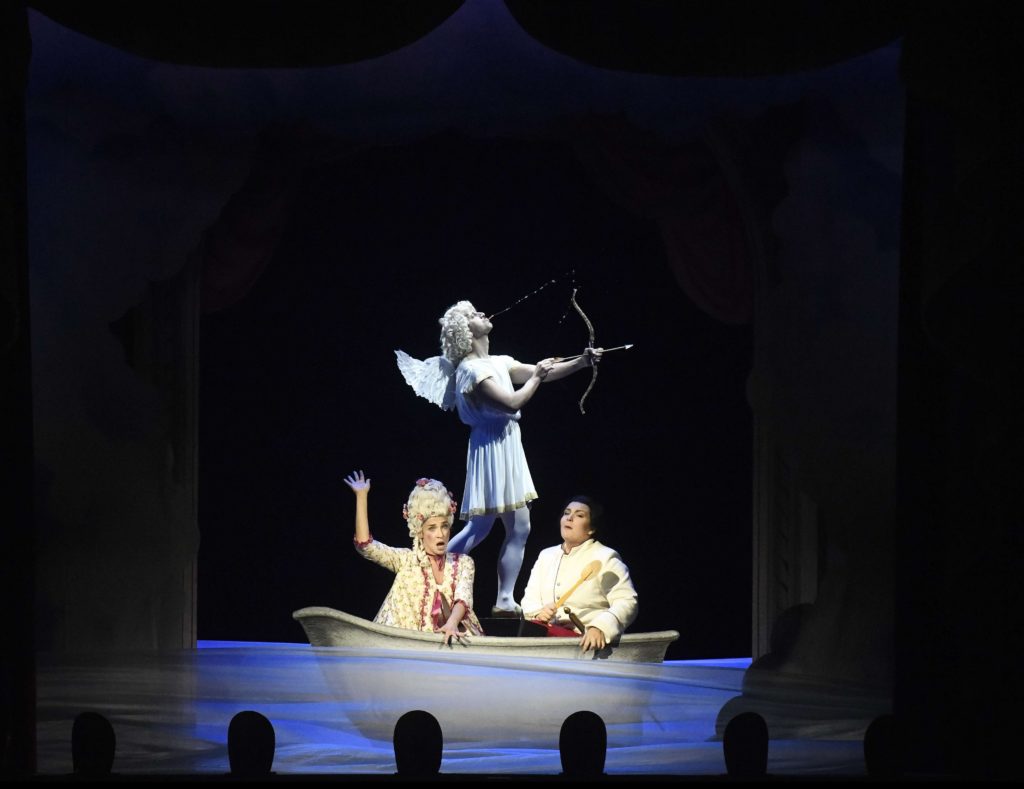
Teresa Iervolino and Dave Monaco in the second act of Enrico di Borgogna. © Michele Crosera.
The vocal cast, entirely renewed from the Bergamo performances, yielded mixed results. Teresa Iervolino took on the title role en travesti with stylistic authority and the dark timbre characteristic of the now rare heroic contralto tradition, although her interpretation remained more accomplished than truly incandescent. Dave Monaco endowed Guido with a bright, daring tenor voice and a certain stage presence, without ever fully escaping the broad characterization imposed by the production.
Giuseppina Bridelli, for her part, offered a polished portrayal of Elisa, although her stage charm was often lost amid the surrounding bustle. Omar Montanari (Gilberto) confirmed his experience and restraint in the buffo repertoire, one of the few areas where the balance between singing and comedy survived intact. More problematic was Christian Collia’s performance: his commitment was unquestionable, but Pietro’s high-lying tenor tessitura repeatedly exposed the fragility of a voice that seemed particularly vulnerable in the middle register. In the supporting roles, Giuseppe Toia (Brunone), Nicola Pamio (Nicola) and Chiara Notarnicola (Geltrude) fulfilled their duties without leaving a particular impression, while the male chorus of Teatro La Fenice, though not always immaculate in precision, tackled its many interventions with commendable professionalism.
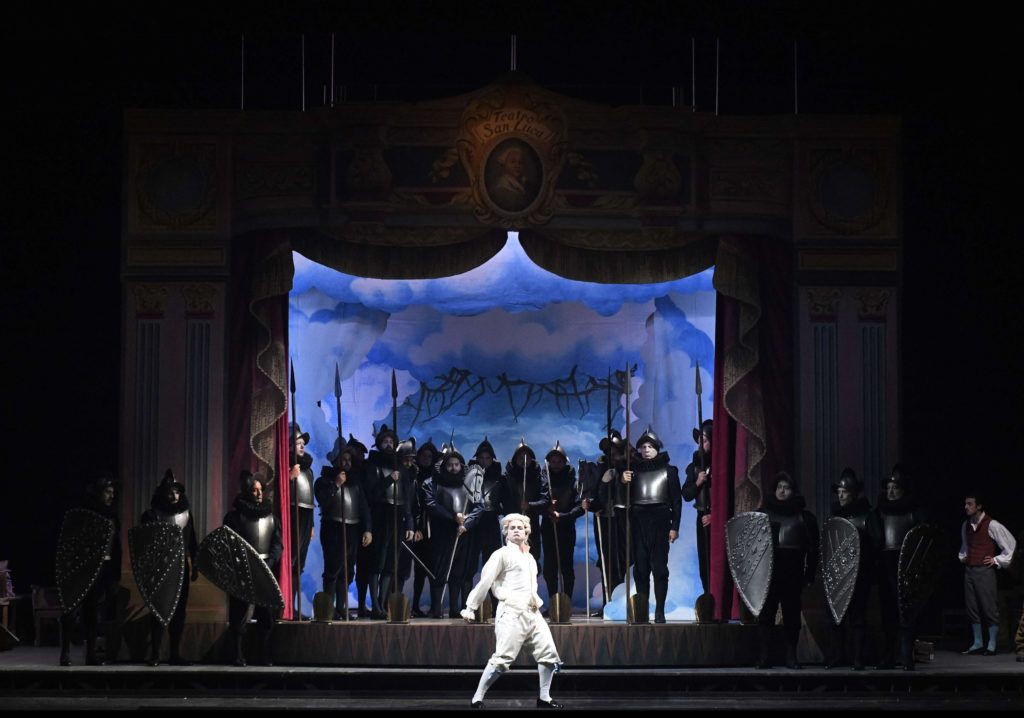
Dave Monaco in the second act of Enrico di Borgogna. © Michele Crosera.
In the pit, leading the Orchestra of Teatro La Fenice, Corrado Rovaris offered a reading of brisk tempos, yet one marked by a notable timbral monotony: the orchestral palette remained almost unchanged throughout, lacking the shifts of colour and tension that the score might have allowed him to explore. Rhythmic drive alone was never sufficient to compensate for this sonic uniformity, while occasional coordination problems with both stage and chorus—the latter directed somewhat uncertainly by Alfonso Caiani—contributed to a general impression of monotony rather than genuine theatrical vitality.
The sizeable audience in attendance greeted the performance with sincere enthusiasm. A sign that this early Donizetti, supported by a more refined and less cluttered theatrical conception, might aspire to something beyond mere historical curiosity.
Nadie ha publicado ningún comentario aún. ¡Se tú la primera persona!