

The absence of New Media Art works from the ambitious exhibition at the Reina Sofía Museum, which proposes a reordering of its permanent holdings through its Contemporary Art Collection 1975–Present, specifically addressing the Spanish and Latin American geopolitical sphere, was highlighted in a previous article (“Why Are There No New Media Art Works at the Museo Nacional Centro de Arte Reina Sofía?”). In this text, as a continuation of that one, I will offer, from a constructive perspective, possible approaches and strategies that could enable their long-overdue inclusion.
The validity and relevance of none of the twenty-one themes that feed the three itineraries proposed by the current directors of the Museo Reina Sofía (MNCARS) can be questioned. These themes are intended to construct a discursive narrative capable of articulating a museographic strategy that offers a complete and authoritative vision of the Spanish (and Latin American) artistic landscape from the late twentieth century to the present day. However, the total absence of New Media Art works (led by digital and electronic arts, created during precisely the same period covered by this extensive exhibition) demands an explanation and requires analysis. How is it possible that key works created by artists addressing the consequences of the technological revolution that took place during this period are not being shown, despite having been co-responsible for what we might call “the cultural atmosphere of the transition from the analogue society to the current digital one”?
These are creations and discourses that can be identified with clarity and precision, and through which artists, based on their first-hand experience, have developed new practices and languages (grouped internationally under the heading of New Media Art), taking into account the multiple consequences that this revolution has had on our everyday lives. Paradoxically, through their absence and oblivion, they represent the zeitgeist of our late twentieth-century era.
There are simply too many exemplary works, projects, and creations produced during this historical period in our territory by a multitude of artists—stretching back more than fifty years—for them to remain without presence, without narrative, within the museum.
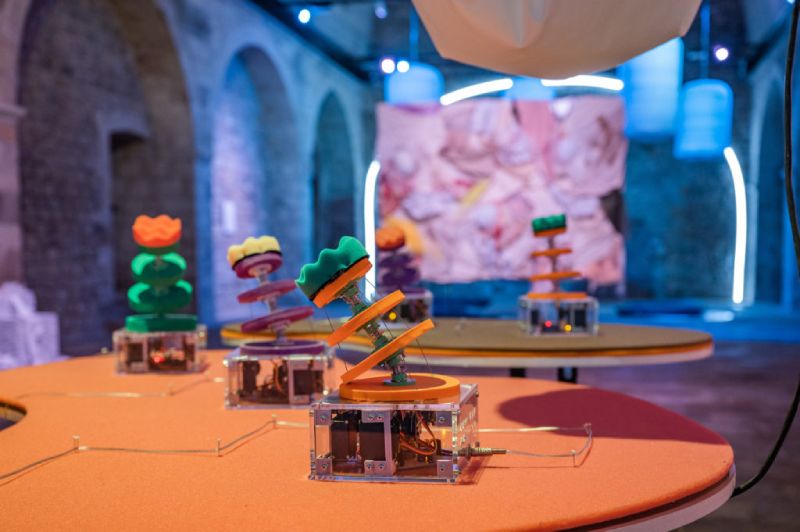
Hipertelia (Mónica Rikic, 2023). Exhibition at La Capella. Barcelona. Photo: @Pep Herrero.
Perhaps the construction of these narratives—entirely absent from the current presentation of the MNCARS collection—is not an easy task for those responsible for it. Art historians and critics, curators, cultural managers and museum directors have chosen to focus on and study other artistic practices aligned with today’s mainstream concerns. This is a respectable choice (and perhaps even a necessary one). But then someone will have to address those practices revolving around New Media Art, because they are equally necessary for the construction of a complete historiographical account of contemporary art.
Assuming this responsibility requires the development of new narratives capable of articulating these artistic practices, these new languages and discourses. There is an urgent need to undertake the demanding task of producing methodological analyses grounded in theoretical and critical reasoning, analyses that might help change such biased museographic policies, if only to remedy the current lag or to fulfil the institution’s own responsibility by providing it with the expert knowledge that it still lacks.
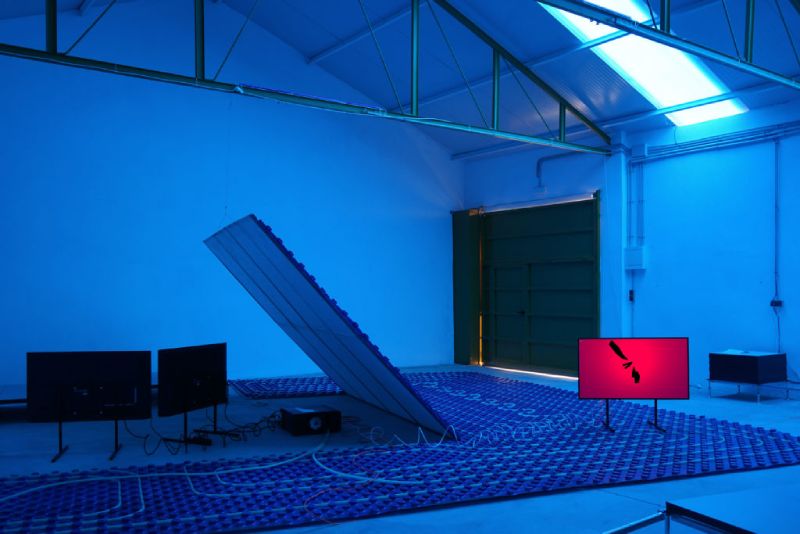
Cuando las paredes dejen de llorar (Mario Santamaría, 2024). Nave Sierra, Madrid. @Mario Santamaría
It is deeply discouraging, at this point in history, to see how this exhibition recently presented by the MNCARS, which proposes a reordering of its permanent holdings, distorts the historical memory of contemporary art in general—and Spanish contemporary art in particular. Yet the inertia of history, which is itself a narrative as perverse as it is conscious and self-interested, can—and should—be changed. In this regard, it is worth considering the insightful words written by María Marco in her article “Colecciones incómodas, relatos en disputas”(“Uncomfortable Collections, Narratives in Dispute”) in El Cultural, 15–21 May 2026 (pp. 6–10), where she argues that “a museum implies a narrative and points to the person who writes it. It is a history of power that negotiates between memory and domination, conservation and repair, prestige and justice. And that is where the future of our museums will be decided: in the amount of truth they are capable of sustaining. Writing history through clean narratives and white flags flying on their labels.”
The structure proposed below may serve as a guide for those who will have to write this history in the name of truth and justice. It is merely a proposal formulated from a constructive standpoint, intended to add another layer to this emerging analysis. It offers a series of potential discursive narratives that could well constitute the backbone for organizing the New Media Art works that ought to be present in the MNCARS collection.
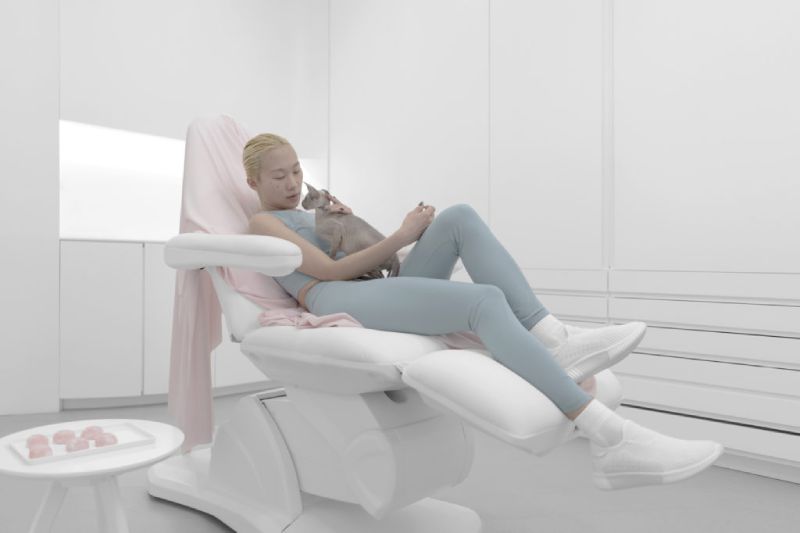
From Adaptasi Cycle series. Infography (Mit Borrás, 2021-26). Photo @Mit Borrás.
Following the discursive strategy employed by the MNCARS itself to organize the works displayed in the exhibition according to thematic categories, these are some of the themes that could be established to provide a coherent framework for works and materials related to artistic practices that engage with new media (New Media Art):
- Discovering, designing and inhabiting the new electronic space. The experience of life between screens.
- Identity crises. Hybrid beings. Avatars and cyborgs.
- The blurring of boundaries between the public and the private.
- Technological surveillance. Political control of life in digital society.
- The acceleration of time in Internet life. Twenty-four-hour attention to the screen. When the user becomes the product.
- Contemporary dystopias. From the utopian euphoria of net artists to the melancholy of digital natives.
- The disappearance of mediators. When the “like” becomes authority and the canon is established by statistical rankings and big data.
- Living in the fake. When truth is determined by repetition exceeding a threshold in media information, rather than by the verification of events.
- New narratives: shaping the world through the statistical constructions of AI-mediated realities. Prompt-images. The poetics of generative AI algorithms.
This list of “pending issues” represents only a tiny fraction of the problems that affect us today in relation to technology, and only one layer of their meaning. It is perhaps the layer most closely related to discursive concerns, insofar as it describes the mainstream themes that shape our everyday digital lives. However, to this list we could—and should—add another series of themes that concern purely formal questions, everything that artistic practice reveals in its centripetal form, that is, in its capacity to reflect upon itself. These are internal, self-referential questions that artists have always encountered in the studio and addressed with genuine passion and commitment.
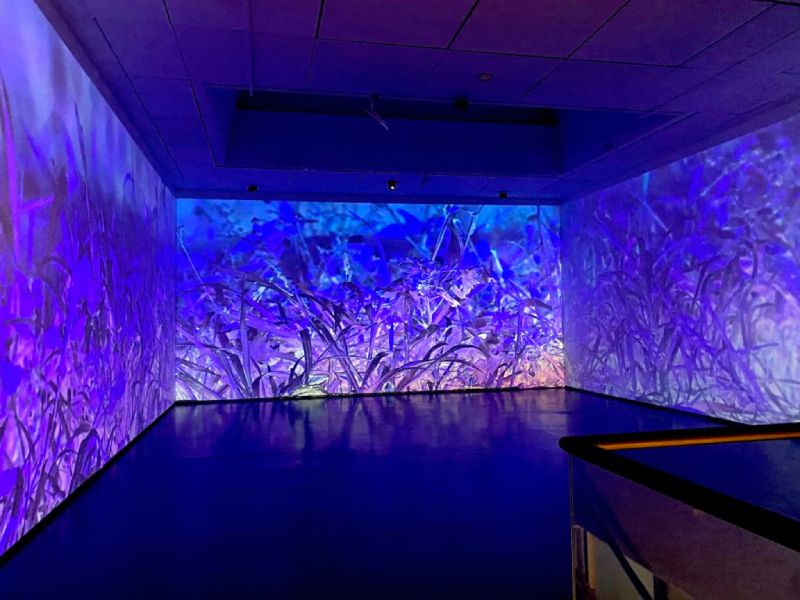
De l’autre côté (Claudia Robles, 2021-2025). Installation view at the Museum of Visual Arts, Bogotá. (2024). Photo @Claudia Robles.
As a possible guide, some of these internal questions concerning the production of artworks—and the ways in which they have been affected, irreversibly and as truly revolutionary artefacts, by digital technologies—could be formulated as follows:
- The shift from the production of objects to an interest in process. The translation into images of a theoretical problem: what the critic Miguel Fernández-Cid described as “the vision of the internal order of the image.” Generative systems constitute one of the new paradigms in artistic creation within the society of image technologies.
- The issue of the ad infinitum multiplicity of images, a direct consequence of the emergence of technical images within artistic production. The Original/Copy duality and the emergence of the concept of the multiple lead us towards a redefinition of the archive and to a reconsideration of the artwork as a digital archive with multiple layers of meaning and reappropriation.
- Meme images. Cultural images resulting from online circulation and collective flows, digitizing the Surrealist process of the exquisite corpse, now travelling between screens in an online world that resignifies them with each reception, with each recursive appearance on the screen of the individual device.
- The design of electronic space. How to “architect” virtual space through the opposition between the concepts of Space and Place—antagonistic yet complementary notions that acquire a new meaning and require a clear distinction following the invention of electronic space, that full-scale virtual replica of our physical world.
- The creation of new languages sustained by non-linear narratives, conceived from and for the online environment. Discourses of the opera aperta that dismantle the tyranny of Aristotelian narrative, which has operated with remarkable efficiency for the last three millennia through the technology of the printed book.
-
Interactive space and immersive installations, capable of introducing the spectator—now transformed into a proactive user—psychoperceptually into the trompe-l’œil of the two-dimensional plane of the Renaissance painting.
This second museographic approach was employed, for example, by Alcalá and Casares in curating the exhibition Artists and Machines: Dialogues in the Development of Digital Art, held at the CCCC in Valencia in 2021–22. Their thesis was structured around four sections into which the exhibition was divided, each of them containing several narratives (in much the same way as the current reinstallation of the MNCARS collection). These were: 1. “Original / Copy / Multiple,” which in turn included “Original, Copy or Multiple” and “Repetition and Multiplicity”; 2. “From Object to Process,” comprising “The Creative Process as Protagonist” and “The Electronic Interface: New Forms of Communication between Artist and Artwork, User and Machine”; 3. “Authorship in the Work of Art,” including “The Machine as Artist,” “Depersonalization of Authorship in the Process of Artistic Creation” and “Remote and Collective Creation”; and 4. “The New Imaginaries of Technical Images,” which encompassed “Specific Iconographies of Media Art,” “The Machine Graphic Sign” and “Poetics of Technical Images and Their New Imaginaries.”
Each of these narratives and discourses could be perfectly illustrated by a selection of the abundant exemplary works and pieces of Spanish and Latin American New Media Art produced since 1975, the same year from which the exhibition in question begins historically, and which the Reina Sofía Museum (and the rest of Spain’s contemporary art museums) should have begun purchasing, collecting and musealizing a long time ago.
In this regard, it is worth paying attention to the important research carried out by the Spanish New Media artist Mar Canet, together with Ksenia Mukhina, Antonina Korepanova and Maximilian Schich, entitled Quantifying Collection Lag in European Modern and Contemporary Art Museums, published in Guangzhou, China, in September 2023. In it, the authors explain that “we collected and analysed data from twelve European contemporary art museums, considering the creation dates of artworks, the acquisition dates of collections, and the artists’ ages at both moments. From this simple quantitative framework, we are able to reveal marked differences in museum profiles at an aggregate level. This lag can function as a macroeconomic index of ‘average collection acquisition delay’, ranging from three years in the most dynamic cases (Kiasma) to thirty-five years in more established institutions (Museo Reina Sofía).”
In other words, the reasoned and well-founded conclusion reached is that a contemporary art museum such as the Reina Sofía takes, on average, approximately thirty-five years to gather works and materials belonging to an artistic avant-garde. This delay might justify the absence from its permanent holdings of part of the New Media Art production created from 1991 onwards by Spanish artists or within the Spanish geographical context, but it would not justify the absence of earlier production, which is both extensive and highly relevant.
It should be borne in mind that the origins of New Media Art must be located in the pioneering use made by artists and visual and audiovisual creators from the 1960s onwards, when modern machines began to be commercialised—that is, machines whose techno-functional processes were already automatic and instantaneous. These included the photocopier, the computer with a graphic interface, the video camera and Polaroid photography. Each of these technological families generated the languages and processes that, thanks to their creative use by artists, gave rise to video art, copy art, fax art, digital and electronic art, network and Internet art, video games, interactive installations and immersive environments and, more recently, the art of Artificial Intelligence.
However, as we have seen in this major MNCARS exhibition, when there is a clear political interest in showing the most avant-garde forms of artistic creation, that thirty-five-year delay is significantly shortened, as is the case with many of the artistic practices selected for this exhibition, whose dates of production extend into the decade immediately preceding the present one. This reinforces the reasoning behind the present argument, which holds that only a lack of interest, or an inability or incompatibility with its museographic format, has denied visibility and presence to the discourses proposed by New Media Art in this exhibition that addresses and reorganises the permanent holdings of the Reina Sofía Museum.
As is evident, this analysis is intended merely as a proposal—necessarily limited and incomplete—but one that may help the professional community to refine and expand it, bringing it closer to the desired construction of a complete, institutional and canonical narrative that could be embraced not only by the Reina Sofía Museum, but also by the majority of contemporary art museums, which unfortunately find themselves in a similar situation.
It may well be, however, as an increasing number of experts in media arts believe, that these artistic practices do not properly belong within the remit of contemporary art museums. There is considerable logic in the argument that attempting to incorporate these new media practices—fundamentally electronic and digital art inhabiting the screens of a dematerialized, hybrid and permanently fluid world—into the traditional contemporary art museum, structured around the museographic strategies of the White Cube model, is both contradictory and dysfunctional. According to this view, such art was never conceived by its creators to be accommodated within the traditional museum. It therefore requires a new and unprecedented museographic model based on a different architecture, different exhibition conditions and entirely different curatorial approaches.
If this is indeed the case, the most honest and clarifying course of action would be for the directors of contemporary art museums to make an explicit public statement acknowledging that their historical scope is limited to those artistic practices whose avant-gardes challenged the Renaissance paradigm—attacking its languages and conventions while still operating within its underlying framework, that is, continuing to regard the traditional museum as the stage upon which their interventions took place, even when their purpose was to undermine it.
Such an explicit confession —an institutional statement of intent— would immediately provoke a catharsis within the museological field, since it would officially acknowledge the orphanhood of media arts, which are among the most authentic expressions of the zeitgeist of our age. For if contemporary art museums are not responsible for preserving and exhibiting these practices, then who will take charge of musealizing the artistic production that emerged between the end of the twentieth century and the beginning of the twenty-first—art that directly addresses the consequences of digitalization and the technologization of everyday life?
Such a lapse, such an absence of responsibility, would be serious and unforgivable. It is a task that must be addressed and repaired. A challenge that would require public institutions to urgently assume responsibility for funding the new museographic model that these forms of art require in order to function effectively, thereby completing the true history of contemporary art—in the fullest sense of completeness.
Until the directors of today’s contemporary art museums make such a declaration—such a confession—public, civil society will remain under the mistaken belief that these institutions alone are responsible for preserving these artistic practices and that, therefore, if they have not incorporated them into their collections—as exemplified by the exhibition that presents and reorganizes the permanent holdings of the Reina Sofía Museum, the flagship institution of Spanish and Latin American contemporary art for the period extending from 1975 to the present—it is simply because they do not consider them worthy of belonging to the narratives that shape the history of contemporary art.
It will be necessary to make them aware of the shortcomings of their museographic approach. Let this analysis, together with the proposals and reflections offered here, serve as a kind of “User Manual” should they decide to reconsider their position.
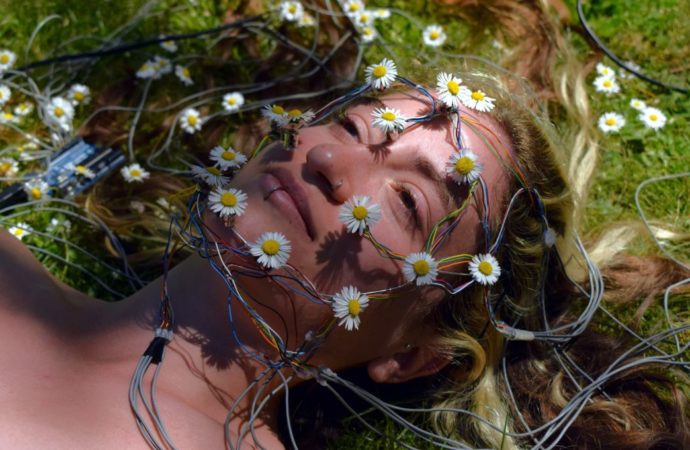
Header image: Bloom (Laura Budia, 2023). Interactive installation. Photo © Laura Budia.
Nadie ha publicado ningún comentario aún. ¡Se tú la primera persona!