

In The Black Ball, presented at the 79th edition of the Festival de Cannes, Javier Calvo and Javier Ambrossi embark on their most ambitious project to date, following their first feature film and a series of memorable television works: a 155-minute epic about historical memory, the repression of homosexuality, and the wounds that still remain open in Spanish society. Loosely based on The Dark Stone by Alberto Conejero and structured around the mysterious unfinished work by Federico García Lorca that gives the film its title, the Javis’ proposal combines historical melodrama, fantasy, memorial reconstruction and political vindication within a triptych structure spanning three historical moments—1932, 1937 and 2017—linked by the same invisible thread of desire, pain and inheritance.
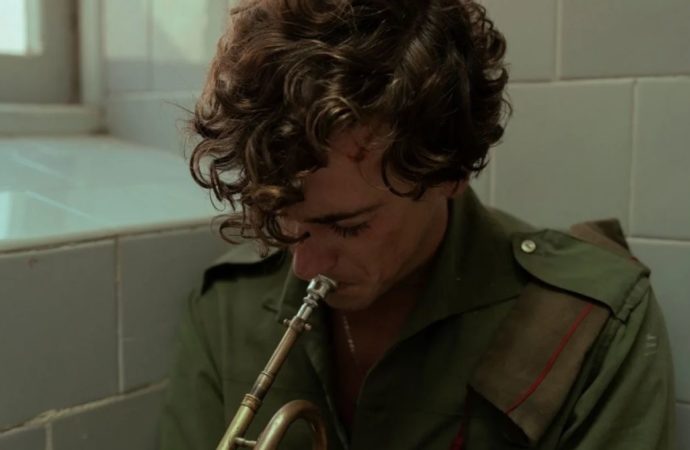
The film opens in 1937 with a dazzling sequence. In a small Spanish village, a municipal brass band prepares to welcome the Italian troops who supported Franco’s military uprising. As the discordant notes of Soldadito español echo through the streets, the Regia Aeronautica suddenly bombs and strafes the civilian population. Horror erupts with a violence that is as abrupt as it is absurd. Among the victims is the mother of Sebastián (Guitarricadelafuente), a young trumpeter who watches in disbelief as those who were supposed to arrive as allies become executioners.
Confusion and emotional devastation crystallise in one powerful image: Sebastián flees by desperately climbing the monumental sculpture of a mutilated Saint Sebastian inside a ruined church. The arrows piercing the martyr become both physical and symbolic handholds for a young man who, within a matter of minutes, has lost his innocence and shed his former self.
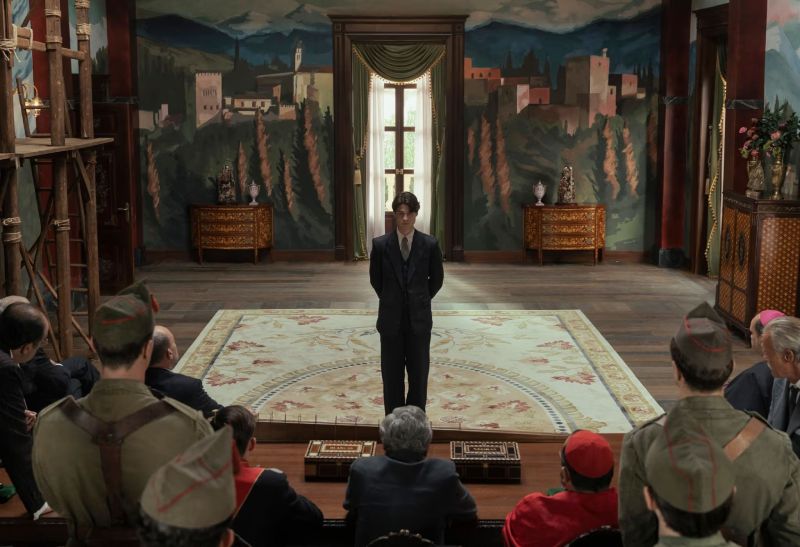
This simultaneously hyper-realistic and deeply symbolic opening, visually magnificent throughout, establishes the tone of a film that uses the persecution of homosexuality as an emblem of all forms of repression: political, cultural and intellectual oppression, as well as the suppression of women’s emancipation. With sexual freedom as its banner and the denunciation of intolerance as its driving force, The Black Ball seeks to function simultaneously as an act of remembrance, a gesture of symbolic reparation and an attempt—however difficult—at reconciliation between victims and perpetrators.
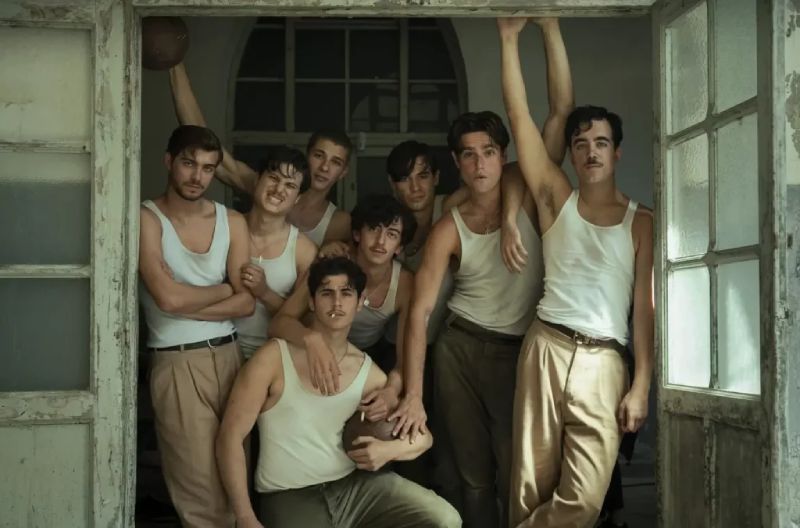
The episode set in 1937 finds its dramatic core in the encounter between Sebastián and Rafael Rodríguez Rapún, portrayed by an outstanding Miguel Bernardeau. A football player, engineer, socialist activist, Republican lieutenant, actor and secretary of La Barraca, Rapún was also Federico García Lorca’s last great love. Reclaimed for historical memory through the work of Ian Gibson and María Teresa León, his figure serves here as both an emotional and ideological catalyst for Sebastián and as the foundation upon which the film’s entire narrative architecture is built. The relationship between the two men becomes the seed from which Ambrossi and Calvo construct a complex web of connections, seeking to bridge generations separated by war, dictatorship and decades of silence.
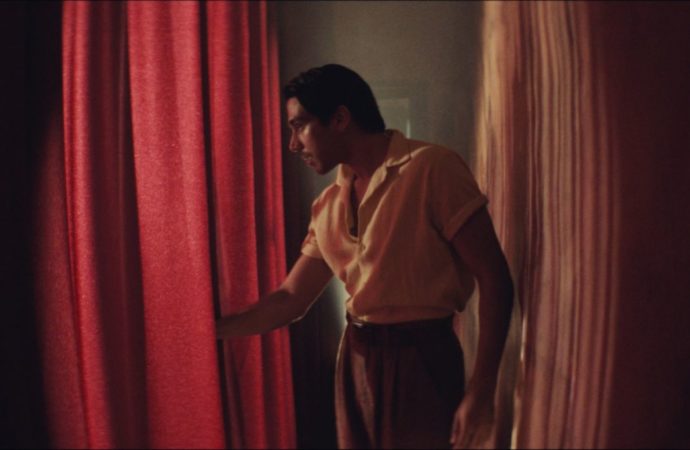
The second movement, set in 1932, is probably the film’s most inspired from a visual standpoint and the one in which fantasy soars the highest. Through a young man played by Milo Quífes as a stand-in for Lorca himself, within this layer of metafiction, the film explores the deeper meaning of the mysterious black ball. The title derives from an unfinished novel by the poet from Granada, of which only a few pages and a letter addressed to Cipriano Rivas Cherif have survived. In it, a young man is rejected by an exclusive Granada social club because of his homosexuality through a voting system based on black and white balls. The black ball thus becomes a symbol of every form of exclusion, rejection and stigmatisation.
The Javis transform that symbol into a powerful image, as dark as the black sheep themselves, embodying everything accumulated in the hidden corners of Spanish history: forbidden kisses, fear, secrecy, beatings, imprisonment, expulsion from one’s family, marginalisation and alienation. The final sequence of this chapter, visually eloquent and emotionally devastating, draws on influences ranging from Jean Cocteau to Federico Fellini, passing through Andersen’s The Snow Queen. In it, the directors seem to suggest that there may never be justice for innocent martyrs, but there remains the possibility of a society capable of evolving and confronting its past with honesty and critical awareness.
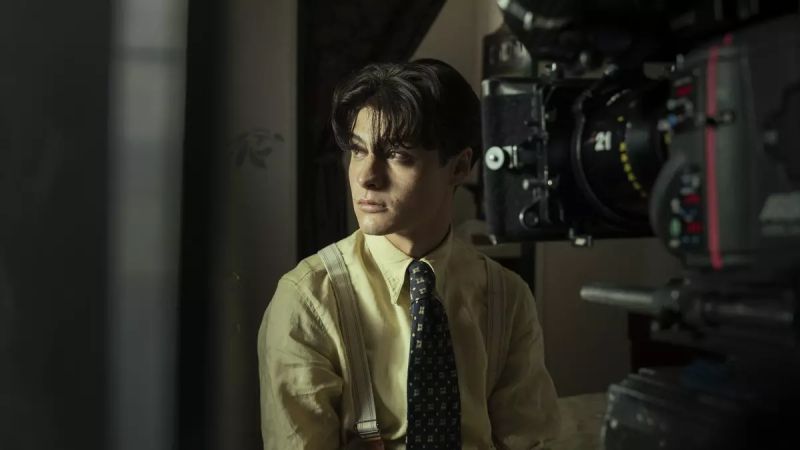
Milo Quífes in La bola negra.
The third timeline, set in 2017, is centred on a gay historian played by Carlos González, the unexpected heir to the supposedly complete manuscript of The Black Ball, preserved for decades by his grandfather. His investigation into the text gradually becomes an investigation into himself. The absence of both father and grandfather, maternal neglect and the weight of family legacy transform his own biography into a troubled enigma, mirroring that of Lorca’s lost work. This strand also provides the space in which the Javis introduce an explicit reflection on Spain’s relationship with its cultural memory, its tendency towards self-denigration and the neglect of a heritage that often appears to be valued more highly by foreign scholars than by Spaniards themselves. The appearance of Glenn Close speaking Spanish functions precisely as a symbol of that external admiration for a cultural tradition that Spain itself continues to handle uneasily.
Formally, The Black Ball displays an absolute creative freedom. That freedom is simultaneously its greatest strength and its principal weakness. The Javis seem unwilling to renounce a single idea, symbol or reference, however repetitive or prolonged it may become. The result possesses genuine freshness, uncommon energy and moments of authentic visual and emotional inspiration. Yet it also conveys the sense of a work that might have achieved an even greater stature had it approached questions of structure, length and narrative refinement with greater critical distance. Wanting to include everything—and having the means to do so—does not necessarily produce excellence. Even the most extravagant works require a rigorous form capable of allowing talent to flourish without dispersing itself.
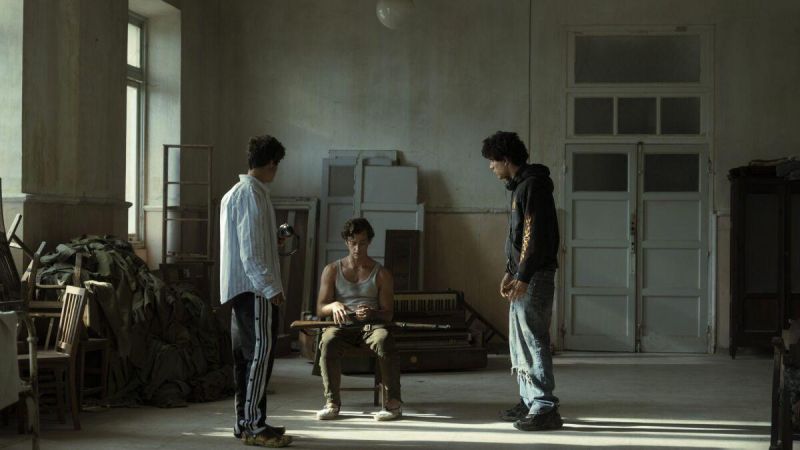
Javier Calvo and Javier Ambrossi directing Guitarricadelafuente in La bola negra.
The film’s achievements are nevertheless numerous. Its approach to homosexuality under Francoism feels both effective and deeply personal; its visual inventions are frequently brilliant; and the performances reach an outstanding level. Particularly noteworthy is the work of Miguel Bernardeau, whose portrayal of Rafael Rodríguez Rapún could well mark a turning point in his career. Less convincing is the musical interlude featuring Penélope Cruz, where broad strokes and somewhat questionable casting choices undermine the genuine emotional impact inevitably evoked by references such as ¡Ay, Carmela! by Carlos Saura.
The most valuable aspect of The Black Ball is not even its formal ambition, but rather its ability to transform a work only barely sketched by Lorca into a contemporary instrument of memory and reparation. By imagining that the manuscript survived the dictatorship in secret and passed through generations hidden among family secrets, the film constructs a beautiful fiction about the persistence of what others sought to erase.
For all its excesses, irregularities and moments of overreach, The Black Ball remains a passionate, deeply personal and politically committed work. It is a film that vindicates the memory of the forgotten, denounces intolerance and asserts the right to exist without asking permission. Although it may not ultimately become the masterpiece it occasionally seems destined to be—or the film that definitively consecrates the creators of The Messiah—it is nevertheless a singular, courageous and necessary work, capable of transforming historical wounds into a collective narrative.
Nadie ha publicado ningún comentario aún. ¡Se tú la primera persona!