

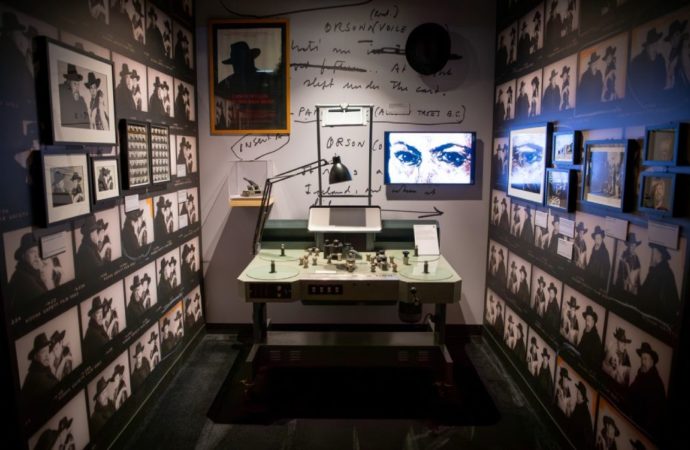
The exhibition My Name Is Orson Welles, inaugurated last year at the Cinémathèque française and now on view at the Museo Nazionale del Cinema in Turin until October 2026, does not so much demystify as expand a myth, unfolding it in space until it becomes legible in its full breadth. Those in search of demystification may instead find that the legend ultimately eclipsed the complexity of a career that never ceased to reinvent itself, now reclaimed through an exhibition destined to leave a lasting mark.
Conceived by the Cinémathèque and curated by Frédéric Bonnaud, with scientific collaboration from Esteve Riambau and François Thomas, the exhibition brings together more than 400 pieces—photographs, documents, drawings, audiovisual materials, and installations. In its Italian venue, these unfold along the helical ramp of the Mole Antonelliana, forming a journey that resists linear chronology in favor of tracing the folds of a life marked, from the outset, by exceptionality. As Bonnaud notes in the curatorial text, to exhibit Orson Welles is to unfold in space the meanders of a life placed from the very beginning under the sign of the extraordinary.
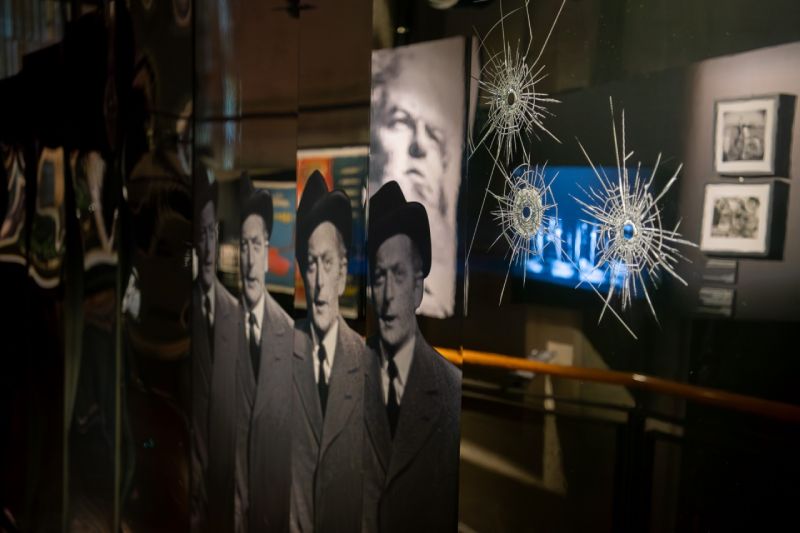
Museo Nazionale del Cinema, Turin.
Because Orson Welles was not only the director who revolutionised cinematic language with Citizen Kane, nor merely the creator of one of the most hypnotic sequences in film history in The Lady from Shanghai, nor the radical experimenter behind F for Fake. He was also an actor, writer, magician, radio storyteller, man of the theatre, and draftsman—a true one-man band, in Frédéric Bonnaud’s words, whose work moves across disciplines without hierarchy, as if each medium were a natural extension of his creative impulse.
The exhibition rightly insists on that foundational moment that was Citizen Kane. The first feature film of a young man already famous, received simultaneously as a masterpiece and a scandal, and threatened by the very media power that inspired it, the film did not merely transform cinema. As Bonnaud recalls, it never disappoints, having lost none of its capacity to unsettle. That ability to disturb, rather than simply dazzle, may well be the true core of its modernity: a silent revolution that operates from within the forms themselves.
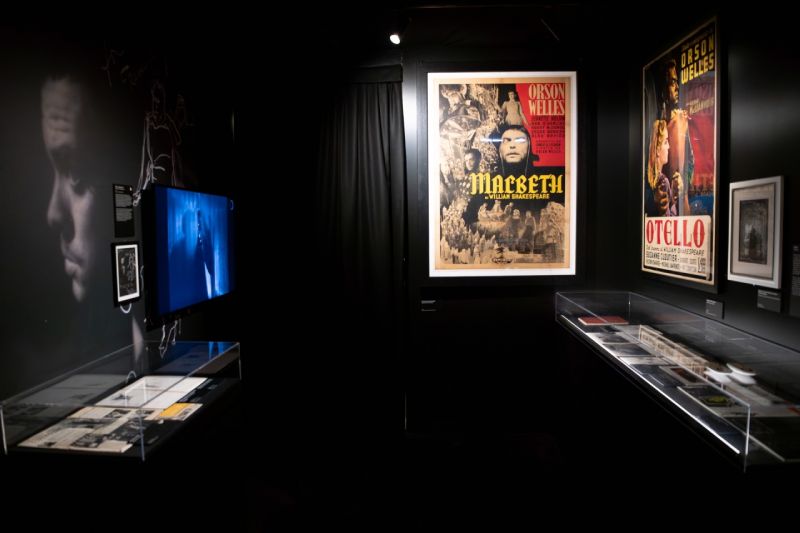
Museo Nazionale del Cinema, Turin.
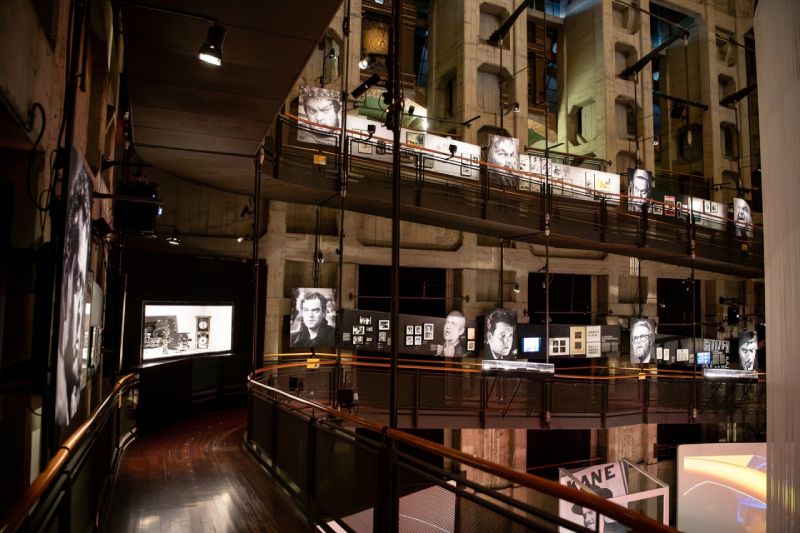
Museo Nazionale del Cinema, Turin.
The exhibition also opens onto his lesser-known facets: drawings, paintings, even sculptures that reveal an artist who, as Frédéric Bonnaud notes, “also thought with his hands.” Far from being a marginal appendix, these works deepen the understanding of his cinema, which is closely tied to the materiality of gesture and to artifice conceived as a conscious construction.
If there is a unifying thread throughout the exhibition, it is the idea of illusion, not as deception, but as a critical tool. Masks, disguises, and multiple identities run through his work, turning his own face into a space of constant invention. In Orson Welles, cinema is not mere fiction: it is a device for interrogating the truth of images, for challenging the relationship between what is seen and what is real.
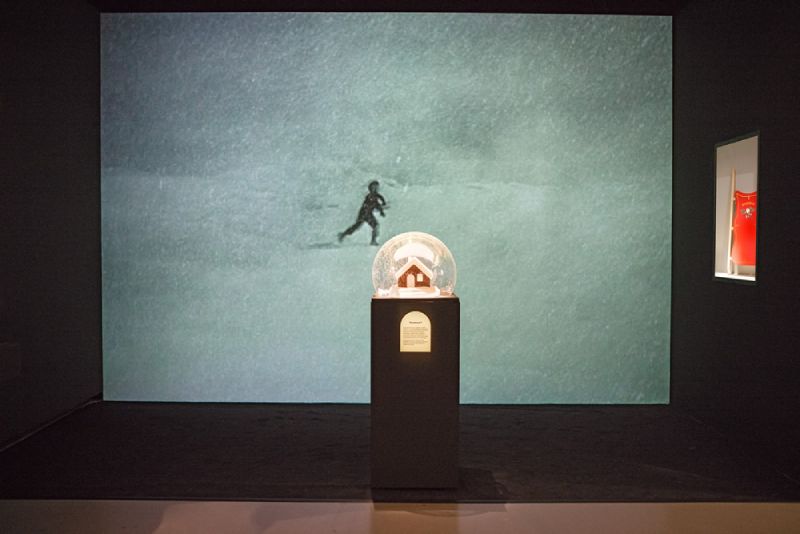
Cinémathèque française.
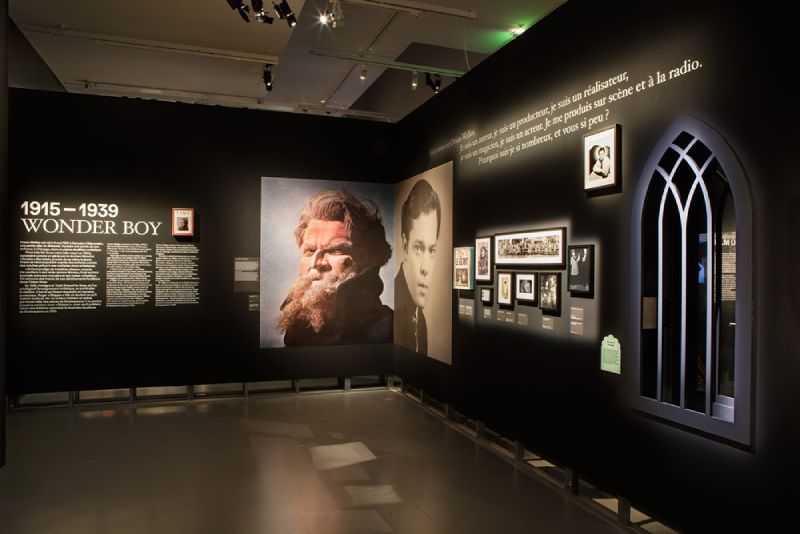
Cinémathèque française.
After moving through the exhibition, one is left with an unavoidable sense of instability —one that must be accepted, along with the impossibility of fixing a single, definitive image. The trajectory does not close in on itself; like his own cinema, the exhibition extends a restlessness: that of an artist who understood that every image is, ultimately, a form of illusion—and, precisely for that reason, a path toward truth.





Nadie ha publicado ningún comentario aún. ¡Se tú la primera persona!