
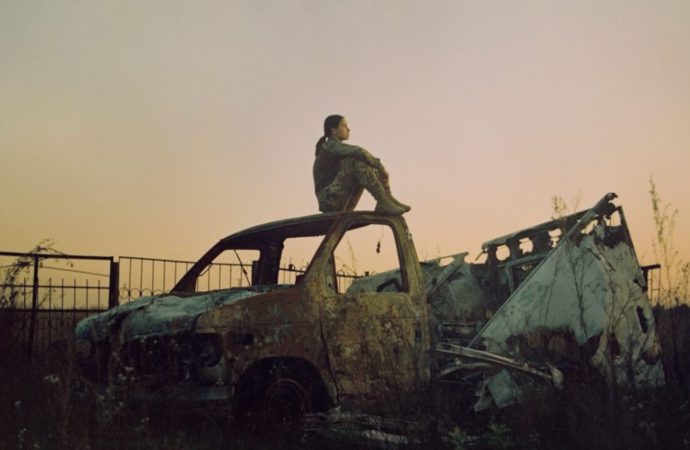

Among contemporary Ukrainian war documentaries —emerging since 2014 and intensifying after 2022— many offer repetitive perspectives on the conflict, merging into a continuous stream of images too immediate to fully process the complexity of the ongoing conflict. Mariinka (Pieter-Jan De Pue, 2026), however, distinguishes itself through its narrative ambition, visual precision, and an encompassing—almost Biblical—perspective on a war that transcends the Ukrainian context, challenging broader notions of allegiance, patriotism, faith, and brotherhood.
Over the course of more than a decade, Pieter-Jan De Pue follows several protagonists from the war-torn east of Ukraine, demonstrating a level of commitment that distinguishes his work from the rapid, reactive output typical of contemporary war reportage. His subjects are far from conventional: shaped by difficult social environments, they carry the weight of early trauma even before the war enters their lives. When it does, it becomes fertile ground for further psychological fracture.
De Pue approaches this intricate and emotionally charged narrative without overt judgment, offering no explicit political stance.
Across an intense 94 minutes, the film traces lives struggling to endure within a collapsing world: one brother recovering from severe war injuries, another fighting on the Ukrainian side, a third aligned with Russian forces, and a fourth adopted by a conservative, deeply religious American family—rooted in evangelical values and a strong military ethos—yet unable to escape the pull of his past, drawn back toward the war with an almost fatalistic inevitability. Alongside them unfold the stories of two women: a paramedic working on the Ukrainian front, and a young woman surviving in the ruins of a shattered town, smuggling goods across a newly imposed border that has violently divided communities once united.
De Pue approaches this intricate and emotionally charged narrative without overt judgment, offering no explicit political stance. Instead, he focuses on the universal consequences of war—on bodies, on memory, on identity. Yet the film’s intelligent editing invites reflection on recurring patterns that echo across conflicts. On both sides, fighters seek religious blessing before entering battle; faith becomes a tool of justification as much as of comfort. In one striking image, a chaplain blesses military equipment with holy water—an act at once absurd and deeply tragic, yet entirely real.
Mariinka pays tribute not only to individual fates but also to the land itself. Brutal combat footage—often containing highly sensitive material—is juxtaposed with haunting, almost otherworldly images of the terrikons, the coal heaps that dominate the Donbas landscape. Shot on 16mm, the film captures devastation with a tactile, almost lyrical quality. De Pue’s camera finds moments of fragile beauty amid destruction, offering brief instances of meditative stillness—only to have them abruptly shattered by the relentless intrusion of war.
In its scope and intensity, Mariinka can feel overwhelming. Unlike many contemporary documentaries, it refuses simplified narratives and resists the comfort of clear moral binaries. The division between good and evil, so often imposed to make conflict more comprehensible, dissolves here into something far more ambiguous and unsettling. De Pue does not guide the viewer toward easy conclusions. Instead, he constructs a film that is at once chaotic and precise, poetic and brutal, intimate and expansive.
What remains is a demanding experience—one that asks the viewer not only to watch, but to confront, process, and endure. It offers no resolution, no catharsis. But neither does the reality it depicts. For the film’s protagonists—as for millions affected by a war now stretching into its second decade—there is no clarity, only continuation filled with devastating uncertainty.


Nadie ha publicado ningún comentario aún. ¡Se tú la primera persona!