
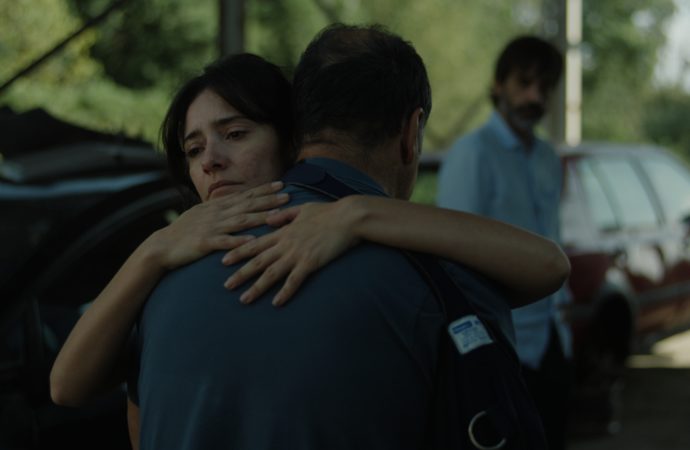

A co-production between Spain, Portugal and Greece, the film explores grief, belonging, the transformation of the landscape and the contradictions of the energy transition.
We meet the director, who is presenting his film at the 67th Thessaloniki International Film Festival, on a grey, rainy morning worthy of Angelopoulos himself — a filmmaker whose name will come up later in our conversation, with just one degree of separation.
That question became the starting point for a fictional story that gradually took on other concerns. At the time, as he tells us, the director had left the Galician coast to settle in inland Ourense, where his then-partner was from. The move introduced him to a rural reality very different from the one he knew and brought him into contact with a community confronting the growing development of wind farms.
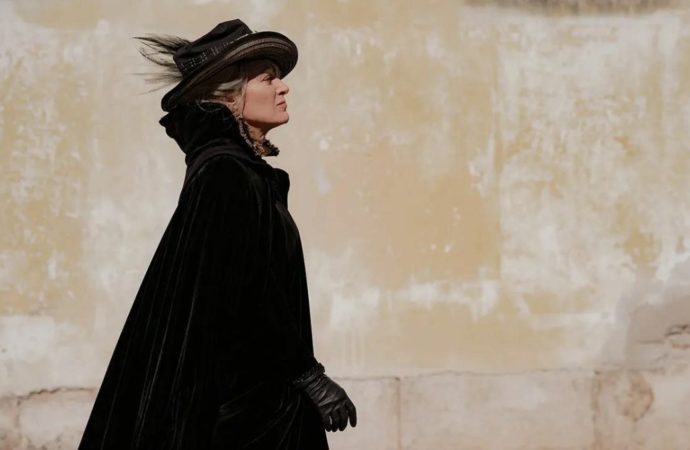
Three experiences eventually converged in the screenplay: his friend’s bereavement, his own move to unfamiliar surroundings, and the social conflict generated by a particular model of energy development. From their intersection emerged Ana, a forty-year-old woman who returns to a place she had once fled and must confront both her father’s death and the decisions that have shaped her life.
The choice of age was deliberate. “I found it very interesting to explore what it means for a forty-year-old woman to come here and forge a new identity,” he explains. The filmmaker, who was also forty when he began developing the project, wanted to challenge the assumption that life should already be firmly settled by that age. “We’ve been taught that by forty you should have an established career, a clearly defined identity, a profession.” Against these expectations, Ana embodies both the possibility and the difficulty of starting over.
The presence of someone who is no longer there
One of Wild Is The Wind‘s greatest achievements lies in the way it evokes the absent father. Although he never appears in the narrative’s present, his presence permeates the spaces, objects and memories that surround Ana.
“We worked extensively on how to make someone invisible feel present, how to convey presence through absence,” the director explains. The father’s workshop becomes one of the central spaces through which his memory is evoked. During the writing process, they even considered small physical traces, such as cigarette butts, suggesting that he had been there only moments before.
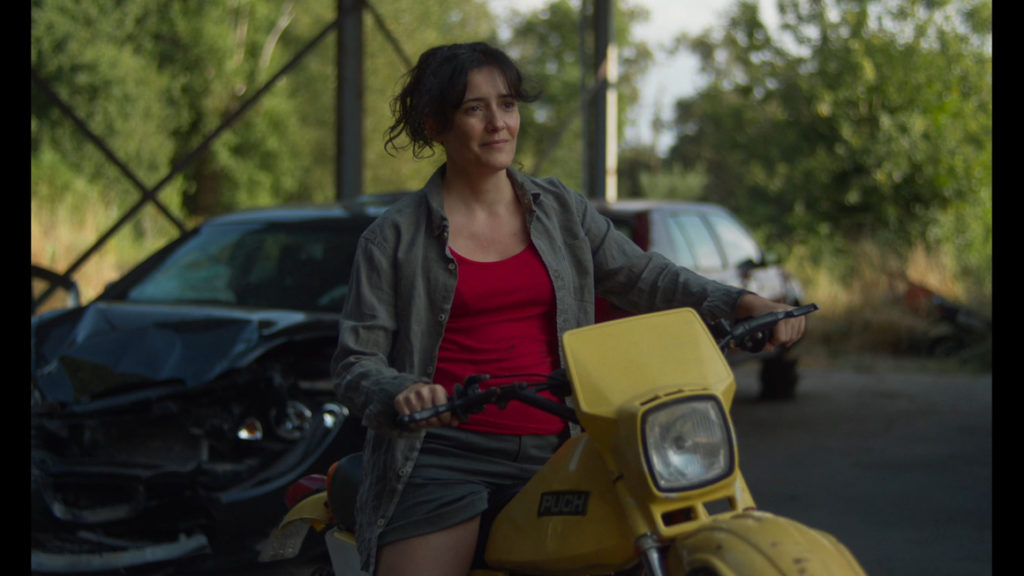
Domínguez Serén reveals a particularly meaningful detail. In one scene, as Ana washes her hands, a man’s hand enters the frame and touches her. “It’s my own father,” the filmmaker confides.
Making the film has also transformed his relationship with his own family. He has returned to the region where he grew up and is restoring his parents’ house, in a process that unexpectedly mirrors his protagonist’s journey.
“Since making this film, I’ve noticed that I’m spending much more time with my parents. I don’t want to lose them,” he admits. The lesson may seem simple, but it takes on a deeper meaning when one has witnessed someone struggling with the impossibility of recovering lost time: “Make the most of the time you have, because they won’t always be there.”
The landscape as a site of conflict
Ana’s personal grief unfolds in a territory experiencing another kind of loss: the transformation of its landscape and way of life.
Wild Is The Wind addresses the controversy surrounding the construction of wind farms without reducing it to a simplistic confrontation between supporters and opponents of renewable energy. The issue it raises is not so much the legitimacy of the energy transition itself, but the economic, social and territorial conditions under which it is taking place.
“You can be an environmentalist, you can support renewable energy, and still disagree with the extractivist model,” Domínguez Serén argues.
The director draws a parallel between historical forms of natural resource exploitation and today’s energy development. What affected communities are questioning, he explains, is the fact that the economic benefits do not adequately flow back to local residents, while certain rural areas bear an extraordinary concentration of infrastructure.
Moreover, the impact extends far beyond the visible presence of wind turbines. As the director explains, their installation requires the construction of access roads, massive concrete foundations and the transformation of land used for farming and livestock. Domínguez Serén points to disruptions to watercourses, difficulties faced by livestock farmers and the consequences for rural tourism among the concerns raised by local residents.
In one of the film’s community assemblies, a local resident warns that those who will profit from wind energy are the same people who once exploited the mines. The remark encapsulates a historical mistrust: the fear that the transition to new energy sources will reproduce the inequalities of earlier economic models.
Nevertheless, the filmmaker insists that he never intended to draw a moral dividing line between his characters. Much of the dialogue emerged from conversations overheard in local bars, where he encountered opposing viewpoints rooted in legitimate concerns.
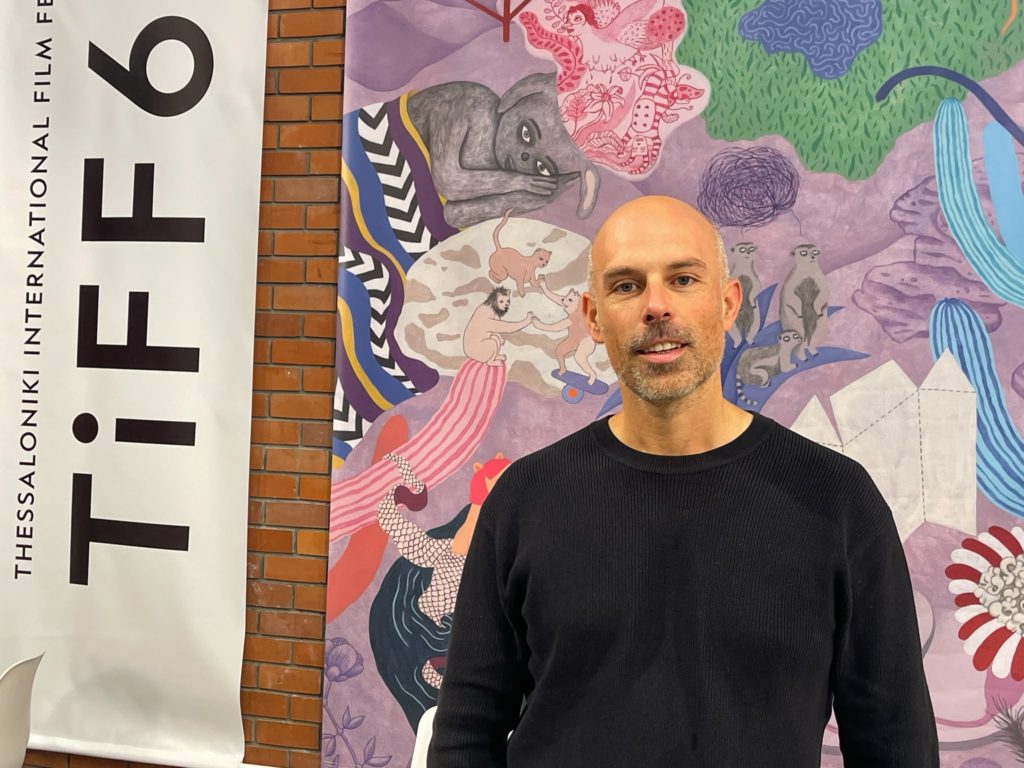
Eloy Domínguez Serén at Thessaloni Festival. Photo © El Hype.
“Everyone is right from their own point of view. And from their own point of view, they’re being honest,” he says. “There are no dark forces at work. It’s not Machiavellian. It’s not about wanting to hurt your neighbour.”
In this respect, Wild Is The Wind deliberately distances itself from portrayals of rural communities as places where conflict between neighbours inevitably leads to violence.
Particularly significant is the comunidad de montes, a traditional Galician institution based on the collective ownership of certain areas of land. For Domínguez Serén, it offers a particularly compelling expression of the relationship between territory and community life: “The mountain land belongs to everyone. Simply by being a resident, you have the right to be a co-owner. For better or worse, we have to reach an agreement.”
Meritxell Colell and the creation of Ana
The screenplay for Wild Is The Wind was developed in collaboration with filmmaker Meritxell Colell, whose contribution proved decisive both in shaping the narrative structure and in developing the protagonist’s psychological complexity.
Domínguez Serén acknowledges that his documentary background had accustomed him to working through prolonged observation and the accumulation of material. Colell, a director, screenwriter and editor, brought a more clearly defined approach to the film’s dramatic structure.
“She has a very strong sense of narrative structure,” he explains. But her collaboration was equally important in exploring Ana’s inner world and the different ways she might respond to personal and family conflicts.
“She offered me her perspective on certain aspects of the character, not only psychological ones, but also how she relates to other people,” he recalls. Alongside this insight, Colell brought a poetic sensibility that he considers essential to the finished film.
Melania Cruz’s performance is another of Wild Is The Wind‘s central strengths. Ana is a reserved, contradictory woman who does not immediately reveal the reasons behind her behaviour. Her inner world gradually emerges through silences, gestures and restrained reactions.
To develop this complexity, Colell, Domínguez Serén and Cruz undertook an unusually extensive preparation process, beginning six months before filming.
One of their most interesting methods involved a diary that the actress wrote in the first person, as though she were Ana. Rather than recounting events from the film, the diary explored imagined memories from the character’s earlier life.
“We would tell her: write an entry about the day you met, or your second anniversary, or the day you started working at the factory,” the director explains. The exercise helped construct an emotional biography that never needed to be explicitly revealed on screen, but informed every gesture the character made.
Ana’s relationship with Luis, her partner of fourteen years, was developed with equal care. Over several months, Domínguez Serén arranged meetings, dinners and shared experiences between the two actors, encouraging them to develop a genuine familiarity.
“I wanted to help them get to know each other so that you would believe they’d been together for fourteen years.” This preparation goes a long way towards explaining the naturalism of a relationship undergoing a crisis without the need for dramatic verbal confrontations.
From documentary to fiction
The decision to work in fiction also reflects an ethical consideration of the limits of documentary filmmaking, the genre from which Domínguez Serén emerged.
His friend’s experience could have provided the basis for a documentary about grief. Yet the director felt uncomfortable with the idea of bringing a camera into someone else’s experience of loss. “It felt too intrusive to enter someone else’s grieving process,” he acknowledges.
Fiction offered him the freedom to explore those emotions without asking a real person to expose their suffering. He could construct a dramatic experience and then, through the actors, discover the emotional truth he was seeking.
Nevertheless, the result retains certain qualities of his documentary approach: an attentiveness to spaces, the observation of community relationships, a sensitivity to the passage of time and a considerable trust in what the characters leave unspoken.
According to the director, this restraint is connected to certain characteristics of Atlantic culture. “In Galicia, when I think about my family and my neighbours, conflicts are rarely expressed openly. We’re very restrained in the way we communicate.”
It is a sensibility he also recognises in Portuguese culture, expressed through the strong relationship between people, the landscape and their cultural heritage.
Yet when asked about the universality of his film, Domínguez Serén does not believe that its regional specificity limits its reach. On the contrary, he identifies three ways in which audiences from any background can connect with the story: grief, the breakdown of a romantic relationship, and the conflict between individual and collective interests.
A Galician film that also speaks Greek
The screening of Wild Is The Wind in Thessaloniki holds particular significance because of Greece’s involvement in its production. The film is a co-production between Spain, Portugal and Greece, bringing together three national cinemas through a story deeply rooted in the Galician landscape.
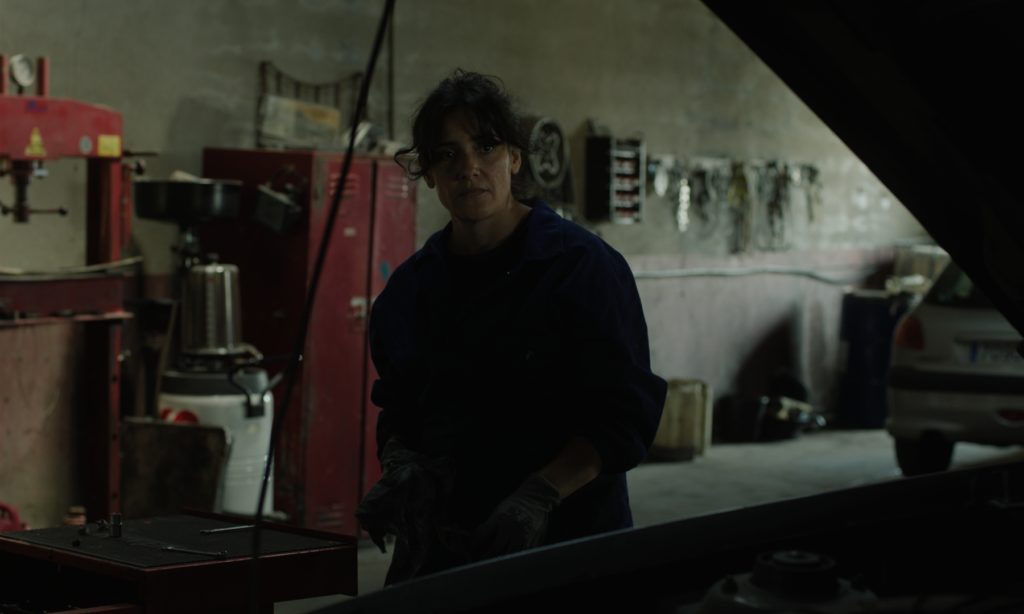
The Greek production company Asterisk played an important role in the film’s technical and artistic development. Sound recordist Alexis Koukias-Pantelis took part in the shoot, spending five weeks surrounded by people speaking Galician.
Post-production took place in Greece, including colour grading, sound design and mixing, and visual effects. The colour grading was carried out by Gregory Arvanitis, son of Giorgos Arvanitis, renowned for his work as cinematographer with Theo Angelopoulos.
The collaboration also led to unexpected cultural encounters. Domínguez Serén recalls that, while walking through Greece, he sometimes has the impression of hearing Spanish because of certain similarities in intonation. This acoustic resemblance made it possible to incorporate Greek voices into some of the film’s background soundscapes, such as the conversations heard in the bar.
Beyond the co-production itself, the director finds connections between Galicia and Greece in the conflicts affecting their rural communities. He mentions, for instance, protests against certain wind farm projects on the island of Evia, illustrating how the tensions explored in Wild Is The Wind extend far beyond Spain’s borders.
Domínguez Serén’s cinema refuses to offer easy answers. Grief does not necessarily bring reconciliation, returning home does not mean recovering the past, and defending a territory does not erase disagreements among those who inhabit it. Tralovento —original title, a word coined by the director and rendered in English as Wild Is the Wind — continues to blow and reverberate long after the final credits, leaving us exposed to the force with which it dismantles our fragile certainties, as so powerfully captured in the film’s final scene.
Nadie ha publicado ningún comentario aún. ¡Se tú la primera persona!