
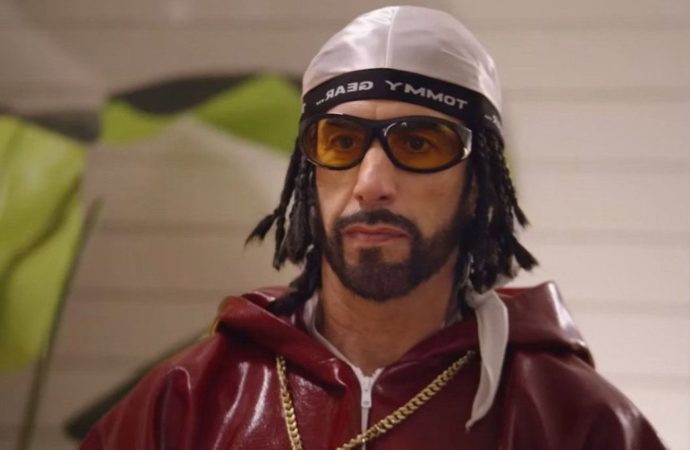

The creator of Borat brings Ali G back more than two decades later and makes his feature-film directorial debut — having previously directed the television series Who Is America? (2018) — with a film that combines political satire, action, and encounters with real people.
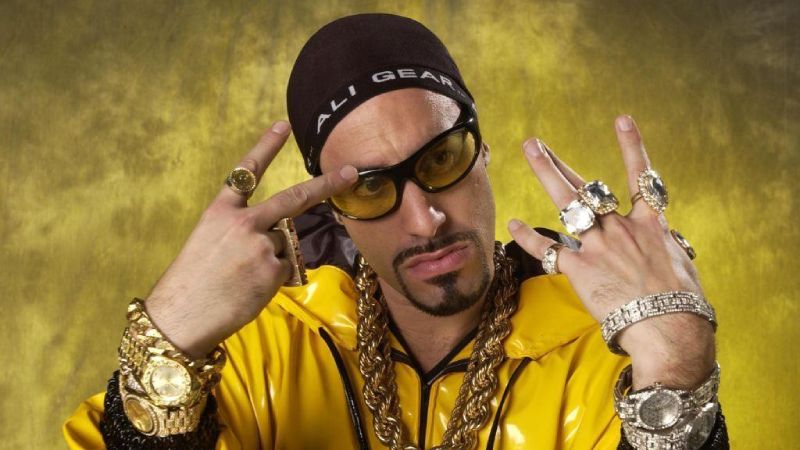
Ali G is one of those characters seemingly destined to remain trapped in the era that gave birth to them. The eccentric, middle-class aspiring rapper, convinced that he represents an urban culture he barely understands, returns in Ali G: Who Iz I? to confront a world he no longer recognises.
Ali G’s return has already sparked considerable controversy in the UK. Critics have questioned the character’s continued reliance on racial stereotypes and cultural appropriation as sources of humour, while a campaign has even called on cinemas not to screen the film. The debate raises a question that goes beyond Baron Cohen’s stated intentions: does exposing prejudice through comedy necessarily challenge it, or can it also perpetuate the very stereotypes it seeks to ridicule? This distinction is particularly relevant to a film whose creator continues to defend provocation as a means of social criticism.
Sacha Baron Cohen presented his new film at an international press conference on 21 October 2026, moderated by film critic Joe Neumaier, during which he reflected on the boundaries of comedy, cancel culture and the dangers of misinformation. The Amazon Studios production combines hidden-camera comedy, thriller elements and action cinema.

The story begins when Ali G discovers that Julie, his long-term partner, is pregnant. Faced with the prospect of becoming a father, he decides to travel to the United States to reclaim his former glory. However, what begins as another adventure for the character develops into a satire of political polarisation, cultural prejudice and the ease with which people can justify extreme behaviour when they believe they are acting in the name of a righteous cause.
For Baron Cohen, the key is that Ali G has not evolved. It is society that has changed around him.
“The characters don’t change. What’s funny is that the world changes, and we can observe that transformation through them.”
The filmmaker acknowledges that his protagonist remains inherently problematic: a white man who appropriates cultural codes that are not his own, makes sexist remarks and displays almost limitless ignorance. Yet he also insists that beneath this exterior lies a surprisingly innocent intention: to combat hatred and encourage people to live together peacefully.
Satire and the Limits of Provocation
Controversy has accompanied Sacha Baron Cohen throughout much of his career. From Borat to Brüno, his characters have created uncomfortable situations in which humour serves as a means of exposing behaviour that the real people involved would probably prefer to keep hidden.
During the press conference, the actor explained that his primary motivation remains making people laugh. His obsession with comic effectiveness goes so far as to measure audience laughter during test screenings and adjust the editing to achieve as many laughs per minute as possible. Yet behind this almost mathematical approach lies a political intention
Baron Cohen recalled a performance as Borat in an Arizona bar, where he sang an antisemitic song and persuaded some members of the audience to sing along. For the comedian, their reaction exposed a prejudice that might otherwise have remained concealed.
Satire, he explained, is precisely a way of shining a light on issues that society is not always willing to discuss openly.
In Ali G’s case, the mechanism is particularly complex. The character appropriates expressions, gestures and references from African American culture while understanding very little of their meaning. His creator insists that the targets of the joke are not the communities he imitates, but those who adopt their cultural codes superficially. Baron Cohen recalled a line from screenwriter Colton Dunn that sums up this intention: “Ali G is not racist. He’s a tool to expose racists.”
The filmmaker nevertheless acknowledges that this approach means accepting conflicting interpretations. He recalled that Brüno, which he conceived as a denunciation of homophobia, was itself accused of reproducing the prejudices it sought to challenge.
For Baron Cohen, this ambiguity is part of the risk of using provocation as an artistic language.
Ali G: A Character from the 2000s Confronts Today’s Polarisation
The new film expands Ali G’s universe by introducing two other characters played by Baron Cohen: Dr Nira Cain-N’Degeocello and Colonel Morad, figures associated with opposing political extremes.
Both originate from Who Is America?, the programme in which the comedian used fictional identities to interact with real people and explore the contradictions of American politics.
In Ali G: Who Iz I?, these characters allow Baron Cohen to address what he calls an age of “virtuous violence”: situations in which people consider aggressive or contemptuous behaviour legitimate because they are convinced they are defending a morally superior cause.
One example discussed during the press conference was a sequence featuring Dr Nira Cain-N’Degeocello at an African American community centre.
The people attending initially discuss problems that directly affect their community, including gentrification and violence against Black people. Then Baron Cohen’s character appears: a white man convinced that his intellectual and moral authority entitles him to explain what their real concerns should be.
According to Baron Cohen, the scene is intended to challenge the paternalism of those who present themselves as defenders of particular communities without listening to the people who belong to them.
This confrontation between the participants’ reality and the convictions of a fictional character is, as the director explained, one of the central devices of his satirical approach.
Baron Cohen believes that polarisation has created an especially appropriate context for bringing Ali G back. His ignorance, already provocative two decades ago, takes on new meanings in a society marked by identity politics and the scrutiny of public behaviour.
Eight Hours of Filming and a Psychological Experiment
Beyond its political dimension, Ali G: Who Iz I? represents a considerable formal challenge.
Baron Cohen makes his feature-film directorial debut with a film combining action sequences, thriller elements and situations involving people who, he explained, were unaware of the true identities of those standing before them.
Unlike a conventional production, in which actors can repeat a sequence until the desired result is achieved, this kind of comedy depends on spontaneous reactions that are almost impossible to reproduce.
Preparation required meticulous visual planning. The director storyboarded every scene and enlisted Christopher Markus and Stephen McFeely, screenwriters associated with the Avengers films, to incorporate the dramatic tension characteristic of action cinema.
The greatest challenge, however, was the film’s final sequence: an eight-hour continuous action scene spanning approximately 50 miles, twelve locations and forty cameras. Featuring explosions, weapons, a drone and even a birth, the sequence required Baron Cohen to switch between different characterisations while maintaining the credibility of the situation among people unaware of the true purpose of the shoot.
The filmmaker explained that the sequence required the coordination of approximately four hundred narrative beats. A single mistake could lead one of the participants to realise they were being deceived, destroying the continuity of the experiment.
The greatest challenge was the film’s final sequence: an eight-hour continuous action scene spanning approximately 50 miles, twelve locations and forty cameras.
The production also suffered a particularly costly setback: during an initial attempt, a forest fire forced the evacuation of one of the locations and brought filming to a halt. Baron Cohen said the incident resulted in losses running into millions of dollars, some of which he had to cover personally.
The complexity was compounded by the prosthetics required to portray two of his characters, involving up to five hours of make-up before beginning a day’s filming in extreme heat.
However, the decision to shoot the sequence in this way was not motivated solely by technical ambition. The director explained that he needed to preserve the continuity of the reactions because the scene had been conceived as a psychological experiment inspired by Stanley Milgram’s studies of obedience to authority.
The intention was to observe how far certain individuals might go when someone legitimised their actions or presented them as necessary. Baron Cohen avoided revealing the essential details of the ending but said that some of the responses exceeded his own expectations.
Misinformation and the Dangers of a Divided Society
The Milgram experiment connects the film’s formal approach with its central political concern.
Baron Cohen believes contemporary societies are going through a particularly dangerous period, characterised by the concentration of control over information, the spread of conspiracy theories and the gradual disappearance of a shared understanding of reality.
During the press conference, he warned that democracies need a common set of facts to sustain public debate. When those facts are replaced by incompatible narratives, coexistence becomes increasingly difficult.
The comedian also expressed concern about artificial intelligence and the influence certain actors can exert over the information sources used by these systems.
When leaders lie, the consequences can be deadly.
In his view, the problem lies not only in the circulation of false information but also in the consequences that can follow when citizens act on manipulated beliefs.
Baron Cohen presents the film as an exploration of the relationship between information, obedience and violence, using real-life situations created by fictional characters.
Music, Improvisation and Sacha Baron Cohen’s Directorial Debut
Music is another new element in the film. Baron Cohen explained that, during editing, he felt the soundtrack still did not adequately reflect Ali G’s personality. To address this, he turned to his brother Aaron, who was responsible for the original music for the television programme.
Producers Andrew Watt and Hit-Boy subsequently joined the project, and together they developed an eleven-track soundtrack in approximately six weeks.
The filmmaker explained that his experience in musicals such as Sweeney Todd and Les Misérables had helped him understand the narrative possibilities of songs. Rather than using them merely as accompaniment, he decided to turn them into an expression of Ali G’s inner thoughts.

His directorial debut also draws on lessons learnt from some of the filmmakers he has worked with. He particularly recalled Martin Scorsese, who allowed him to observe the directing process during the filming of Hugo, and Tom Hooper, from whom he learnt the importance of close-ups in capturing emotionally intense performances.
The conversation also revealed some details of his forthcoming collaboration with Quentin Tarantino, who has offered him the leading role in a stage play for which he is training in sword fighting.
The contrast is considerable: while Ali G: Who Iz I? relies heavily on improvisation and the unpredictable reactions of real people, working with Tarantino demands meticulous attention to every word of the script.
Can Satire Still Bring a Divided Society Together?
Despite the film’s technical and political complexity, Baron Cohen repeatedly returned to a much simpler idea: his stated ambition to make audiences laugh together. The director explained that he had organised numerous test screenings and continued to adjust the editing in response to audience reactions.
During the conversation, he recalled the influence of Monty Python, Mel Brooks and South Park, as well as the importance of Stanley Kubrick’s cinematic satire Dr Strangelove or: How I Learned to Stop Worrying and Love the Bomb. In the latter, he found a particularly significant reference point: a comedy capable of provoking laughter while contemplating the possibility of collective catastrophe.
Baron Cohen acknowledges that some audiences will find his work offensive and others will reject his methods outright. Yet he insists that controversy is not his primary objective.
The director of Borat presents his film as an attempt to restore the possibility of people with opposing political views sharing a common experience.
Whether Ali G: Who Iz I? succeeds in challenging prejudice or instead ends up reproducing some of the stereotypes it seeks to condemn remains to be seen. Baron Cohen’s defence of satire as a tool against intolerance is central to his artistic approach, but a creator’s intentions do not necessarily determine how a work is received or interpreted. In a cultural climate increasingly divided over the boundaries of comedy, Ali G’s return raises the question of whether the provocations that defined the character two decades ago still have something meaningful to say.
Source: International press conference for Ali G: Who Iz I? (21 October 2026), moderated by Joe Neumaier, film critic for WOR Radio, featuring Sacha Baron Cohen.



Nadie ha publicado ningún comentario aún. ¡Se tú la primera persona!