
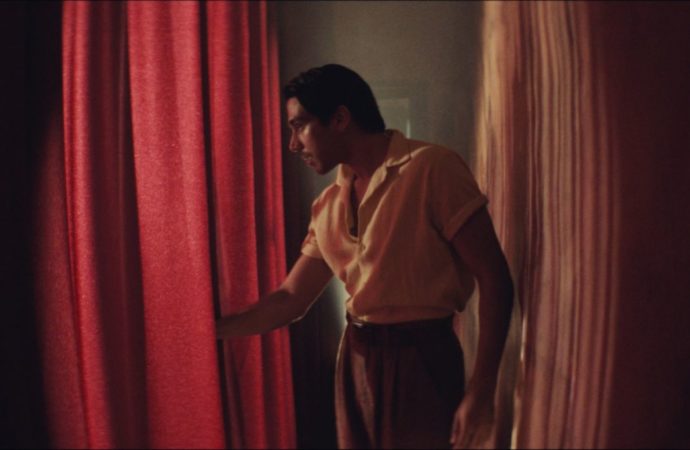

Eight years after The Heiresses, Marcelo Martinessi returns with Narciso —winner of the FIPRESCI Prize at the Berlin Film Festival and his country’s submission for the Academy Awards—, a film that retains the dense, absorbing atmosphere of his previous work while shifting its gaze from the intimate sphere to the social body. In Paraguay in 1959, a young man (Diro Romero) returns from Buenos Aires fascinated by rock and roll and soon becomes a radio star, an object of desire for both men and women, and a symbol of a freedom that clashes with an increasingly repressive society. After his final performance, he is found dead. Inspired by the murder of Bernardo Aranda, the film uses the case to explore the mechanisms of fear, morality and repression.
But Narciso also possesses the force of an archetype. Martinessi deliberately keeps him at a distance: we come to know him through those who watch, desire or fear him. Hence the reference to Pasolini’s Teorema that emerges in our conversation: the catalytic character who, rather than revealing himself, forces others to confront what had remained hidden.
With Martinessi, we talk about cinema and atmosphere, desire and repression, masculinities constructed through fear, rock and roll as the possibility of being different, and a film set in 1959 that refuses to remain confined to the past.
EVA PEYDRÓ: In The Heiresses, there was already a very particular atmosphere, almost a density that ultimately seemed to absorb the characters. In Narciso, I feel that density again, but this time it is also accompanied by the force of the archetype. To what extent are you interested in constructing your films through atmosphere rather than narrative?
MARCELO MARTINESSI: I think cinema is atmosphere. The cinema I most admire has a great deal to do with the construction of atmosphere; it is also about the possibilities cinema offers through lighting, colour and space itself. In The Heiresses, I felt there was a much clearer plot. It was a more conventional development—in the best sense of the word “conventional”—of the character of Chela, played by Ana Brun, who is going through a very particular moment in her life. The journey she undertakes has a great deal to do with my aunt’s own journey—the film is based on her diaries.
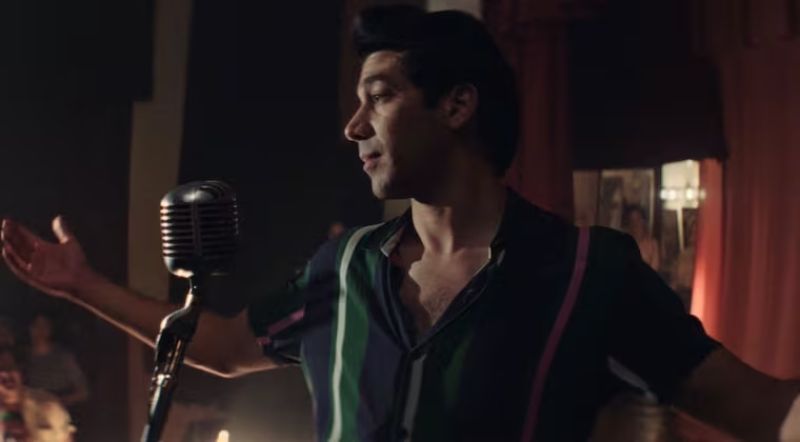
With Narciso, I think that takes on a more public dimension. The atmosphere encompasses an entire historical moment: the late 1950s and the establishment of an authoritarian project. What comes along to disrupt that is rock and roll, brought by a young man who, driven by his passion, simply wants to share music, share a different way of moving, share another possibility with a country that seems determined to plunge itself into darkness.
I do not think of Narciso as a period film in the strict sense of the term. It is very much in dialogue with the present and with the fears we have today that these authoritarian projects might once again strip us of hard-won rights and freedoms. I feel that this dialogue within the film is very universal; it reflects concerns that exist in Spain, France, Brazil and, of course, the United States.
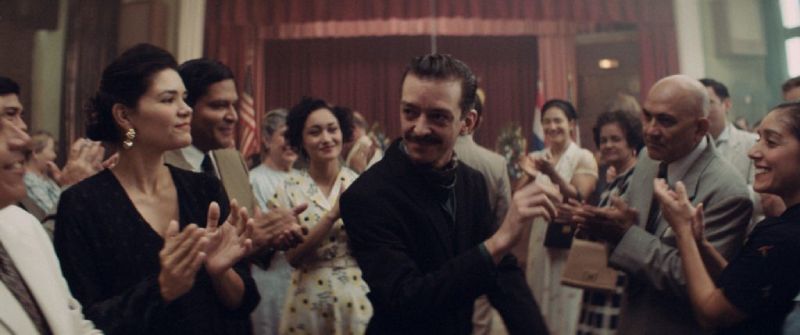
It is a film that allows us to engage with the world through an intensely Paraguayan story without remaining confined within it, while also enabling us to make the film itself somewhat freer, less constrained. A film should leave you with questions; it does not need to answer them all. I think that is very important in cinema today, and particularly in a Paraguayan cinema that is only beginning to establish itself.
Narciso is desired by both men and women, yet we have the impression that we never truly possess him as a character: he exists above all through the gazes and desires that others project onto him. Did you deliberately want to preserve that mystery?
I wanted to think of him as a desired character; it is precisely that mystery that constructs Narciso. I think that any star, anyone who fascinates us, if you look at them too closely, becomes a much more ordinary person, much more like anyone else. So it was important to keep Narciso at a distance and construct him through the image that the radio station owner has of him, through his wife and her gaze, through the young rock-and-roll fans, through the American. In other words, to see how all these people gradually construct this character, who clearly has something mythical about him. I never thought about developing him in the conventional sense. I never said, “Let’s see what he is really like.” I think that was entirely deliberate.
This is a film that feels much more like an ensemble piece to me than The Heiresses, because I feel that what it really does is inhabit the world around him, everything he sets in motion. He comes to shake up a numb society; he brings a little light into a country that is growing increasingly dark. For me, inhabiting him too closely would mean losing the opportunity to observe the social fabric, which is ultimately what interests me: understanding how we all contribute, as a society, through indifference, through looking the other way or through silence, and what role we play in the construction of these projects.
Thinking about Narciso, I was reminded of the visitor in Pasolini’s Teorema: a character who arrives, awakens the desire of both men and women, and acts as a catalyst, revealing something that was already latent in those around him. Are you interested in that tradition of the character who not only drives a story, but reveals others through the desire he provokes?
I love that you mentioned Teorema, Eva, because it gives me the opportunity to tell you that I actually discussed that with the writer. The film is based on real events, but I also approached them through Guido Rodríguez Alcalá’s novel Narciso. At one point, precisely because of the force of that reference, I even considered not calling the film Narciso. But then I felt there were too many elements that gave the film that weight and made such a powerful mythological reference necessary.
At the same time, I was particularly interested in exactly what you mention: desire and repression. In Paraguay, they are practically inseparable. I think that in a country that endured a dictatorship as harsh as Paraguay’s, a country as silent as Paraguay, repression is always embedded within desire. At one point, I considered filming the consummation of desire, filming it differently. I watch a Brazilian film, for instance, and I feel a healthy kind of envy when I see those bodies in bed, those beautiful scenes. But then I think: this is not the story I can tell from Paraguay. So I feel that I make very restrained films, precisely because of that.
You will have noticed that when I film the consummation of desire, I take it only to a very precise limit in the scene between the radio station owner and his assistant. For me, that is the hardest scene in the film, apart from the scene with the list. Those were things I struggled with a great deal: finding exactly the right balance so that they could continue to speak to what interests me, which is a society that remains profoundly repressed, and characters who carry repression in their DNA, characters who do not dare to embrace desire. And that is precisely what Narciso brings with him as a possibility: he embodies what they cannot do. They cannot desire.
There is something almost sacrificial about Narciso: he embodies desire, freedom, modernity and transgression, and ultimately his body is found dead. Were you interested in giving him that dimension as a sacrificial victim of a society that needs to eliminate whatever destabilizes its codes?
Absolutely. I read the book when The Heiresses was being released in Paraguay, at a time when the country’s political and conservative elites were raising the banner of morality against the film—the banner of false morality, really. And I thought, “Wow, this book I’m reading is talking about exactly what is happening to us right now.” We were bringing a breath of fresh air into this numb society, and they were telling us: “Get out. These lesbian women will soon want to get married, they’ll want rights—get them out of here.”
The Heiresses and this book, which I happened to read at that particular moment, allowed me to do precisely that: to understand the society I live in. And from there, the film can also construct a discourse that speaks to the present moment, which I think is the greatest challenge.
There is an extraordinary paradox in the fact that the United States helped politically sustain authoritarian regimes in South America while, at the same time, exporting rock and roll, which introduced young people to an idea of freedom. Were you interested in showing how the same culture could simultaneously export power and rebellion?
That was more of a consequence. I don’t think it was at the heart of my thinking about the film from the outset; it was something that emerged along the way. I work with actors who are human beings and who bring a great many elements into the film, things that have to be incorporated and moved around. As they become part of the project, I adapt the screenplay and the scenes.
In that sense, the involvement of Nahuel Pérez Biscayart (Mr. Wesson), who is a great actor, brought those possibilities into the film: the chance to inhabit the world of the Cold War more fully, and to explore a country that, on the one hand, imposes certain values and, on the other, brings with it an enormous desire for freedom.
I think that was already there, but I would say it was more of a discovery. The film contains so many things that I am increasingly convinced cinema should be like life, which is why I’m very wary of an overly constructed plot. I like a film to wander, to move.
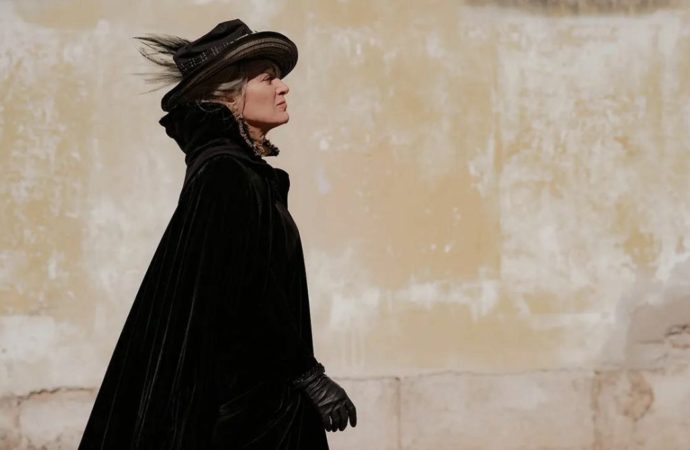
For me, the character played by Mona Martínez is, as she herself says, almost a continuation of the small role she plays in The Black Ball, extending that femme fatale character in a way. She is an actress—and a person—who is deeply committed to her work. She lived in Paraguay and stayed with us for a while before the shoot so that she could truly understand what she was doing and the world she was entering.
In that respect, I feel that Spain’s contribution has been extraordinary across every area of the film, and that this is one of the added values of the co-production [Narciso is co-produced by Paraguay, Germany, Uruguay, Brazil, Portugal, Spain and France].

Marcelo Martinessi © Seba Arestivo.
As for the music, which is so important in Narciso, it has also been a vehicle for rebellion in other historical contexts: swing under Nazism or rock in the Soviet bloc, as portrayed in Leto (Kirill Serebrennikov, 2018). What was specifically subversive about rock and roll in Narciso’s Paraguay?
I would say this was very difficult for me, because I feel that in Paraguay folk music has always been closely associated with nationalism and, of course, with the dictatorship. But I love Paraguayan music, and I wanted to reclaim its aesthetic possibilities without necessarily having it so closely tied to a regime.
I think what happens with rock and roll is somewhat different from the examples you mention, because all rock and roll really does is present another alternative, doesn’t it? It could have been rock and roll, perhaps it could have been jazz. Rock and roll obviously has certain elements that make it much more sensual, much more violent—in the best sense of the word—but what rock and roll ultimately does is say: “We are not all the same. We can also be like this.” And that is what disturbs people, and ultimately what condemns the character who brings rock and roll into the country.
There is an idea I find particularly compelling: fear does not appear as an event, but as an atmosphere. How do you translate something invisible like fear into cinematic terms? Is it in the silences, the bodies, the spaces, in what the characters do not dare to say?
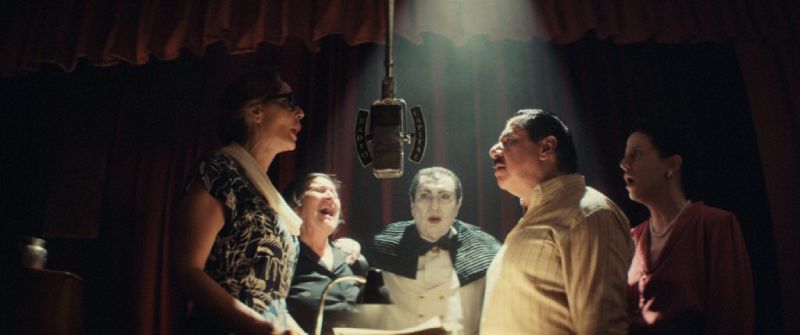
I think it lies in the accumulation of elements. For me, something very important that actually happened in real life was the Dracula radio play. The possibility of filming radio drama in that way, with those great actors, was extraordinary, and I think it ended up colouring the entire film to some extent.
You will have noticed, Eva, that almost the entire film is deliberately dark; it was shot at night. And we discovered that the night of 2024, when we were filming, looked remarkably similar to the night of the 1950s: the silence, the cicadas at times, the bells of the cathedral. There is still a profound silence at night in Paraguay, particularly in Asunción, and I think that helped us enormously. There was something enchanting about the night that allowed us to inhabit the film’s territory.
I don’t know whether I’ve strayed too far from your question, but yes, I think atmosphere was fundamental to constructing a film like this—at least for me, at this particular moment in cinema and in my own life and interests. It would have been almost impossible for me to construct it differently, with a very rigid structure or fewer characters.
I think the film possesses that freedom. I would say that I had many difficulties throughout the process, particularly with the final cut, which took us much longer—an additional year. But when we finally finished the film and I saw it for the first time in Berlin, I felt that there was a collective of people behind it—technicians, artists, cast members—who were thinking about cinema. At the very least, we were not simply allowing ourselves to be guided by what is expected of us; we were giving ourselves the freedom to think about cinema. And that is a wonderful gift today, when there is so much control from platforms, funding bodies and showrunners. Horrible. I want to keep thinking about cinema.
I am increasingly convinced that cinema has to be like life, which is why I am so wary of an overly constructed plot.
In The Heiresses, desire was explored through mature women; here you turn to masculinity and desire between men. What did you discover about masculinity by filming it not through strength, but through fear?
Yes, there are different forms of masculinity. I think that, for me, one of the central axes of the film is the character of Lulú (Manuel Cuenca), the owner of the radio station. A great deal of dramatic weight is concentrated in that character: he embodies power, repression, vulnerability—a whole range of elements surrounding a form of masculinity that I feel is very universal. In some way, I think there are many elements there that I can see in society today, and that I think it is important to put on the table and allow them to help us think.
Both in The Heiresses and in Narciso, I found it extremely difficult to isolate desire from toxicity, or from the forms that desire takes, because I feel that, for me, these things emerge so instinctively while we are making a film. Dialogues and scenes arise without necessarily being able to frame them in advance. It is part of a much broader discourse about desire.
Even though I am a great admirer of Foucault, and every ten years I reread all of Foucault, I would never be able to construct a single theory capable of encompassing everything that is happening in the world: looking at The Heiresses in the context of #MeToo, and then at Narciso in relation to masculinities… I feel that all of this is so present for me that, rather than judging it or placing it within a fixed framework, what we need to do is put it on the table and see how we interpret it in different places. And in many cases, there is no answer—only new questions.
The film begins in 1959, but you yourself have said that it is deeply rooted in a present that remains open and unresolved. What do you recognize of contemporary Paraguay when you look back at that story? And how has Narciso been received there?
Fortunately, the reception of the film in Paraguay has managed not to focus solely on the sexual dimension, something that often happens in conservative societies. This time, I think the film has acquired considerable force in terms of historical re-examination, memory, and the role played by the social fabric in the construction of an authoritarian project.
I feel that today it is much more crucial, much more essential, to convey a discourse through a film. But beyond the film itself, it is also important that we—the individuals, the collective that worked throughout the process, this community of people—can participate in opportunities such as the one you are giving us now, which allows me to speak in greater depth about the importance cinema can have, as I was saying, as a tool for the future, as a means of reflecting on things that are happening to us today.
To make Narciso and limit ourselves to talking only about the past would, for me, be pointless. I think there are fears in the film, and the seeds of a reflection on the way authoritarian projects today, using different means, are once again enveloping the social fabric. It is very important to remain aware of that.
Thank you for your film and for this conversation. We wish you every success with Narciso.
Narciso termina siendo menos una película sobre un muerto que sobre todo aquello que su presencia pone en movimiento. El protagonista trae consigo otra música, otra sensualidad y, sobre todo, la posibilidad de ser diferente: «no todos somos iguales, también podemos ser así», resume Martinessi al hablar del rock and roll. Y es precisamente esa posibilidad la que termina resultando intolerable en su contexto.
Pero la oscuridad que envuelve la película no pertenece únicamente a 1959. Para Martinessi, regresar al pasado solo tiene sentido si permite interrogar el presente. Y esa misma voluntad alcanza a su concepción del cine: frente a estructuras narrativas cada vez más cerradas y condicionadas por plataformas y expectativas industriales, reivindica películas capaces de respirar, acumular capas y dejar preguntas sin respuesta. Narciso nace de esa libertad: la de un cine que todavía puede permitirse no explicarlo todo.



Nadie ha publicado ningún comentario aún. ¡Se tú la primera persona!