

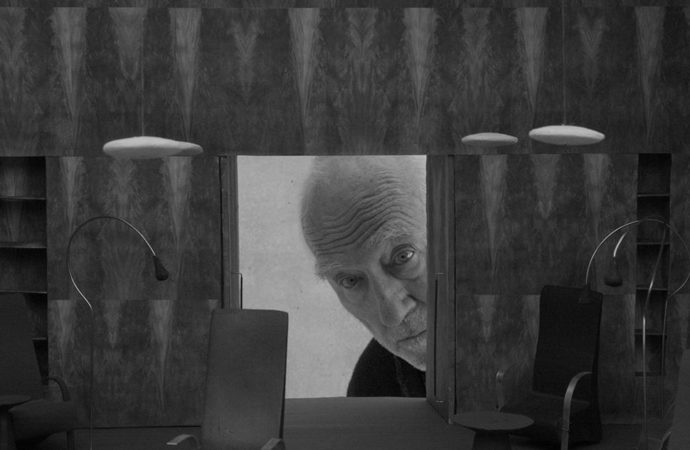

In From Inside Out – The Architecture of Peter Zumthor, presented in Venice Open – Out of Competition at the 83rd Venice Film Festival, Wim Wenders once again turns to 3D to show us the relationship we establish with the spaces we inhabit. After Pina (2011), Every Thing Will Be Fine (2015) and Anselm (2023), the third dimension ceases to be a spectacular device and becomes a means of approaching its subject. This time, the architecture of Peter Zumthor, but above all the physical and emotional experience of being inside it.
Shot over more than fourteen years, the documentary, produced by Brad Pitt, takes us through some of the most significant works by the Swiss architect and Pritzker Prize winner, from privately owned buildings or those far removed from the major circuits — his own home, the Therme Vals, the Bruder Klaus Field Chapel in Wachendorf — to the monumental project of the new David Geffen Galleries at LACMA in Los Angeles. Wenders does not set out to construct a biography or compile a catalogue of works. What he attempts is something considerably more difficult to film: to make perceptible what happens between a building and the person who moves through it.
Architecture from the Inside
The title contains the film’s formal principle. Zumthor’s architecture is not contemplated solely from the outside, as a finished object, but discovered from within and, especially, through those who use it, work in it or inhabit it.
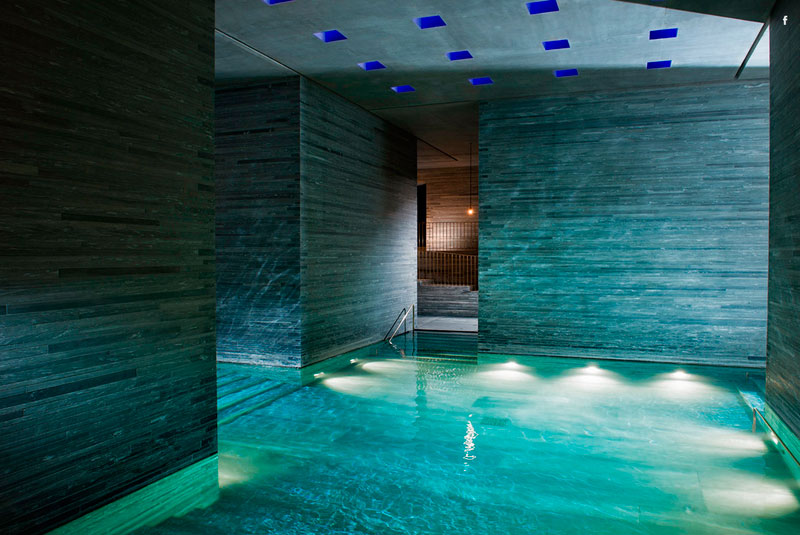
Termas de Vals (Suiza), Peter Zumthor arquitecto. © Cortesía Peter Zumthor.
Wenders begins with an elementary fact: we spend much of our lives inside buildings. In them we sleep, work, love, remember, contemplate works of art or say goodbye to our dead. Houses store our biographies, and spaces shape, in ways we rarely notice, our relationship with the world. From Inside Out therefore does not seek to teach us about architecture but, as Wenders himself puts it, to expand our “sensorium” for perceiving it.
3D is particularly well suited to this purpose. Rather than showcasing the buildings, it restores their depth, scale and distance, allowing the viewer to grasp intuitively the relationship between bodies and space. The camera of Franz Lustig and Sebastian Cramer moves forward, waits and observes. Doors, corridors, walls, materials and openings cease to be isolated architectural elements and become an experience of moving through space.
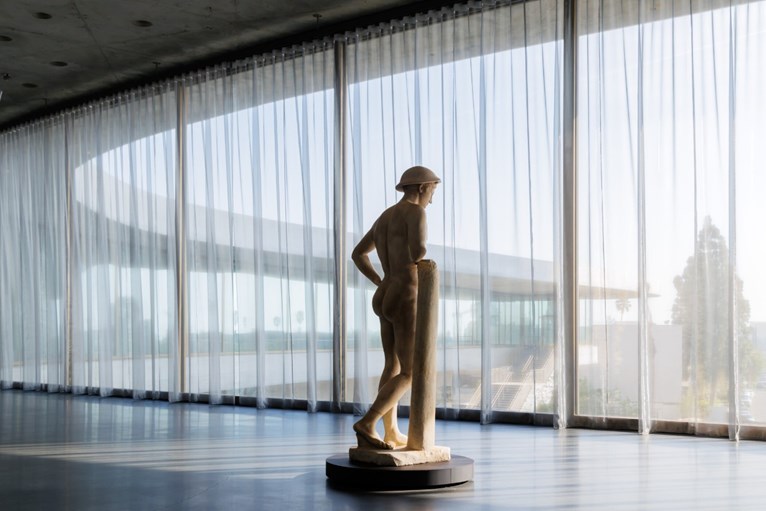
David Geffen Galleries at LACMA, Los Ángeles.
The choice connects directly with Zumthor’s conception of architecture. At the age of 83, the architect speaks of his work less as the creator of grand forms than as someone attentive to materials, place and the way a building is constructed. Particularly revealing is his insistence on the importance of craftspeople and trades. Architecture does not end with the architect’s drawing: it continues in the hands that work with wood, stone, metal or concrete, and in the small details capable of altering our perception of a surface.
Ninety-One Lights in Vardø
Among the spaces Wenders takes us through, we are particularly struck by the power of the Steilneset Memorial, built in Vardø, above the Arctic Circle, in memory of the 91 people tried and executed for witchcraft in the region.
It is Siri Hustvedt who guides us through the structure. Zumthor designed an elongated wooden structure housing an extremely narrow, hundred-metre walkway. Along it are 91 small windows, one for each victim, accompanied by texts drawn from historical sources. Behind each opening, a single light bulb glows.
The effect is extraordinary precisely because the architecture refuses to compete with what it commemorates. The lights evoke the small illuminated windows of the region’s houses and restore an individual presence to those whom History might reduce to a number. There is something profoundly cinematic in this succession of darkness, names, light and landscape: the memorial does not represent the dead, but constructs a space in which to remember them.
It is also one of the moments in which the film best expresses the affinity between Wenders and Zumthor, who seem to share the conviction that space can produce emotion without the need to explain it.
A Doll’s House
At the opposite end of the spectrum is Zumthor’s house and studio in Haldenstein. Here we are faced neither with monumentality nor with a space of remembrance, but with architecture subjected to its most elementary test: being lived in.
Wenders shows Zumthor with his family. The large, curtainless windows allow us to look in from outside at the illuminated rooms and the people inhabiting them. At times, the house takes on the appearance of an enormous doll’s house, with small scenes of life unfolding simultaneously behind the glass.
The image sums up much of the film with admirable simplicity. A house does not acquire meaning when its construction is completed, but when someone begins to inhabit it. Architecture then appears less as a sculpture than as a framework for life.
A Living Form in Los Angeles
The journey eventually takes us to an entirely different scale: the new David Geffen Galleries at LACMA in Los Angeles, Zumthor’s monumental project beside the La Brea Tar Pits and Wilshire Boulevard.
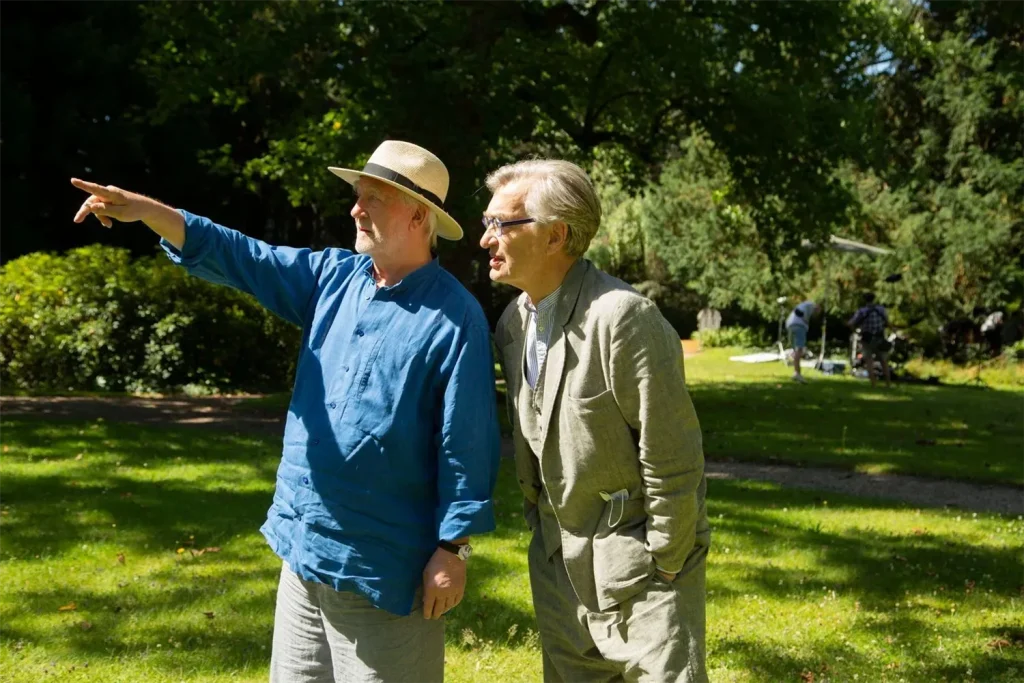
Werner Herzog and his wife Lena appear walking through the museum. The presence of Herzog — another filmmaker obsessed with territory and the human relationship with it — feels particularly fitting in a film constructed to a large extent through other people’s perspectives on Zumthor’s spaces.
The building’s organic form, almost like an amoeba, extends across its surroundings without conforming to the conventional monumental block. Part of its body even crosses over Wilshire Boulevard, allowing traffic to pass beneath it, as though negotiating with its context.
Here we gain a clearer understanding of Zumthor’s extraordinarily long working process. His buildings do not seem to be conceived as autonomous objects that are subsequently placed on a site. The surroundings — the topography, light, materials, uses and those who will ultimately occupy the space — are part of the architecture itself.
Learning to Look at a Building
The presence of Aoi Yamada, Ava DuVernay, Mariana Castillo Deball, Mark Oliver Everett, Sophie Hunger and Hustvedt, among others, also prevents From Inside Out from becoming enclosed within a conversation between two great artists. It is the visitors who ultimately put the architecture to the test. Each moves through it differently, because a building does not produce a single experience, nor does it belong exclusively to the person who designed it.
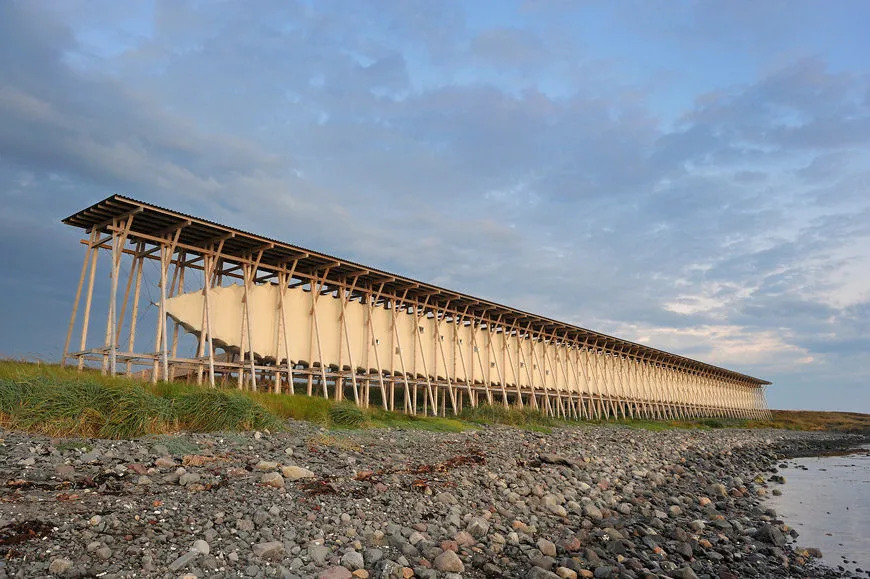
Steilneset Memorial (Vardø).




Nadie ha publicado ningún comentario aún. ¡Se tú la primera persona!