

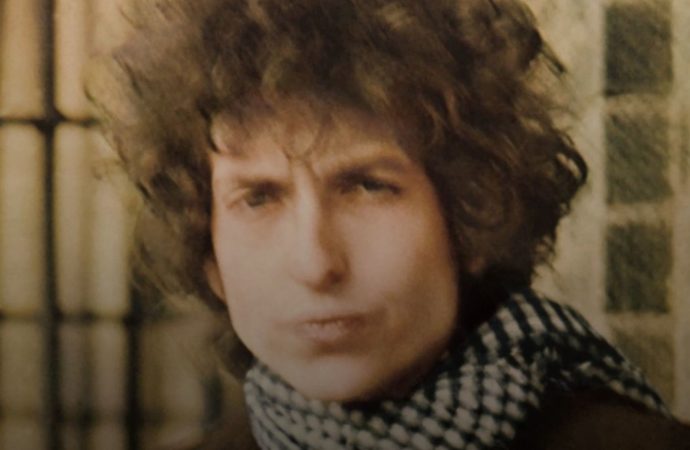

The road to Blonde on Blonde begins on August 28, 1964, at New York’s Hotel Delmonico. It was one of those encounters capable of defining an era: the voice of his generation met the phenomenon that would change twentieth-century music forever.
Bob Dylan and the Beatles gathered in a hotel room, clearly fascinated by one another. The Beatles began by offering Dylan amphetamines, and Dylan, in turn, introduced them to marijuana. Between laughter and Dylan answering every phone call to the room with the words, “Beatlemania speaking,” the evening ended with the folk hero playing some of his new songs for the Liverpool quartet, quickly catching John Lennon’s attention and telling him, “Hey, John, listen to the lyrics!” Only to have Lennon reply, “The lyrics? Who cares about the lyrics? Are we out of our minds, paying attention to lyrics? Listen to the rhythm! That’s all!”
After that evening, John—and Paul, George, and Ringo—would begin paying much closer attention to words. Dylan, for his part, would become much more concerned with rhythm. Rock music would reap the benefits, reaching its maturity in the mid-1960s with albums such as Rubber Soul, Highway 61 Revisited, Revolver, and Blonde on Blonde.
The Beatles’ explosion pushed the folk hero back toward his first loves: rock & roll and Chicago blues. He no longer had to hide behind an acoustic guitar alone; art could be made with a drum kit behind him. His followers—the same people who had elevated him to the most sacred position, as the Messiah of folk music—would accuse him of being Judas the moment he strapped on an electric guitar. But Dylan did not care. After all, he had more in common with John Lennon and Paul McCartney than with Pete Seeger and Dave Van Ronk.
He first recruited Mike Bloomfield as his lead guitarist and, during the recording of the song that would define his new electric phase, “Like a Rolling Stone,” he discovered Al Kooper as an organist. But when Bloomfield chose to remain with the Paul Butterfield Blues Band and Kooper grew tired of the boos at live performances, Dylan found himself without a band. Shortly afterwards he discovered a group called Levon & The Hawks and became fascinated by those four Canadians and their Southern drummer—and singer. The one who impressed him most was their lead guitarist, Robbie Robertson, but gradually he hired them all.
On September 24, 1965, they gave their first concert together in Austin. The group sounded razor-sharp and Dylan realized he had found his Band. Robertson’s Telecaster spat fire, and Dylan had plenty to say—to clueless music critics (“You know something is happening, but you don’t know what it is, do you, Mr. Jones?”) and to the old folk purists who smiled to his face and tore him apart as soon as he turned his back (“I wish that for just one time you could stand inside my shoes, then you’d know what a drag it is to see you”). He was completely inspired, living on pills and alcohol, always attached to his typewriter, spewing page after page of schizophrenic poetry while the world was being turned upside down around him. He was travelling at one hundred miles an hour. The folkies might boo him every night, but the rest of the rock world had embraced him as the Second Coming.
Brimming with ideas, Dylan entered the studio on November 30 with the Hawks to record the follow-up to his first two Top Ten singles, “Like a Rolling Stone” and “Positively 4th Street.” The new song was called “Can You Please Crawl Out Your Window?” and it was the hardest-rocking, most aggressive thing he had recorded up to that point. The track would blow the mind of a young and then unknown Jimi Hendrix, although Dylan himself would remain less than fully satisfied.
He had a new sound in his head—more sophisticated, more mercurial, not as raw as the sound the Hawks were producing at the time. As if that were not enough, the nightly boos eventually became too much for Levon Helm, who, before the California concerts in December 1965, decided he had had enough. He left the band, leaving the drum stool to Bobby Gregg, who had already played on the Highway 61 Revisited sessions.
After the American tour ended in late December 1965, Dylan returned to the studio in New York between January 21 and 30, 1966, to begin recording Blonde on Blonde. Out of ten sessions, only one song emerged that satisfied him: “One of Us Must Know (Sooner or Later),” with Robertson on guitar, Rick Danko on bass, Al Kooper on organ, Bobby Gregg on drums and Paul Griffin on piano. Dylan remained dissatisfied and made this clear to his producer, Bob Johnston, who suggested an unexpected destination: Nashville.
The country capital was filled with exceptional session musicians, and Johnston believed it might be the perfect fit for Dylan. The songwriter agreed. He still remembered with admiration the contribution made by one of those musicians, Charlie McCoy, during the recording of “Desolation Row” for Highway 61 Revisited. So Dylan headed for Nashville, taking with him his two most trusted collaborators, Robbie Robertson and Al Kooper.
In two magical series of sessions, in February and March 1966, in the midst of the world tour with the Hawks that would culminate in the legendary Royal Albert Hall concerts—attended by the Beatles—Dylan would record the first double album in rock history and expand the possibilities of the genre to previously unimaginable horizons. The result was Blonde on Blonde.
At his first Nashville session, on Valentine’s Day 1966, Dylan recorded the definitive version of “Visions of Johanna,” a song he had attempted several times in New York without ever quite finding its final shape. Listening to those early takes with the Hawks is revealing: they possess the edge and force of his live performances, but they lack the magic he would ultimately achieve in Nashville. The tempo slows down. It begins with a slight acoustic touch and his harmonica, followed by that subtle drum beat and Al Kooper’s howling organ in the background as Dylan sings of Johanna’s visions and the ghost of electricity howling in the bones of her face.
The artist had found his sound, what he himself would later describe as “that thin, wild mercury sound.” Metallic gold and shimmering, with all that image might suggest. “Visions of Johanna” has it. So does another song recorded that February 14 session, “4th Time Around.” The song was a gentle warning to Lennon, since Dylan felt that “Norwegian Wood” sounded a little too much like his own style. So he borrowed part of the melody and closed the song with a pointed remark: I never asked for your crutch, now don’t ask for mine.
That thin, wild mercury sound —metallic gold and shimmering, with all that might evoke— pervades the entire album.
Perhaps it was a little unfair. It seems obvious that the Beatles would never have written “Norwegian Wood” without having heard Dylan, but Dylan himself would never have written “Most Likely You Go Your Way and I’ll Go Mine,” with its Buddy Holly echoes, or “Absolutely Sweet Marie” (which George Harrison would later cover), without the Beatles. Blonde on Blonde opened itself to more musical influences than any previous Dylan record: from the circus and marching-band touches that open the album with “Rainy Day Women #12 & 35” to the folk-rock of “I Want You,” from the Chicago blues that runs through “Pledging My Time” and “Leopard-Skin Pill-Box Hat” to whatever it is that makes “Sad Eyed Lady of the Lowlands”—that extraordinary waltz-time ode to his new wife Sara Lownds—so utterly sublime.
That more than eleven-minute piece emerged during the second Nashville session, an utterly unusual affair in which Dylan sat at a table writing lyrics while the other musicians played cards and chatted among themselves. It was not until four in the morning that Dylan called them over, quickly showed them the chords and launched into the song. Session drummer Kenny Buttrey later recalled that, accustomed to three-minute songs, the musicians began building intensity after the second chorus, assuming that was where the song would end. But then Dylan played another harmonica solo and dropped back into another verse, forcing the dynamics to subside again. After ten minutes of this, we were laughing at each other because of what we were doing. We had reached the climax five minutes earlier. Now what were we supposed to do?
That spontaneity is part of the charm of a gigantic record with which Dylan reached the summit, completing his electric trilogy after the equally extraordinary Bringing It All Back Home and Highway 61 Revisited. By the time Blonde on Blonde appeared on June 20, 1966, three weeks had passed since the last Royal Albert Hall concert and a month since the Manchester show where someone shouted “Judas!” and Dylan answered, “I don’t believe you. You’re a liar.” Then he turned to the band and, as angry as he could possibly be, barked, “Play fucking loud!” before hurling himself into the definitive version of “Like a Rolling Stone,” the equivalent of a slam dunk right in the face of the folk mob that had first elevated him to Prophet and then tried to crucify him.
Blonde on Blonde was the culmination of all this, the pinnacle of the most fascinating Dylan of all. But, of course, no one can keep travelling at one hundred miles an hour forever, releasing two albums a year and dragging rock music into adulthood. So what do you do when you reach the peak of your career at twenty-five? You slow down and disappear.
And that is exactly what happened. After a mysterious motorcycle accident on July 29, 1966, Dylan withdrew from the road and from public life for several years. He would not tour again until eight years later, in 1974, once again with the Hawks, by then permanently rechristened The Band.
There was a musical and personal transformation as well. Dylan would not remain attached to Memphis blues for much longer, and his turn towards other sounds—with country music as his guiding light—soon became apparent. The beatnik in dark glasses disappeared too; now came the family man.
There would be many more reinventions and many more masterpieces, but the absolutely imperial Dylan resides here, somewhere between those shared joints with the Beatles and the motorcycle crash, between the guitar blasts of Mike Bloomfield and Robbie Robertson and the Desolation Row, between the ghost of electricity and that thin, wild mercury sound…
Nadie ha publicado ningún comentario aún. ¡Se tú la primera persona!