

Under the Dantean verse Nacque al mondo un sole (“A sun was born into the world”), dedicated to Saint Francis of Assisi on the eight-hundredth anniversary of his death, the 2026 Ravenna Festival unfolds one of its most ambitious and symbolically charged editions. More than 100 performances and 1,000 artists transform the city and its monumental spaces into a vast laboratory of music, theatre, dance, and thought. The Franciscan thread runs through much of the programme: from Paul Hindemith’s Nobilissima visione—inspired by the figure of Saint Francis and conducted by Riccardo Muti—to projects based on the Canticle of the Creatures, as well as encounters with philosopher and intellectual Massimo Cacciari, who will join Muti in discussion following the concert devoted to Hindemith, and new theatrical and choreographic creations centred on spirituality, fraternity and the idea of community.
Among the most eagerly anticipated events are Riccardo Muti’s return to the podium of the Orchestra Cherubini, a concert by the Philharmonic Brass—bringing together members of the Vienna and Berlin Philharmonics—the celebration of Dulce Pontes’s thirty-five-year career, and appearances by Kent Nagano, Pat Metheny, Stefano Bollani, and Jeff Mills. Not to mention the second edition of Cantare amantis est, which, as it did last year when more than three hundred choristers performed under Muti’s direction, will once again transform the city into a large-scale experiment in humanity and coexistence.
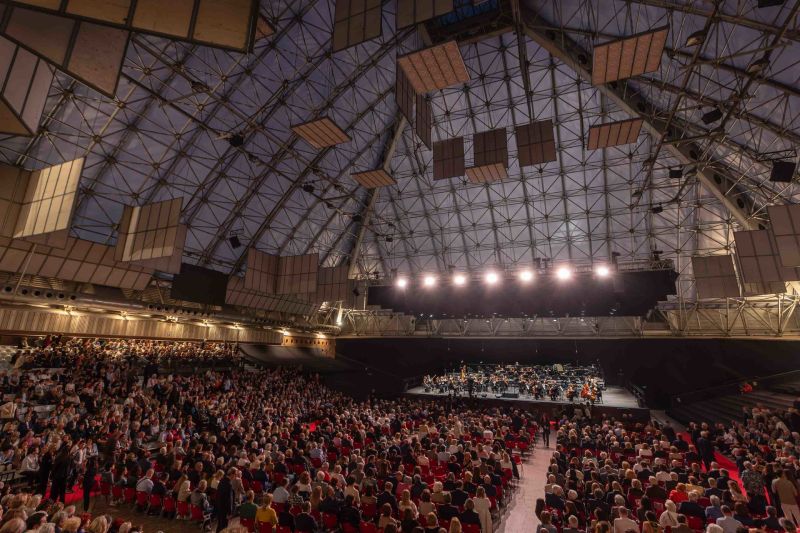
Pala de Andrè, Ravenna. ©Zani-Casadio.
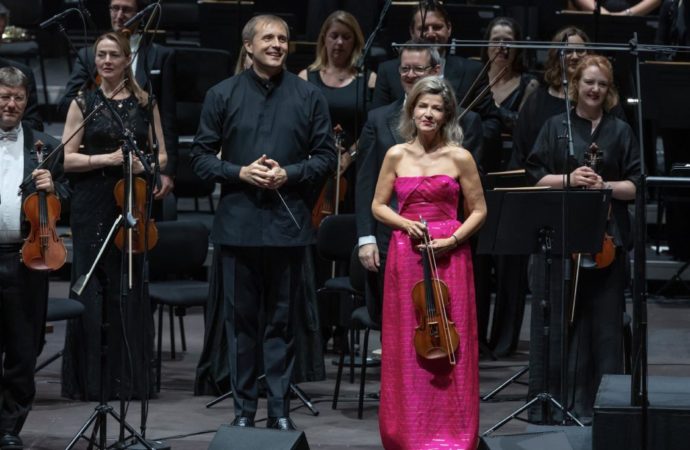
Within this context, one of the festival’s major symphonic events took place on 21 May at the Pala de André: the eagerly awaited appearance of Anne-Sophie Mutter alongside Vasily Petrenko and the Royal Philharmonic Orchestra, of which he is Music Director. Together they headlined the inaugural concert that officially opened this year’s festival. The German violinist approached Beethoven’s Violin Concerto with her characteristic individuality of sound and expression, supported by an unimpaired technical command and by that instantly recognisable tonal quality that continues to define her playing.
Yet the interpretation proposed by Mutter and Petrenko seemed to favour a markedly Romantic vision that partially displaced the Classical equilibrium underpinning the work. Where Beethoven also demands formal restraint, proportion and a certain architectural severity, the violinist and conductor frequently leaned toward lyrical expansion and an expressive approach of undeniable emotional richness, but one that at times moved too far from the inner discipline sustaining the composer’s writing.
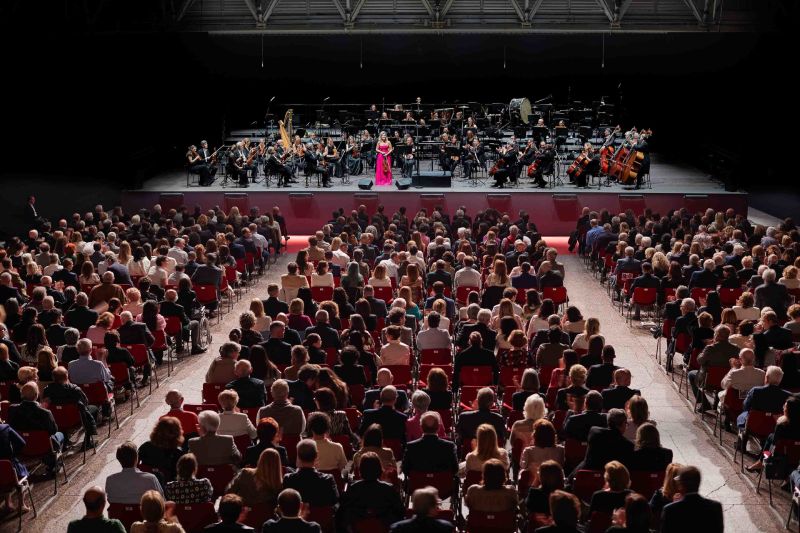
Mutter and Petrenko in Pala de Andrè, Ravenna. ©Zani-Casadio.
Despite this debatable interpretative choice, the first movement was shaped with noble phrasing and remarkable clarity in its dialogue with the orchestra, preserving at least in part that delicate tension between poetic impulse and formal discipline that lies at the heart of the concerto. Petrenko accompanied with intelligence and transparency, avoiding any excessive display of authority and cultivating a carefully balanced orchestral texture. The Larghetto was arguably the most convincing section of the performance, benefiting from broad and concentrated breathing, while the final Rondo allowed the violinist to recover a greater sense of lightness and spontaneity in her phrasing.
As an encore, Mutter offered Likoo by Iranian-Dutch composer Aftab Darvishi, a brief lament inspired by traditional forms from Baluchistan and conceived as a meditation on loss, exile and the condition of Iranian women. Introduced by the violinist herself with words of deep personal commitment, the piece provided one of the evening’s most genuinely moving moments.
The second half of the programme was devoted to Gustav Mahler’s majestic Fifth Symphony, territory in which Vasily Petrenko confirmed the strongest and most convincing qualities of his conducting. Avoiding both grandiloquence and excessive monumentality, he opted for a reading of remarkable structural clarity, attentive to the work’s internal continuity and sustained by constant control over orchestral tensions. From the opening Trauermarsch, the excellent level of the Royal Philharmonic Orchestra was evident, particularly in the authority of the brass section and in the strings’ ability to maintain both density and transparency, even in the most exposed passages.
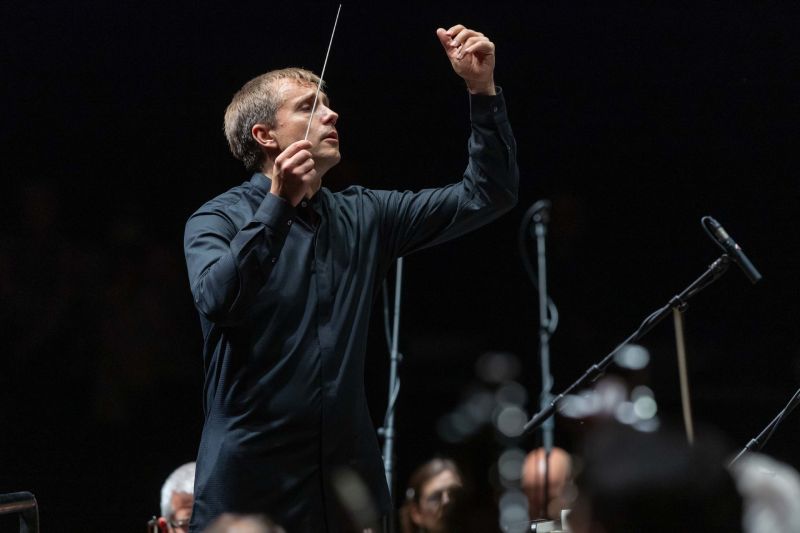
Vasily Petrenko conducting Mahler at the Pala de Andrè, Ravenna ©Zani-Casadio.
Petrenko shaped the symphonic journey with a clearly defined narrative logic, allowing the score’s expressive contrasts to emerge not as isolated episodes but as organic stages within a single dramatic arc. The central Scherzo proved especially impressive for its rhythmic vitality and flexibility of phrasing, always sustained by a living and carefully controlled internal pulse.
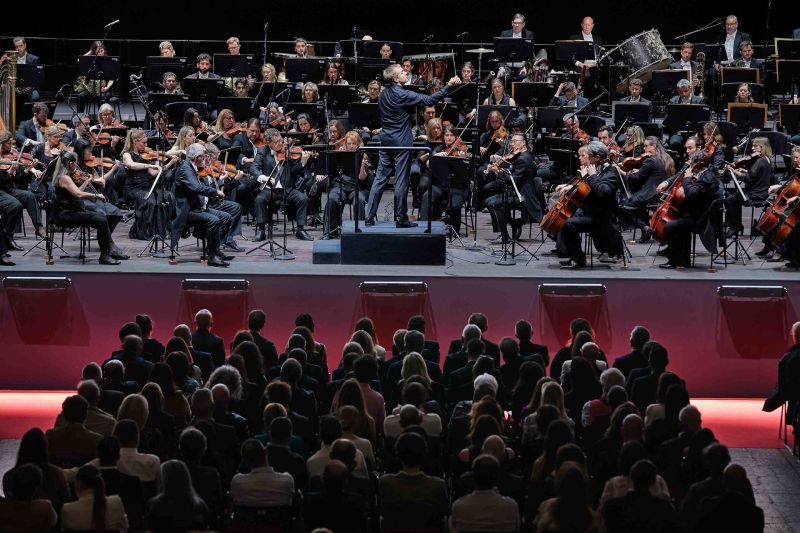
Vasily Petrenko conducting Mahler at the Pala de Andrè, Ravenna ©Zani-Casadio.
More debatable, however, was his conception of the celebrated Adagietto. The movement was taken at an extremely expansive tempo which, despite the undeniable beauty of the string sonority and the refinement of the orchestral sound achieved by Petrenko, did not always preserve the dramatic tension and underlying almost tragic unease that lies beneath the page’s apparent serenity. This temporal expansion transformed the movement into a largely contemplative soundscape—undeniably rich in lyrical sensuality, yet partially deprived of the inner breath and emotional momentum that prevent the Adagietto from becoming a merely aesthetic suspension.
Far more convincing was the Rondo-Finale, realised with precision, contrapuntal lightness and a sense of gradually unfolding expressive liberation that led the symphony toward a luminous and solidly constructed conclusion.

Nadie ha publicado ningún comentario aún. ¡Se tú la primera persona!