


Moulin, the new film by László Nemes, arrived at the 79th edition of the Festival de Cannes with a highly promising premise. The Hungarian director who revolutionised the cinematic representation of the Holocaust and won the Academy Award for Best International Feature with Son of Saul (2015) — showing the gas chambers as no one had before— and who later followed the more labyrinthine Sunset (2018) with a coming-of-age story marked by trauma in Orphan, once again turns toward European memory through an approach that is both physical and psychological. This time he tackles one of the most emblematic figures of the French Resistance: Jean Moulin, arrested in Lyon in June 1943 while attempting to unify the various clandestine forces fighting against the Nazi occupation. The subsequent confrontation with Klaus Barbie, head of the Gestapo in the city, seemed to offer the ideal material for a filmmaker obsessed with historical violence, European memory and the intimate mechanisms of horror.
And yet, somewhat surprisingly, Moulin ends up being the most conventional film of Nemes’s entire career, shot in an entirely canonical manner, leaving no room for the slightest trace of the personal talent that might have allowed already familiar events to be revealed through an original perspective.
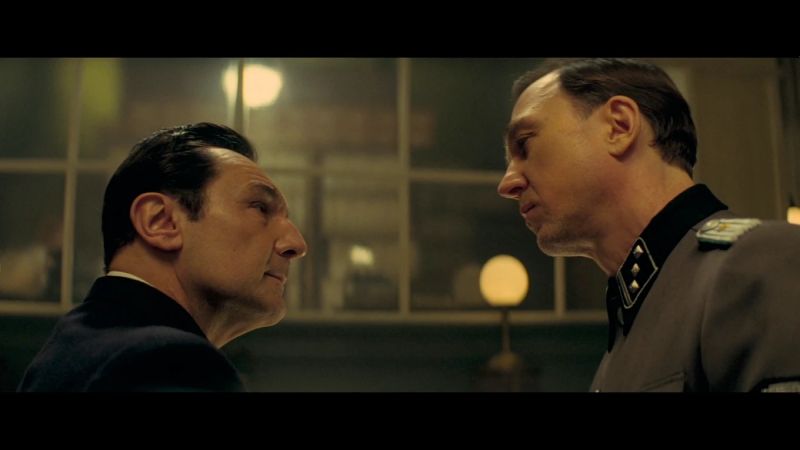
The film follows Moulin’s interrogations and his physical and psychological deterioration after his arrest. The fate of Free France seems to depend on his ability to resist the manipulation and brutality of the Nazi apparatus. On paper, the material contains all the elements of a great political and moral tragedy. Yet Nemes’ approach proves extraordinarily conservative and routine, albeit crafted with great technical quality. Everything in the film conveys a sense of historical déjà vu: the scenes, the dramatic dynamics, the representation of the occupation, the dialogues, even the construction of suspense constantly seem to refer back to already familiar models without offering a genuinely new or personal perspective.
And that is probably the greatest disappointment of this French-Belgian co-production. From a story so deeply rooted in the French historical imagination, entrusted moreover to a foreign filmmaker previously capable of radically redefining the audiovisual representation of horror, one expected a far bolder, more reflective or visually significant approach. But Nemes appears here excessively constrained by the symbolic weight of Jean Moulin as a French national hero. Perhaps precisely because he is not French, the director opts for an almost reverential respect toward both the character and the official memory of the Resistance, sacrificing in the process much of the formal and moral radicalism that made his earlier films such deeply personal experiences.
Moulin is a solid, elegant and impeccably constructed film, but also an unexpectedly comfortable one.
Technically, Moulin is flawless. The cinematography by Mátyás Erdély, a regular collaborator of László Nemes, creates a sombre and elegant atmosphere, perfectly controlled throughout. The rhythm, editing and historical reconstruction all function with precision and professionalism. Everything is meticulously executed. Perhaps too meticulously. The film progresses with the efficiency of a major classical historical drama, yet precisely there lies its limitation, since almost no trace remains of the radical authorship that once defined Nemes’s cinema.
The screenplay, co-written with Olivier Demangel —co-author of Le Roi Soleil (2025)— constantly favours narrative clarity and academic respect over the ambiguity or sensory immersion that defined Son of Saul. Violence is depicted in a far more conventional manner, while the mise-en-scène almost entirely abandons the suffocating physical experience that made Nemes’s debut truly revolutionary.
Even so, the film finds a certain intensity through its performers. Gilles Lellouche is perfect as Jean Moulin, bringing humanity, exhaustion and quiet dignity to the character without ever slipping into grandiloquent heroism. And Lars Eidinger delivers a brutally effective Klaus Barbie, in a true recital of cold cruelty, psychological violence and bureaucratic sadism. Nothing less could have been expected from him.
If any scene truly remains in the memory, it is the interrogation of the fictionalised Countess de Forez (Louise Bourgoin) in Moulin’s presence. There, something more complex and disturbing briefly emerges: psychological games, public humiliation, class tensions and the theatricality of Nazi power converge for a few minutes with an intensity the rest of the film rarely reaches.
With Moulin, László Nemes undoubtedly delivers a solid, elegant and impeccably constructed work, but also an unexpectedly comfortable one. In short: a competent film about resistance, when what many expected was a far more radical exploration of fear, memory and evil.





Nadie ha publicado ningún comentario aún. ¡Se tú la primera persona!