
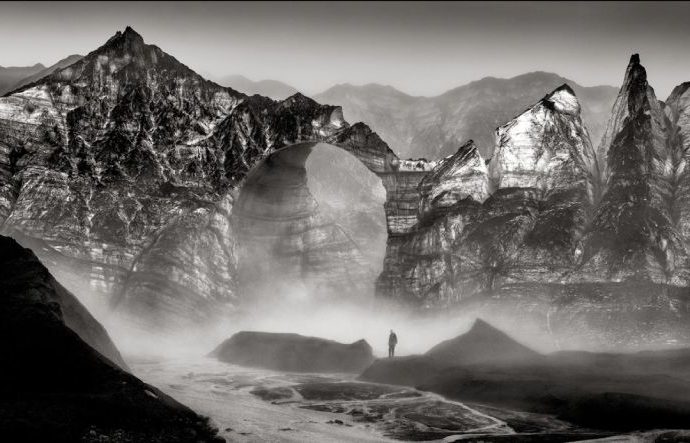

Screening in the Baltic Documentary Competition at the 30th Tallinn Black Nights Film Festival, Pepe Andreu and Rafa Molés’ haunting documentary, La Pietà, transforms the disappearance of Iceland’s glaciers into a meditation on memory, beauty and our responsibility towards the natural world.
A vast expanse of ice, an abandoned farmhouse and the voices of those who once inhabited it. In La Pietà (2026), Spanish filmmakers Pepe Andreu and Rafa Molés approach the climate crisis through an unexpected perspective: not the accumulation of scientific evidence, but the emotional and spiritual relationship between human beings and a landscape condemned to disappear.
The film draws on the extraordinary story of the Björnsson family, who settled near Iceland’s Vatnajökull glacier in the early twentieth century. Among them, Flosi Björnsson devoted much of his life to observing and documenting the surrounding natural world, leaving behind diaries that now bear witness to transformations whose consequences he could scarcely have imagined.
Rather than reconstructing their lives through conventional documentary storytelling, Andreu and Molés create a dialogue between past and present. Archival images, handwritten notebooks and the return of photographer Ragnar Axelsson to the farmhouse of his childhood gradually reveal a world suspended between memory and oblivion.
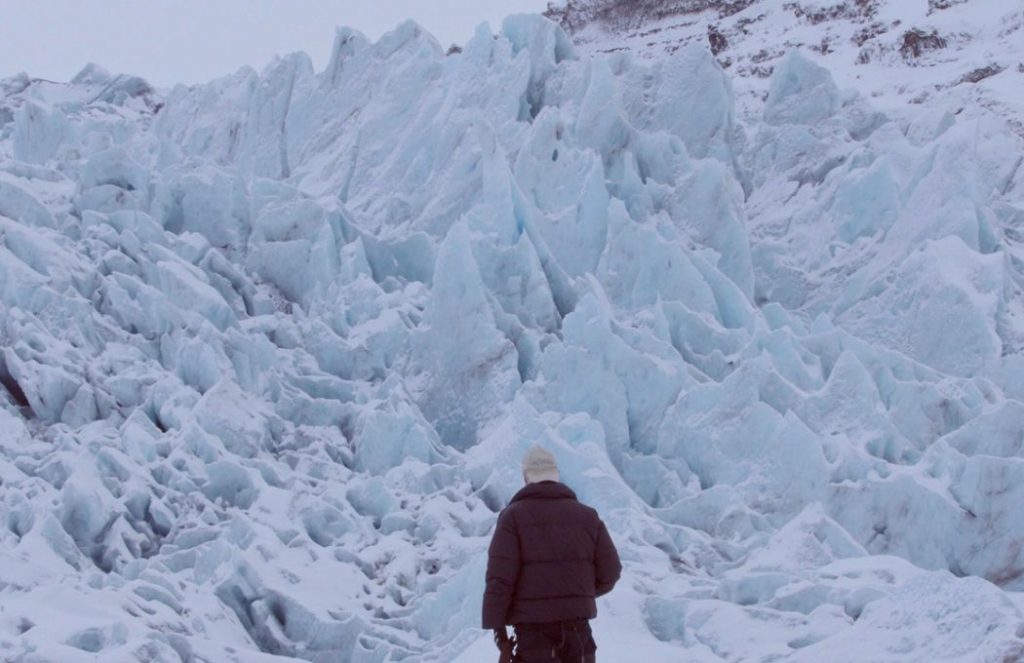
La Pietà (Pepe Andreu and Rafa Molés, 2026).
The abandoned house becomes a central visual metaphor. Its objects, preserved in an atmosphere of abandonment, evoke the still lifes of classical painting. Every creaking floorboard and empty room suggests an absence that remains strangely palpable. The voice of Flosi, performed by Icelandic actor Ingvar Sigurðsson, seems to emerge from the building itself, as though the past were refusing to fall silent.
The Aesthetics of Disappearance
One of the film’s most striking qualities is its refusal to romanticise the Icelandic landscape. Instead of the saturated blues frequently associated with glacier photography, the filmmakers favour a restrained palette of greys and shifting textures. The ice is neither a picturesque backdrop nor a spectacular tourist attraction. It becomes a living presence, vulnerable and slowly approaching extinction.
The soundscape reinforces this impression. Alberto Lucendo’s score and the sound design by Iván Martínez-Rufat incorporate the breathing of wind instruments, the cracking of ice and an almost imperceptible sense of impending loss. Sound and image combine to suggest the laboured respiration of a dying body.
The film’s title finds its fullest expression in the image of a glacier covered by an immense white sheet. Inspired by actual attempts to protect ice from rising temperatures, the gesture evokes both a shroud and the religious iconography of the Pietà. It is an image of compassion, but also of impotence: an extraordinary human effort that exposes the inadequacy of our collective response.

La Pietà (Pepe Andreu and Rafa Molés, 2026).
This tension between beauty and guilt gives La Pietà its emotional force. The film does not attempt to replace scientific knowledge with poetic contemplation. Instead, it questions why overwhelming evidence has so often failed to produce meaningful action.
Its most unsettling suggestion is that those who lived beside the glacier a century ago may have understood something we have forgotten: that caring for the world begins with paying attention to what surrounds us.
With La Pietà, Andreu and Molés offer an elegy for a disappearing landscape, but also a reflection on cinema’s ability to preserve memory. If the glacier cannot be saved by images alone, perhaps those images can still awaken the sense of responsibility that its disappearance demands.
For further insight into the film’s creation, read our earlier conversation with Rafa Molés, published during the Thessaloniki International Documentary Festival.

Nadie ha publicado ningún comentario aún. ¡Se tú la primera persona!