During the last Cannes Film Festival, The President’s Cake was one of the most frequently mentioned recommendations among those interested in cinema beyond the Official Selection. The buzz surrounding the debut feature by filmmaker Hasan Hadi—the first Iraqi film ever nominated for the Oscar for Best International Feature Film—was confirmed with the Audience Award, the Caméra d’Or for Best First Feature, and the AFCAE Award from French cinema exhibitors for Best Film.
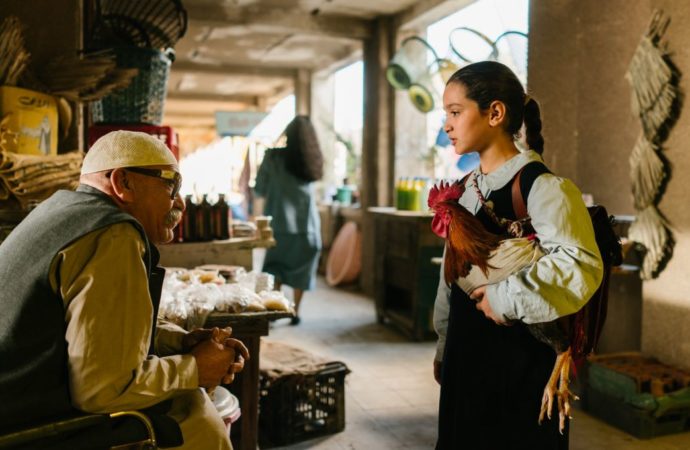
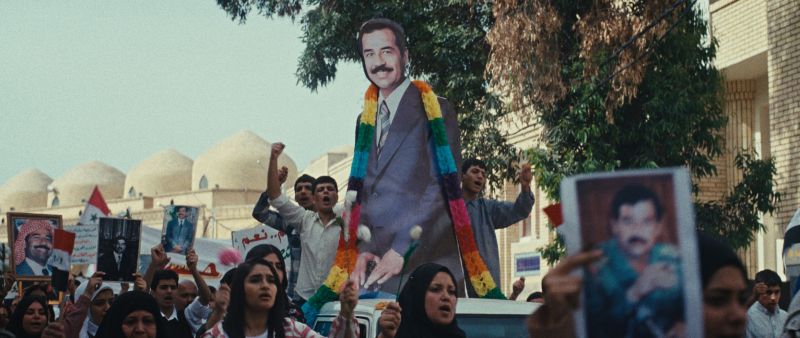
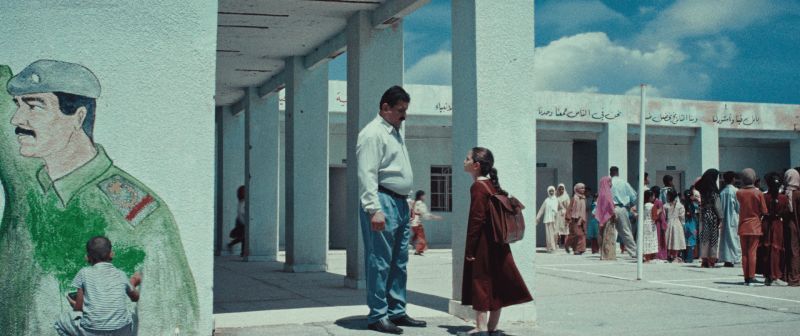
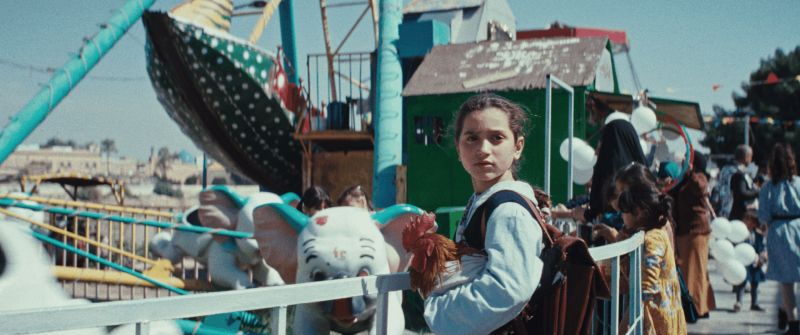
The film is set in the final throes of Saddam Hussein’s dictatorship, depicting the consequences of the international embargo on Iraq in the everyday life of a precarious community. Hasan Hadi’s gaze chooses children as the guides of a hyperrealist tale, especially its protagonist, the nine-year-old Lamia (Baneen Ahmad Nayef), distressed by having to bake a cake for her teacher for Saddam’s birthday, while forced fasting is the daily diet of the family she forms with her grandmother (Waheed Thabet Khreibat). In an oppressive society under a dictatorial regime, the destinies of its citizens are in the hands of teachers, merchants, or law enforcement.
Fortunately, this is not Capernaum, but rather a film that carefully calibrates its impact on the viewer, since its story—representing the drama of an entire country—needs no emphasis. On the occasion of the film’s commercial release in Spain—where it screened in the Perlak section of the last San Sebastián International Film Festival—we interviewed its director, trained at NYU’s Tisch School of the Arts, whose film, a co-production between Iran, Iraq, and the United States, received support from Sundance Labs.
The President’s Cake shows us a moment in Iraqi history linked to the final years of Saddam Hussein’s regime, a period of extreme hardship for Iraqi society. We begin this interview by asking why Hasan Hadi chose that particular moment. When I started writing and making this film, my only objective was to tell a story: a story of love and friendship under dictatorship, war, and sanctions, and to shed light on Iraq and on a period of the country’s history that has never been explored cinematically. It is one of those moments that profoundly marked the Iraqi people and the country, and whose impact is still felt today, even now.
The story is told from the level of a nine-year-old girl, adopting a childlike, naive, and persistent perspective. The director turned children into narrative drivers. Because I was a child at that time, it felt natural to share memories I still carry from those years. Moreover, in a film like this, with a strong political context, I wanted the point of view to be different… The film is inspired by real events and personal memories—Yes, completely. The film is inspired by that. For me, the child’s perspective offered the objective gaze I wanted to convey to the audience. Children are not political, they have no biases; they see the world as it is, without filters. And I wanted that to be the viewer’s experience as well.
How do you approach casting of this kind and working with non-professional actors, especially children? We did street casting. There were no professional actors; all of them were non-professionals. We were looking for people who resembled the characters we had on the page or who were interesting enough to be in the film. When it came to the children, Said, the boy, was the first actor we found, and Baneen —Lamia— was the last actress we found for the film. I received a 30-second video of her introducing herself, saying her name and giving some information about herself. At that moment, I immediately knew she was the girl who could carry the film on her shoulders.
However, her parents did not support the decision at first, because they did not know what cinema was, what making a film meant. And when you don’t know something, you are usually afraid of it. A great deal of persuasion was needed… It took many conversations, explanations, and involving them in the process until they eventually became very supportive and fully backed the project.
One of the important aspects of the film is that adults often appear indifferent or even cruel. What does this say about Iraqi society at the time? I think it reflects the reality of living under a brutal regime, Hadi says. It shows that society was subjected to such immense pressure that its very nature was changed, that morals were altered and social ethics were destroyed. That is what the film tries to highlight.
Can we then say that the blockade transformed Iraqi society? One hundred percent. And we continue to feel its impact today. One of the major problems in Iraq now, especially at the political level, is corruption. And the cycle of corruption began during the sanctions. Unfortunately, once that cycle starts, it is very difficult to stop. It requires a great deal of education and the rebuilding of an entire generation and of the whole country, based on a different ethical code.
Unfortunately, this is not exclusive to Iraq. It is inevitable to think about the consequences that an economic blockade has for the civilian population of countries such as Cuba. Yes, exactly. Similar situations arise because when resources are limited, people are forced to fight for their own survival. That is why, when sanctions are considered a diplomatic tool that only affects leaders, I find it a naïve idea, because it is not true. They affect innocent civilians in their everyday lives.
Filming in Iraq is not an easy task; the technical and logistical difficulties were a real challenge for the crew. There were many. For example, even very basic equipment was not available for rental. Or obtaining permits: something that in a country with a film industry can be resolved with a few emails can take days or even weeks there. Even at the level of human resources, we struggled to fill technical positions because the local crew did not have enough experience for a film of this kind. That is why we had to bring in crew members from abroad and work jointly with the Iraqi team, in order to expand knowledge and skills.
As for the visual language, it is truly striking. The cinematography by Tudor Vladimir Panduru (Malmkrog, 2020) captures both the marshlands and the city with extraordinary clarity and depth of field. The work to unify this visual approach was intense. During pre-production, we talked a lot about the script and about how to work with actors. That is why we decided to minimize coverage and increase camera movement, in order to reduce editing. Working with non-professional actors, we wanted the performances to unfold in a natural, raw, and real way. We also spoke extensively about the tone of the film: that fable-like quality we wanted to convey through the camera and its movement. We chose an image format that would fit the landscape, the vastness of the spaces, and the journey the characters undertake. And we also returned to the period itself, selecting a color palette representative of that time, to create a sense of nostalgia.
Despite its tragic background, the film avoids emotional excess and overt dramatization as a conscious stylistic decision. I did not want to overdramatize. I am not interested in being emotionally abusive toward the viewer. That is why I tried to be as subtle as possible in certain scenes. Moreover, having been exposed to many different kinds of cinema, those are the kinds of films and emotions I respond to as a spectator.
To conclude our interview, we asked the director about the film’s extraordinary international reception and his expectations as it begins its commercial run. So far, the reception has been incredibly positive and warm. My hope is that, when the film ends and the screen fades to black, audiences will begin to think about the characters—whether they survived or not, and, if they did, how they went on with their lives. The film seeks to humanize abstract figures, mathematical numbers, or newspaper headlines. These children could have been just another number in the news. In a way, the film gives them a voice, an identity, a tangible existence. And it also shows what sanctions do, what dictatorships are, and what wars are, so that the next time words like blockade, sanctions, or dictator are heard, it is understood that the victims are not necessarily soldiers. The victims are, in their vast majority, innocent civilians. I hope that comes across to the audience.
No one has posted any comments yet. Be the first person!
Estamos utilizando cookies para darle la mejor experiencia en nuestro sitio web. Puede encontrar más información sobre qué cookies estamos utilizando o desactivarlas en configuración.




No one has posted any comments yet. Be the first person!