
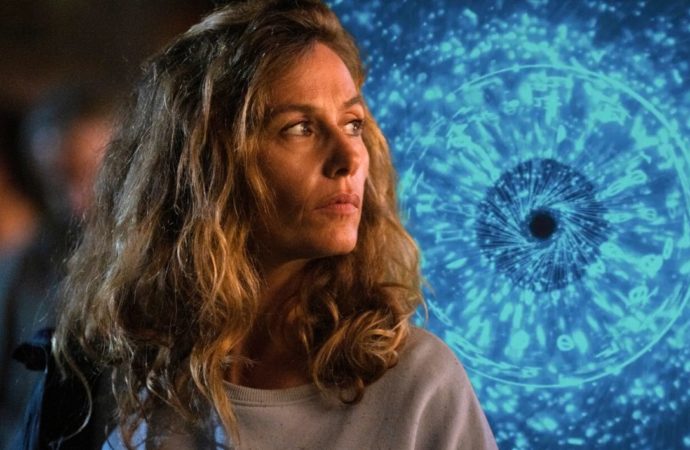
In Dalloway, Yann Gozlan’s new dystopian thriller, Cécile de France plays Clarissa, a writer caught between grief, creative blockage, and an artificial intelligence that threatens to replace her. The film —also starring Lars Mikkelsen, Anna Mouglalis and Mylène Farmer— echoes Virginia Woolf’s Mrs Dalloway, reflects on artistic creation in the algorithmic age, and questions our relationship to technology, truth, and identity. We spoke with the Belgian actress about the intensity of the role, working within contemporary thriller mechanics, and the space cinema can still occupy as a deeply human art form.
The Seduction of the Screenplay
Cécile de France admits she fell in love with the screenplay of Dalloway, and to begin with, we asked her what first captivated her about this story: First of all, the possibility for me, as an actress, to portray a character who evolves, who progresses, who gradually empties herself of her humanity. I saw the opportunity to collaborate with a make-up artist I absolutely adore, Kaatje Van Damme, with whom I have worked several times, and I imagined us working together on the texture of the skin, the complexion, the hair; I even lost weight during the shoot, etc. I truly saw the possibility, also through that very wide emotional palette revolving around fear, paranoia, obsession, exhaustion, and madness. In any case, it was a beautiful gift for an actress to be able to portray a character who evolves, who changes, and who goes through all those very intense emotions.
The film traces an acting arc that demands great intensity, and among all its scenes, de France highlights the challenge of portraying heat at a moment when horror seeps into the thriller. It reached all the spectators thanks to the lighting, thanks to my performance, thanks also, of course, to the sweat, etc. It was about how to depict a character who is cornered, who is pursued by the heat; that was interesting.

Conveying Tension
Cécile de France agrees that this anxiety is real and specific to our time, and that using this axis to connect with today’s audience is an intelligent device. Moreover, director Yann Gozlan is a master of the contemporary thriller—but how does one work with him on tension and suspense? He has a very particular way of filming, of constructing his film. First of all, because a thriller is something that is built; there is a progression to be told and, in his cinema, it truly functions like very precise emotional clockwork. There are real mechanisms, gears proper to watchmaking. It is extremely precise, very delicate, how the machine of paranoia carries away the heroine and the spectator as well. And that requires a real challenge: not only to narrate the heroine’s painful journey, but also to draw the spectator into the story. It’s not easy.
Another challenge she faced in Dalloway was immersing herself in a mise-en-scène that plays with uncertainty and the manipulation of the viewer’s gaze. Yes, absolutely. I believe it is truly the actor’s role to remain available and to serve the director’s vision. He had his film in his head, and when you are working with a thriller specialist like Yann Gozlan, it is necessary to let yourself go, to allow yourself to be directed, and to learn. I really appreciate that way of working—it’s not like other film genres.
The Symbolism of Dalloway
Clarissa’s character is almost a symbolic figure, not merely a realistic one. Yes, that’s true, you’re right. I am a human being who could not help, like all human beings, creating an emotional bond with a machine. That also says a great deal about the human anxiety of losing the meaning of life. An artist who becomes useless also questions our own fear of losing the reason to exist.
Because if AI were to… It is already more intelligent than we are, it already escapes our control. But if it were to develop consciousness, subjectivity, an inner life, emotional life—then what would humanity be for? It is indeed an allegory. What this heroine experiences is also what human beings may feel in the face of the anxieties of our time.
And in reference to that symbolic depth, there is a kind of echo between the names Clarissa and Dalloway. It is perhaps a contemporary rereading of Mrs Dalloway transposed into the age of the algorithm. Because there is a sort of duality: the person and the machine. But when they come together, they form the name of the protagonist of Mrs Dalloway, Clarissa Dalloway. Yes, exactly. You have noticed it correctly. Indeed… And moreover, she is a woman who—well, there is also discussion of freedom, female emancipation, and so on. But above all, she is a human being. And that reference exists in the names, which together form a single person.
On the other hand, Virginia Woolf’s novels speak of a space of emancipation. But in La ResidencIA, the private space—the place where Clarisse could work with comfort and independence—turns into an oppressive space of surveillance and confinement. Can this be seen as a metaphor for the current creative condition? Yes, in any case… that box, that residence, indeed. There are many symbols. For example, the door. That door also symbolically conveys the invisibility of this technology: the fact that there are hidden warehouses, that we do not really know where they are. It also symbolizes disinformation, the mysteries and manufacturing secrets surrounding artificial intelligence. So there are many symbols in this film. It also speaks about the dependency that this technology can generate. It is clearly shown that Clarissa becomes completely dependent when she is blocked. She returns to Dalloway, even though Dalloway pursues her and frightens her. And yet, she cannot create without Dalloway. There are many allegories and symbols that can be found in various elements of the story.
The Artist’s Neurosis
Yann Gozlan’s film also conveys the idea that fragility—the artist’s neurosis—can become a creative driving force. Yes, because that is ultimately what reaches us as spectators, readers, or admirers of a work. We need to recognize ourselves in our anxieties, our neuroses, our traumas lived in our own flesh. And we need to connect with the artist who created the work because we recognize ourselves in them. That is why, as long as artificial intelligence does not possess its own consciousness, we sense when a work has been created by AI. It may be very beautiful, even exceptional, but there is something animal, instinctive, that is still not connected. We need to recognize ourselves in another human being who lives through the same things we do.
I need to be as close as possible to the people who watch and who can recognize themselves in me as a human being, not as a female ideal or as perfection.
The Crisis of Truth
And speaking of artificial intelligence, do you think the dangers are more technological or more political and economic? In all spheres, it is good to reflect, to be aware of the dangers, not to become completely paranoid like Clarissa, but to think. The film invites reflection, debate, and questioning—both in our personal lives and on a global scale—and to allow ourselves to demand rules and laws to respect human rights as well as environmental rights.
Yes, it is good to ask questions. After the honeymoon, the bitter honeymoon with this monster we have created should not arrive. It is a bit like Frankenstein: it fascinates and frightens us at the same time. What do we do with it in a constructive way? We are now living through a profound crisis of truth. It is a real problem: we can no longer distinguish what is true from what is false.
Cécile de France has expressed her rejection of photographic retouching, and this is not merely an aesthetic issue but an ethical one—to preserve reality. Yes, it is a way of giving meaning to why I am an artist. I devote myself to this profession to connect with other human beings. I do it to tell stories that resonate within each of us. I need to be as close as possible to the people who watch and who can recognize themselves in me as a human being, not as a female ideal or as perfection. I believe that would distance me from my audience.

Room for Resistance
Does this mean that there is still a space in which resistance is possible? The actress confirms it: yes, of course—it depends on us to choose. In life in general, it is up to us to decide what is good for us and for humanity, and to speak out when human rights and the rights of nature are not respected. And could cinema continue to be a space of sensitive truth in the face of technologies that manufacture perfect realities? Cécile de France has no doubt: yes, I believe that if cinema remains a profoundly human and humanist art, there will always be artists who wish to offer messages of love and hope through their work. Even when we address complex aspects of humanity, we need that connection; otherwise, art loses its meaning. That lies at the heart of it—it is the very essence of art. Yes, absolutely: we are human beings. We need it; it does us good; it makes us vibrate, reflect, and gives us hope. We should not seek the perfection of the machine, but the perfection of the human being. Yes, when someone—an actor—tries to be too perfect, I think we move away from them.
Freedom to Explore
And to conclude, after such an intense role in a dystopian thriller, we would like to know whether de France will continue exploring this line or move into other territories, perhaps more intimate films. I am very lucky because I have been able to play very different roles—comedies, very distressing films, even horror films. Directors can imagine me in different styles. In France, we are fortunate to be able to make cinema across a wide range of genres, and I am happy to have preserved that freedom. Before making films, I always told myself that if I ever did, I would try to maintain the freedom to play very different roles and explore different genres. That is what I enjoy.
Cinema and Politics
Following the recent controversy at the Berlin festival regarding cinema and politics—sparked by Wim Wenders’ statements suggesting they should be kept separate, and the response by Arundhati Roy and Kaouther Ben Hania—we would like to know the position of the protagonist of Dalloway. I must confess that I have not reflected much on this, but once again, we are free to address the themes we choose, and if a viewer feels moved by a work, then it is necessarily legitimate.
In Dalloway, Cécile de France embodies the vertigo of a world that no longer clearly distinguishes between the human and the artificial. Faced with the fascination and fear provoked by artificial intelligence, the actress reasserts something essential: art as a space of connection between human beings. In times of technological uncertainty and a crisis of truth, her stance is clear—not to aspire to the perfection of the machine, but to preserve the vulnerability that allows us to recognize one another.


No one has posted any comments yet. Be the first person!