
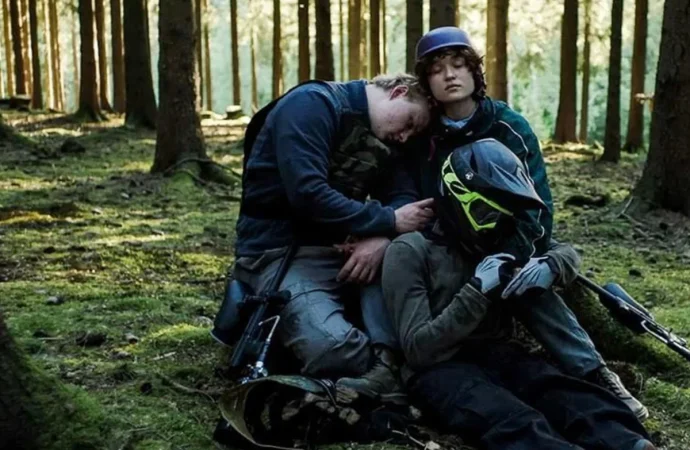

Following its premiere in the Orizzonti section of the Venice International Film Festival —where won the Bisato d’Oro award—, Oasis, by Austrian filmmaker Jannis Lenz, is now screening in the Youth programme of the Tallinn Black Nights Film Festival.
Through the story of three teenagers seeking refuge from violence and misunderstanding, the film explores adolescent vulnerability, the limits of adult intervention and the fragile bonds of friendship. When a video of a student threatening his classmates goes viral, tensions escalate at school. Overwhelmed by pressure from teachers and parents, three isolated teenagers —Andi (Anton Petzold), Lukas (Florian Geißelmann) and Maja (Mathilda Smidt)— seek refuge in a nearby forest, where their games gradually turn into disturbing rituals that blur the boundaries between friendship, intimacy and violence.
We spoke with Lenz about adolescent vulnerability, the cycle of violence and the limits of adult intervention.
The limits of institutional intervention
EVA PEYDRÓ: The school mobilizes considerable resources to prevent violence, yet its interventions seem unable to help Andi. Are institutions sometimes more concerned with managing a crisis than understanding the young people involved?
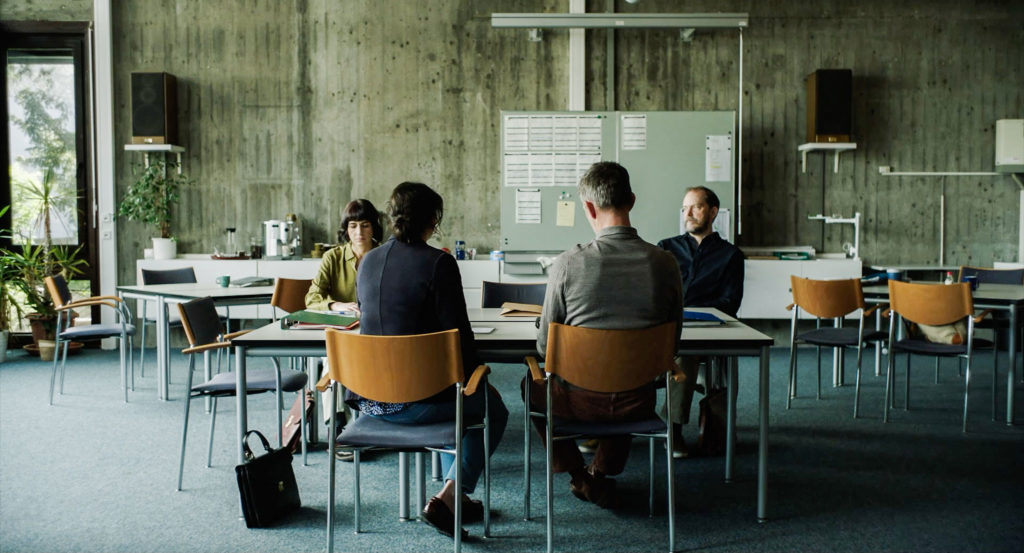
JANNIS LENZ: Schools are part of a larger system. There are established procedures and measures that have to be applied in specific cases, as one of the conversations between the principal and the teacher Martin Vogler suggests. My father, who worked as a teacher himself, taught me that these established procedures are meant to ensure that all students are treated equally, regardless of the goodwill of the individuals who have to make decisions about them in a given situation. That’s an important idea.
I wanted to raise the question of how much individuality a society can accommodate, but also how much conformity and submission an individual can endure.
But it remains a bureaucratic process, and in systems like these, the individual and their needs can quickly get lost. A young person becomes a case. That’s exactly what happens to Andi. I tried to illustrate this through the image of the choir in the film. The choir can be read as a metaphor for our society: it only works if everyone takes on their assigned role, agrees on a rhythm and doesn’t step out of line.
It is a coherent overall picture in which the individual voice disappears. I wanted to raise the question of how much individuality a society can accommodate, but also how much conformity and submission an individual can endure.
Adults and the illusion of understanding
The adults repeatedly invade the teenagers’ privacy in search of answers, but they misinterpret what they discover. Were you interested in exploring how the desire to protect someone can become another form of surveillance and control?
Absolutely. It’s only natural that parents want to protect their children, and there’s fundamentally nothing wrong with that. In Oasis, however, the adults are driven by fear. And when fear starts to dictate our actions, it can quickly lead to exclusion and paternalism, sometimes even to psychological or physical violence. The helplessness the parents feel as they increasingly lose control is one of the main reasons why the situation escalates.
To me, there’s something deeply tragic about this: the parents and teachers in Oasis act because they want to make things better, but in doing so, they only make the situation worse. I didn’t want to condemn them for that. Rather, I was interested in how quickly the understandable impulse to protect one’s own child, or the sense of responsibility for keeping students safe, can set off a dynamic that takes on a life of its own and ends up achieving the very opposite of what was intended.
The two sides of the camera
Images play opposite roles in Oasis: videos shared online become instruments of humiliation, while the three friends film themselves in private. Can filming ourselves become a way of discovering who we are, rather than merely defining how others see us?
I think it’s both. The camera can be a means of understanding ourselves and others better, or a tool for exposing and excluding people. This ambivalence runs through the entire film. As a teenager, I got a MiniDV camera and started filming myself and my friends doing parkour. At first, we wanted to study our movements and get better. Later, we also shared the footage on YouTube to connect with others in the scene. For me, filming back then was above all a way of discovering myself. That experience found its way into the MiniDV footage the young people in Oasis make of themselves.
Our young cast shot this material themselves during the rituals. It forms a documentary counterpoint to the videos circulating around the school. I’ve experienced social media in much the same ambivalent way. In the beginning, it was a way for me to stay in touch with people all over the world and share experiences.
These days, I see it more as a space for self-presentation, where what matters above all is how you are seen by others. Young people today grow up taking these spaces for granted, and I’m interested in where they can still find moments when no one is watching, or when they feel truly seen for who they are rather than judged.
Pain, intimacy and psychological distress
The teenagers voluntarily inflict pain on one another, blurring the boundaries between intimacy, trust and self-destructive behavior. Is this ritual a way of regulating emotional distress, or does pain become a substitute for the affection they cannot find elsewhere?
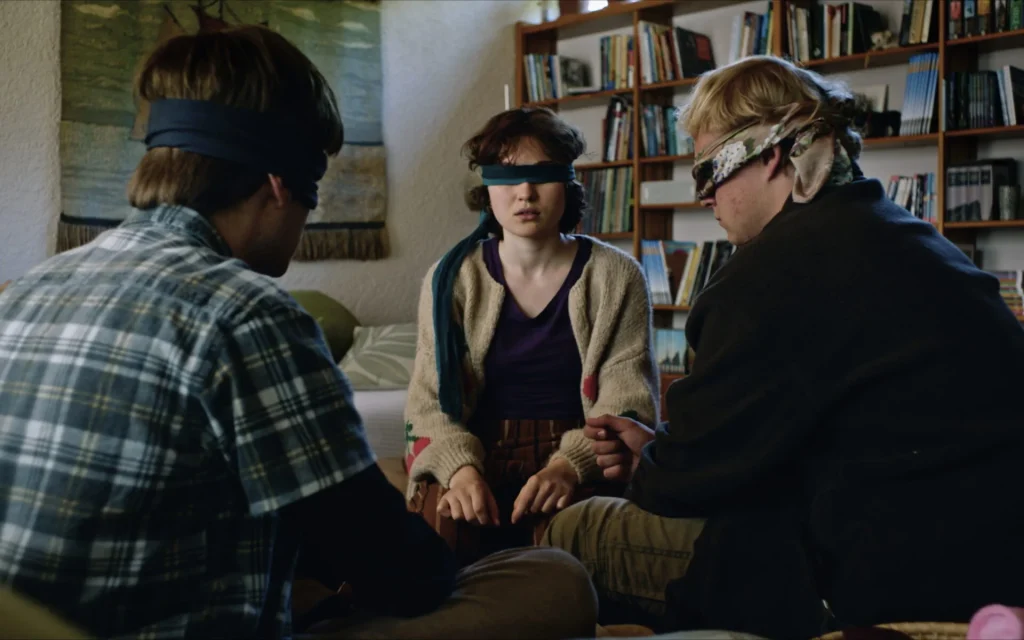
For me, these rituals are primarily about the need to be seen. By looking at their physical wounds, the three are searching for a way to access their inner wounds, the dark places we all hide from the outside world, out of shame or fear of being hurt even more. And they approach these places with a tender, non-judgmental gaze, one they don’t find anywhere else in their everyday lives. They do this quite intuitively.
At the same time, it was important to me to show that this intuitive way of acting carries risks and cannot be a solution. Pain cannot replace affection. It is our responsibility as adults to give young people a sense of security and support, and to show them ways of processing their wounds without physically hurting themselves or others.
I don’t want to dictate how each scene should be read –everyone can find something of themselves in them. Because these are such sensitive subjects, we sought psychological advice as early as the writing stage. An intimacy coordinator accompanied the young cast during rehearsals and was present on set for every demanding scene.
Displacement, violence and paternal absence
Andi’s father is a soldier who teaches him to shoot, yet remains physically absent from his life. Did you intend to explore how masculinity and violence can be transmitted even in the absence of a meaningful emotional relationship?
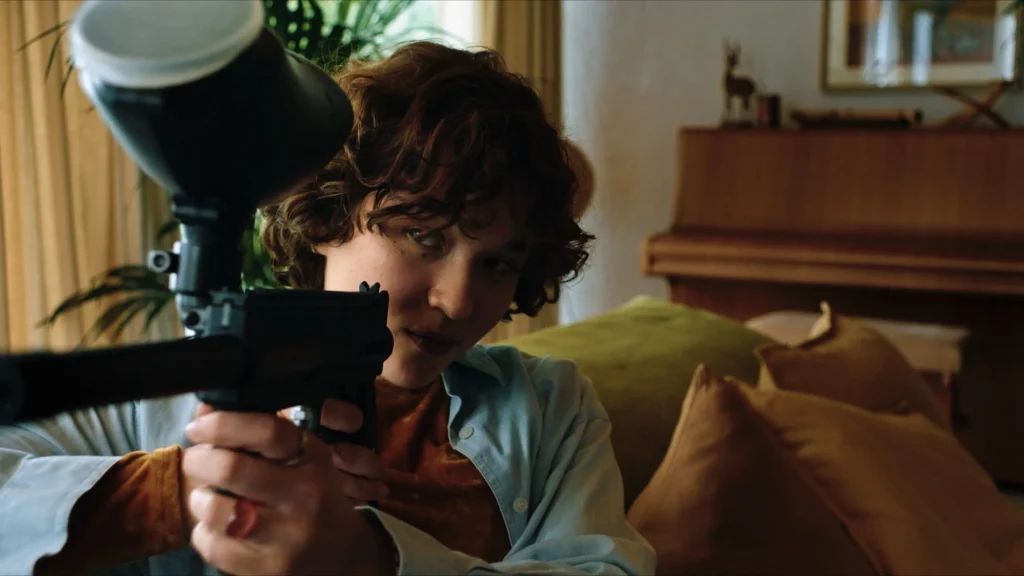
Yes, the father’s absence is central to Oasis. I was interested in what a father passes on when he is hardly ever there. When there are no conversations and no shared language for feelings, often all that’s left is what can be shown by example: a skill, an attitude, a way of relating to one’s own body. In this sense, shooting almost becomes a substitute for closeness –one of the few moments in which father and son share anything at all.
Andi takes from this an image of masculinity in which strength is what counts. But no one shows him how to deal with pain, fear or anger. What matters to me here is that it’s not about the father’s profession. In my documentary Soldat Ahmet, I portrayed a professional soldier who defies many of the stereotypes associated with the military. It’s about the void left behind. Children look to the role models they have, and when someone is missing, they fill that gap with whatever they can find. Often, these turn out to be the loudest images of masculinity.
The aesthetics of violence
The forest and gymnasium sequences have a striking visual beauty, even when the situations become disturbing. Were you ever concerned that such carefully composed images might aestheticize violence, or did you see beauty as a way of revealing something beyond the action itself?
I tried to look at everything in the film with the same gaze, without imposing anything on the audience. We shot the entire film using just one lens, partly to avoid creating a hierarchy of looking: violence is filmed no differently from tenderness.
With the forest in particular, I was very aware of how easily beauty can idealize and distort. The German forest is a place charged with ideology. The Nazi regime appropriated it for a völkisch conception of Heimat, an ethnonationalist idea of belonging and homeland. That’s why I was determined not to romanticize it. Our forest has been logged, wind turbines stand in it, and there are remains of bunkers from the Second World War. It’s not an untouched world apart, but rather a condensed version of the society the three are fleeing.
So the beauty of the images never stands on its own; it always carries contradictions within it. Film offers countless ways of manipulating an audience. I wanted to bring these contradictions to the fore and invite the audience to question what they see –and perhaps also their own viewing habits, the perspectives they bring with them when they watch a film. If that allows someone to see something familiar in a new way, then a lot has already been achieved.
Beyond revenge
Unlike many films about bullying, Oasis does not follow a conventional revenge narrative. Why did you choose to focus instead on the teenagers’ attempts to create their own emotional refuge?
The desire for revenge is deeply human, and it has given rise to many great stories, from ancient tragedy to the present day. But what interested me in Oasis wasn’t whether revenge brings satisfaction, but what it passes on. I wanted to show how violence moves from one person to the next, spreading further and further, almost like a virus.
Revenge promises to put an end to this cycle, yet only perpetuates it. That doesn’t mean you should simply put up with everything. Standing up for yourself is important. But to me, that means speaking out, having each other’s backs and asking for help.
At one point, Andi asks Lukas why he never does anything, meaning that Lukas doesn’t stand up for the group. Lukas later misunderstands this and passes on the violence they themselves have experienced. That’s where the spiral becomes visible.
Revenge promises to put an end to this cycle, yet only perpetuates it.
What interested me more was the opposite: the trio’s attempt to create a refuge of their own. For me, the oasis isn’t a geographical place, but something that only comes into being through the trust they have in one another. Whether this space can withstand the violence coming from outside is the real question at the heart of the film.
The effectiveness of educational interventions
The school organizes workshops and awareness programs to address violence and bullying. Do you believe these initiatives can genuinely change young people’s behavior, or do they sometimes create an illusion of progress?
I do believe that workshops like these can raise awareness. But they only reach young people if they connect with their lived realities, and that doesn’t always happen.
Every day, we see educators desperately searching for solutions, trying new approaches, and still failing to get through to young people. This sense of helplessness also gives rise to methods that reach their limits. The workshop in the film is one such attempt. The trainer is played by Ahmet Şimşek, whom I’ve been working with since my short film Shadowboxer. What interested me was less whether the method was right or wrong than the desperation behind it. I’d rather leave that judgment to the audience.
It was also important to me to show that the teachers and the school as an institution are genuinely trying to make things better, but are finding it increasingly difficult to have an impact. Schools can’t do this alone. It takes all the adults in a child’s life, teachers as much as parents. And what young people need from us is not more control, but more attention: someone who is there for them, listens to them, shows them affection and, when necessary, also sets boundaries.
Ultimately, Oasis is less concerned with revenge than with the possibility of breaking the cycle of violence. As Lenz suggests, the refuge his characters seek is not a physical place, but something built through trust, attention and the fragile bonds that allow us to feel truly seen.
Nadie ha publicado ningún comentario aún. ¡Se tú la primera persona!