
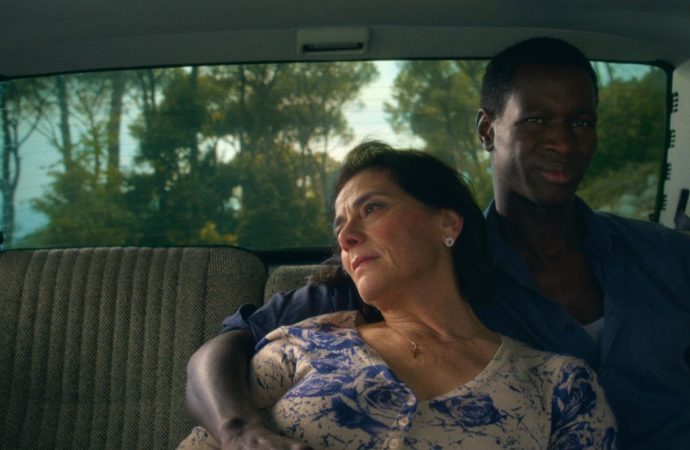

The 76th Berlinale has presented two films directed by Arab women that portray forbidden loves challenging customs and tradition in order to break taboos. Tunisian director and screenwriter Leyla Bouzid premiered In a Whisper, a story set between two cultures, in which thirty-year-old Lilia (Eya Bouteraa) returns to her home country to attend her uncle’s funeral. During this short trip, to which she secretly brings her French girlfriend Alice (Marion Barbeau), she discovers that she was not the first homosexual member of her family.
Bouzid, who premiered her award-winning debut feature in 2015 at the Venice Film Festival (As I Open My Eyes) and closed Cannes Critics’ Week in 2021 with A Tale of Love and Desire, has participated in the Official Competition of the Berlin Film Festival with a film aimed at an international audience. This intention is evident in the way the director explicitly addresses the laws in Tunisia that criminalize homosexuality and portrays the difficulties of living it freely. She achieves this through the network of relationships surrounding Lilia’s uncle, which gradually comes to light as Lilia refuses to accept the official silence about his life and death. Unsent letters, a circle of friends who meet in semi-clandestine gatherings, and the arrest of his last lover introduce the Paris-based engineer to the reality she might have faced had she stayed in her country, while also helping her uncover a family secret.
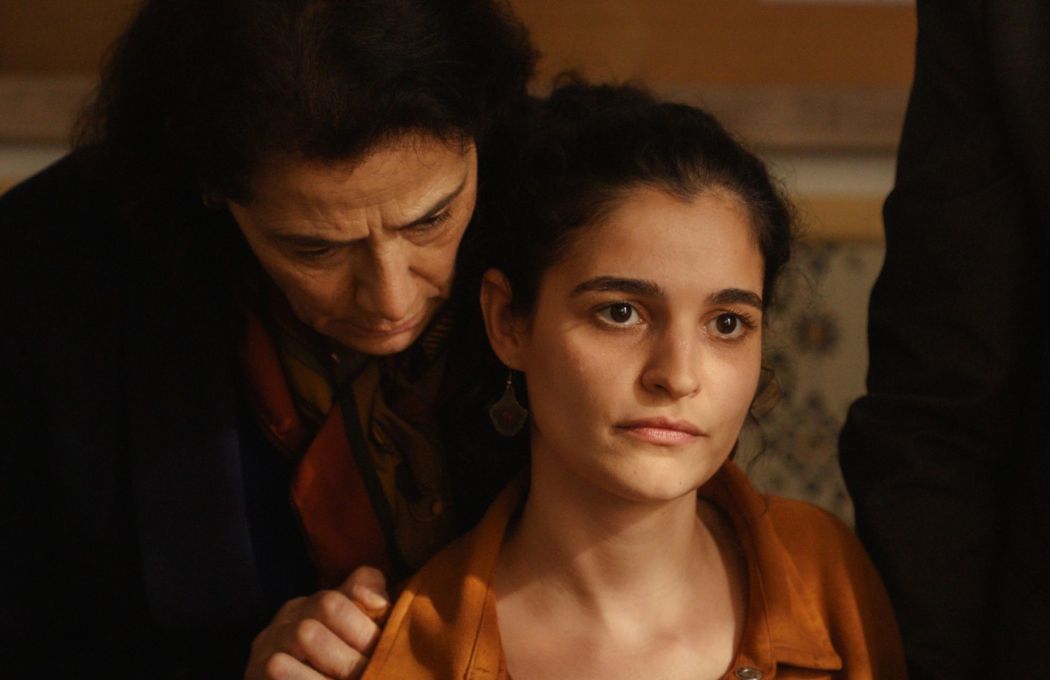 In a Whisper (Leyla Bouzid, 2025)
Bouzid portrays Lilia’s inconsistencies and contradictions: she fights to preserve her uncle’s memory and challenges the hypocrisy of living one’s sexuality “discreetly,” yet at the same time keeps Alice in a tourist hotel, visiting her there but not introducing her to her family. The young French woman’s decision to attend the funeral and meet the family unsettles the convictions Lilia has shown when defending others; when it comes to her own situation, she fails to find the courage to make it public.
À voix basse is a film in which glances are so eloquent that they replace unnecessary dialogue. Lilia’s family—her mother (Hiam Abbass), her aunt, and her grandmother—are as aware as they are reserved; a single look at Alice is enough for the elderly woman to grasp the nature of her granddaughter’s relationship. Knowing is not the same as accepting, and understanding does not imply a family outing. The generational divide and the differing responses of men and women within the family lend realism to the situation Bouzid depicts, culminating in an ending that is as hopeful as it is plausible.
Meanwhile, Only Rebels Win, by Franco-Lebanese director and video artist Danielle Arbid, was also screened. Arbid’s documentaries and essay films have received awards such as the Golden and Silver Leopards at Locarno and the Prix Albert Londres. Her video art has been exhibited at institutions such as the Centre Pompidou and presented at the Venice Biennale, and that artistic dimension is also evident in her latest film. As stated at the beginning, the difficulties of shooting in real locations in Beirut led the production to be filmed in a studio, recreating the settings through projections.
The cinematography by Céline Bozon confines the forbidden love story between Lebanese Christian Suzanne (Hiam Abbass) and Sudanese Muslim Osmane (Amine Benrachid)—also separated by forty years—visually isolating them from a society that condemns their relationship. A magnificent Abbass stands up to family, neighbors, and even the church, which turns a deaf ear to her plea for understanding and acceptance. The development of the story remains largely conventional, moving from the sweetness of falling in love to the gradual erosion of the relationship under social pressure. In line with Leyla Bouzid’s approach, Arbid also suggests that the reaction of women within the family to a non-normative relationship, judged against tradition, can evolve through love and dialogue.
In this case, the contrasting responses of Suzanne’s son and daughter reveal that, beyond race, religion, or age gap, respect and sincere love take precedence over convenience or the acceptance of traditional yet unfulfilling relationships—such as the one the daughter maintains with her abusive husband. The visual and narrative proposals of Only Rebels Win achieve sufficient coherence to overcome the risk of schematic treatment and deliver a compelling film, where Abbass’s brilliance alone is enough to overshadow any weaknesses in its execution.





No one has posted any comments yet. Be the first person!