
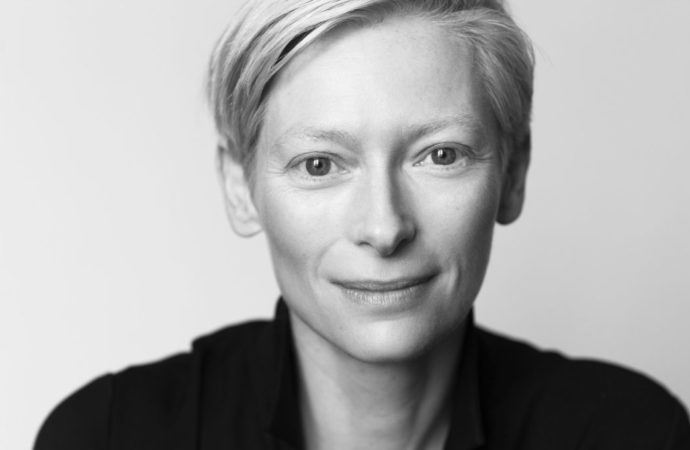

Tilda Swinton
Ongoing
Eye Filmmuseum, Amsterdam (ongoing until March 15th)
It is her presence, the ability to see and listen in a manner that belongs to the very best musicians. It is her wide-ranging awareness of how tone and expression affect the recipient. And then, of course, the distinctive appearance; far and near at the same time, beyond ordinary concepts of time and boundaries of places.
For the first time, the Eye Filmmuseum in Amsterdam, dating back to 1952, has opened an exhibition that is not dedicated to a director. Five years ago, Tilda Swinton –the tall, Scottish and often short-haired actress with a 40-year career under her belt– was asked if she would consider being the topic of an exhibition. She felt, by her own account, overwhelmed and slightly shocked, and asked for some time to think it over. Now that an exhibition with Swinton as its creative hub has finally arrived, the concept feels fresh and idiosyncratic – far from a traditional retrospective and focused on the almost self-evident premise that film is a collaborative medium.
The Eye Filmmuseum’s new building was inaugurated in 2012 and it is a true architectural gem. The building is attractive and captivating, located on the eastern bank of the River IJ with its half-closed eye, letting in the most central element of filmmaking: light. It is tempting to compare the building with Swinton; both combine exquisite surface with deeply rooted content.
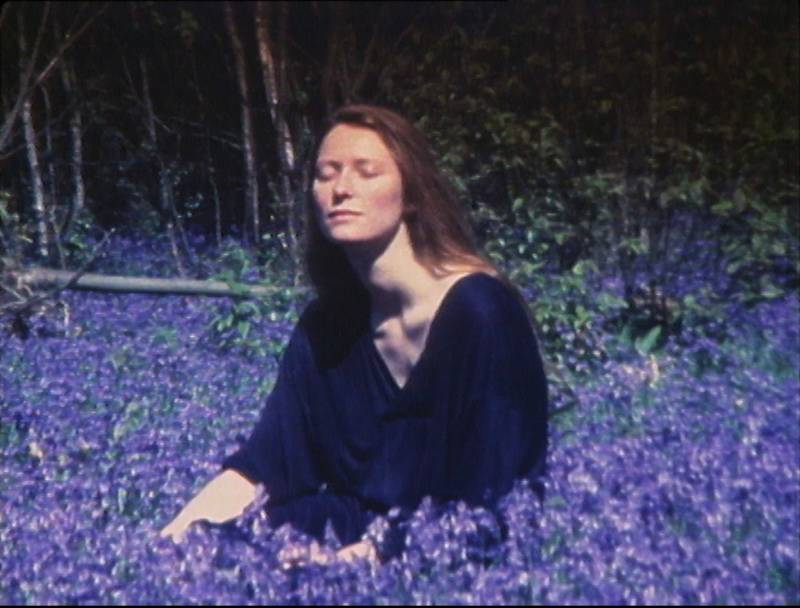
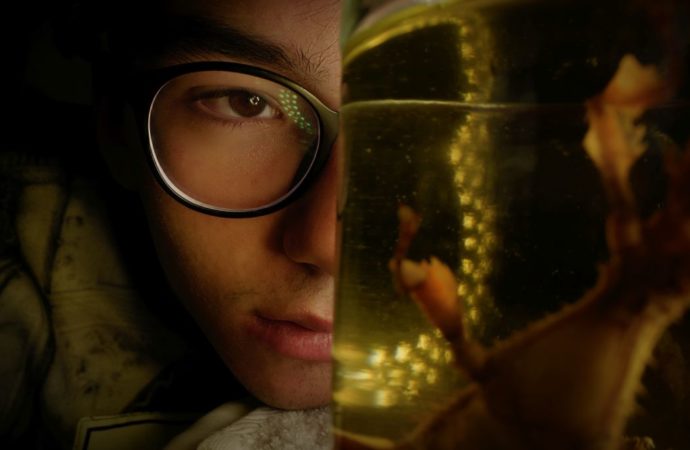
Still from Derek Jarman’s Timeslip, 1988/2025. Commissioned by Eye Filmmuseum, co-produced by Onassis Stegi. Courtesy James Mackay © Basilisk Communications Limited.
Tilda Swinton’s cinematic life began to take shape in earnest when she appeared in Derek Jarman‘s feature Caravaggio (1986). Jarman, a director and queer activist, worked closely with Swinton until his death from AIDS in 1994. “Prospect Cottage” –a black cottage on a pebble beach in Kent, where he moved after his diagnosis in 1987– became a significant place for Swinton. In the environment around the cottage, she was able to explore and become comfortable with her relationship with the film camera.
The exhibition is titled Ongoing, as a way for the protagonist to emphasize the absolutely essential presence of continuation and long-term collaborations. In an interesting analogy with trees (nature is very important to Swinton), she talks about how the trunk represents collective work, how the branches are all wide-ranging and varied conversations, while the leaves are the films, the various works of art. The leaves come and go, and it is clear what is crucial to Swinton’s practice and existence: The films themselves do not nourish the next project, it is the colleagues and the conversations that do.
Eight filmmakers and visual artists feature in Ongoing, which should be seen as a status report from Tilda Swinton on where she is right now as an artist and a human being. Nothing is fixed and finished in the collaboration with Joanna Hogg, Luca Guadagnino, Apichatpong Weerasethakul, Olivier Saillard, Jim Jarmusch, Tim Walker and Pedro Almodóvar. Add to that the painter Sandro Kopp, Swinton’s long-time partner, who often works as a still photographer on her films.
The films themselves do not nourish the next project, it is the colleagues and the conversations that do.
As if to emphasize that the concept of ”retro” is not applicable to this exhibition, most of the participating collaborators are contributing entirely new works. Swinton and her childhood friend Joanna Hogg have made three feature films together, the latest being The Eternal Daughter (2022) – a film in which Swinton, with absolute precision, ghostly improvises a meeting between mother and daughter (she plays both roles) in a remote mansion hotel. The work “Flat 19” is a full-scale reconstruction of Swinton’s flat in London, where she lived for 15 formative years between 1983 and 1998. The unfurnished replica, with its typically British wall-to-wall carpets, overlooks a brick building, and voices and sounds from the past flow from the doors that stand ajar to the various rooms.
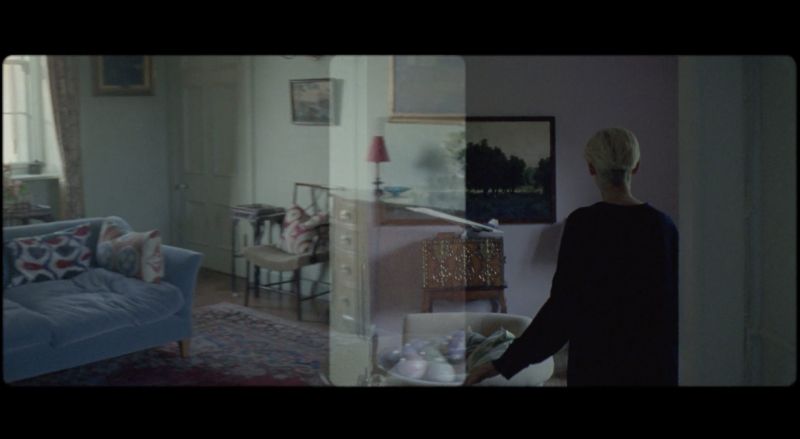
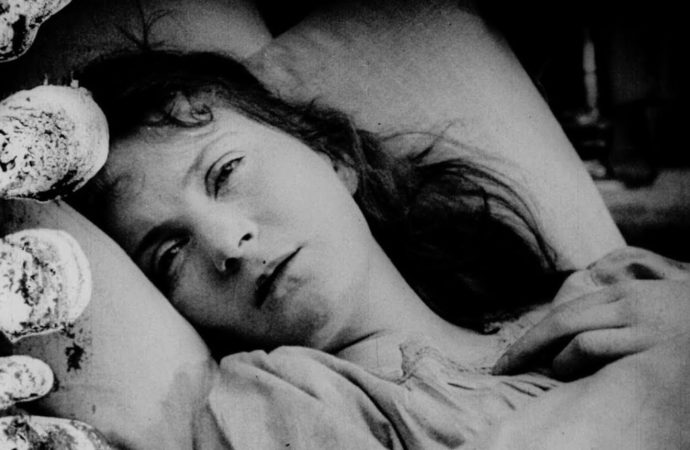
Still from Apichatpong Weerasethakul’s double-channel video installation Phantoms, 2025. Commissioned by Eye Filmmuseum, co-produced by Onassis Stegi. © Apichatpong Weerasethakul, Kick the Machine.
“Flat 19” is a simple yet evocative installation, where the tranquil atmosphere and Swinton’s physical absence point towards the other works in the exhibition space, not least Apichatpong Weerasethakul’s short film Phantoms. Swinton came into contact with the Thai director through a screening of Tropical Malady (2004). She immediately recognized his way of resting in the images and simply letting things unfold. Swinton is drawn to the protracted processes of maturation, which are constantly infused with new elements of life. It took the duo 17 years to complete Memoria (2021), a phenomenally immersive feature film experience. Their collaboration is probably the most moving part of the exhibition. They share so many existential and artistic variables: the powerful influence that memories and places have on our existence, the significance of history on a daily, contemporary basis; they work with constantly open minds and make themselves –and us– accessible to events beyond the obvious.
Photographers often joke that the back of Swinton’s head is her best angle. Yes, the back of her head is aesthetically pleasing, but on a more serious note –it’s more about the effect of the averted, the unspoken, a search for that which cannot be definitively defined. In Phantoms, the camera follows Swinton from behind as she wanders through her family home in Scotland, doors creak and open, and different movements through the rooms of the house are projected next to and on top of each other. In total control of tempo and breathing, Weerasethakul conjures up figures from Swinton’s family life and at the same time allows viewers to travel through their own memory houses.
Another distinctly sensual filmmaker is Luca Guadagnino. He calls his two-part portrait of his friend Swinton Camaraderie. They met shortly after Derek Jarman’s death in 1994 and have made five films together. After circling around a finely sculpted silver bust of Swinton, we once again see her back receding from us in a two-minute short film, shot in Italy last summer. Guadagnino follows her closely up hills and through cornfields, but does not catch up with her until the very end –when she quickly turns her head towards the camera before everything goes black.
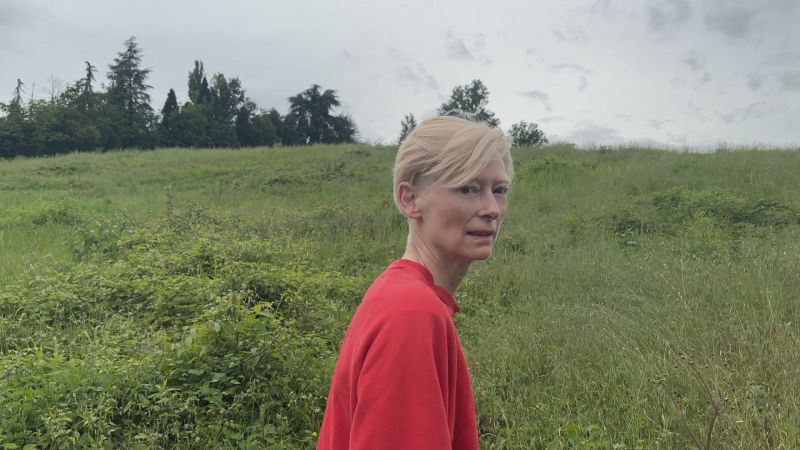
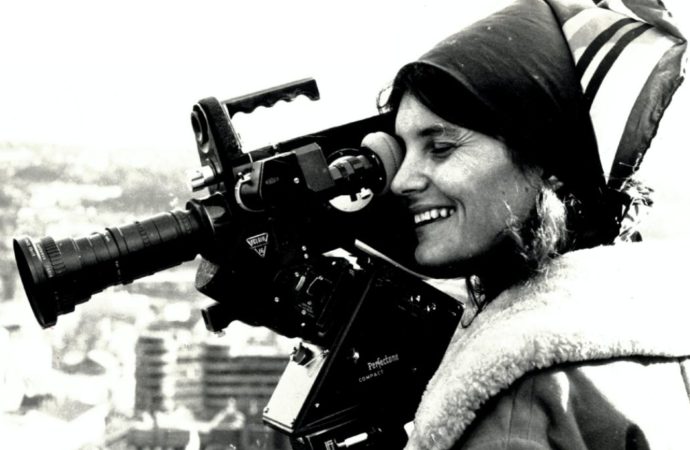
Still from Luca Guadagnino’s Camaraderie, 2025. Commissioned by Eye Filmmuseum, co-produced by Onassis Stegi. © Luca Guadagnino.
In the film, she wears the same red sweater, covered in words, that she wore when they first met, and on a long clothes rack in the middle of the exhibition space, it hangs alongside a number of other garments from Swinton’s private wardrobe. Among the words on the sweater are some concepts central to Swinton: independence, worship, wanderlust, humility, vigilance, companionship.
This clothing collection, “A Biographical Wardrobe”, is presented in collaboration with fashion historian and curator Olivier Saillard. The two have recently worked together to breathe new life into costumes from Pasolini‘s films in the performance Embodying Pasolini (2022-25). The physical garments are complemented by a filmed version of the live presentation that Saillard and Swinton did in connection with the opening of Ongoing. In the adjacent section, fashion photographer Tim Walker takes his cue from the autobiographical wardrobe, as he portrays Tilda Swinton as one of the members of the noble family Swinton in a line of depictions through the centuries.
What is most intriguing in the fashion-oriented sections is the subtle nod to the fashion and celebrity world’s penchant for the overly glamorous and superficial. At regular intervals, individual garments on the rack are lowered to the floor and transformed into a crumpled pile: the clothes tell us nothing of real value until a present person wears them.
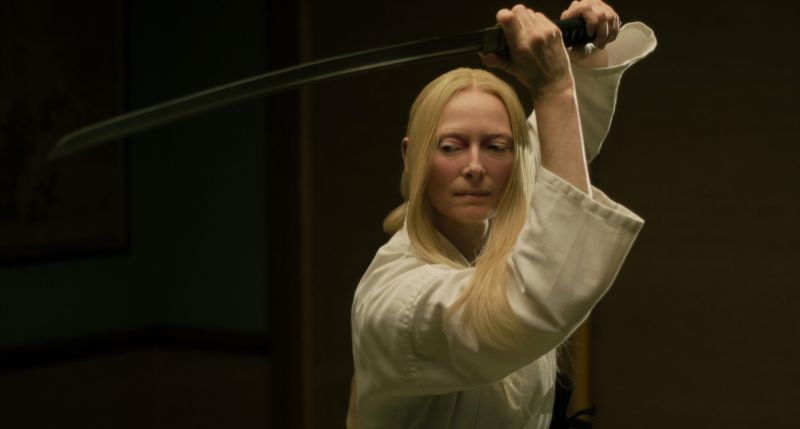
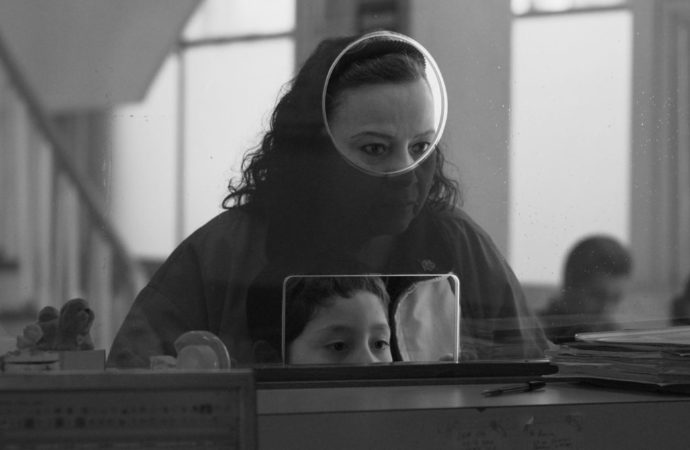
Still from Jim Jarmusch’s Zelda Winston, 2018/2025. Commissioned by Eye Filmmuseum, co-produced by Onassis Stegi. Courtesy Kill The Head Inc. & Focus Features © Jim Jarmusch.
The exhibition’s focus on clothing becomes a kind of transition from Tilda Swinton’s arthouse world to her more large-scale, Hollywood projects. Jim Jarmusch and Swinton have worked together on four feature films since 2005, and here a two-channel projection is shown with an excerpt from The Dead Don’t Die (2018), for which Jarmusch has composed new music. Swinton has described this type of project as something beyond the autobiographical –taking on a script and playing a role in a way that many actors usually do, but which she herself does not do very regularly.
A relatively new collaboration is the one with Pedro Almodóvar, a director Swinton has admired ever since she saw Women on the Verge of a Nervous Breakdown (1988) together with Derek Jarman. Almodóvar is a Bergmanian auteur who walks onto the set with a finished film in his head, and it’s up to the actors to perfect his vision. Swinton’s first film with him, The Human Voice (based on Jean Cocteau‘s one-act play), is highly stylized and meticulously planned –a half-hour film shown in a temporary cinema at the very end of the exhibition. Here we see a different, more direct version of Swinton the actress: with her face fully exposed on the screen, she propels the film forward with doubtless verve and razor-sharp diction.
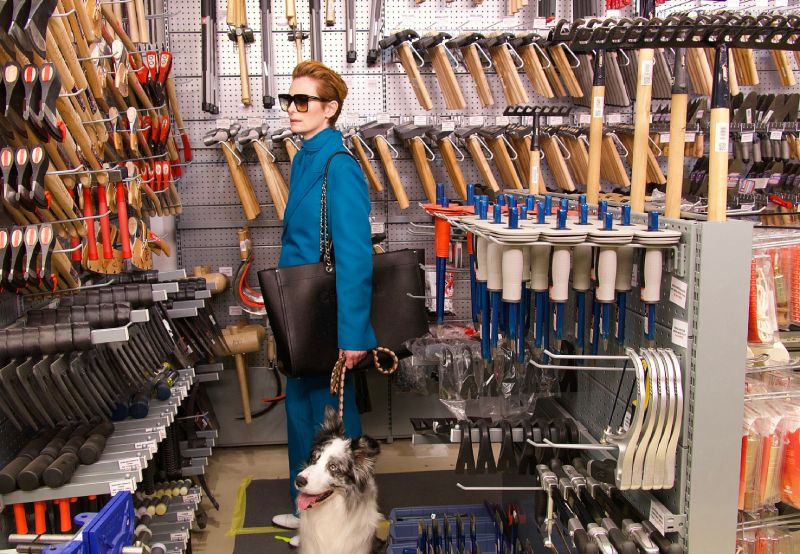
Tilda Swinton on the set of The Human Voice, dir. Pedro Almodóvar, 2020. Photobraphy by Iglesias Mas, © El Deseo D.A. S.L.U.
Tilda Swinton’s greatness lies in her presence of mind and extensive openness. What this exhibition succeeds in doing, is showing the long and varied paths that Swinton, the person and the artist, has walked to find her safe environments and people. She shows that it takes time to get there. To arrive.
Just inside the exit, Swinton’s ”Notes for radical living” is on display, a collection of words she wrote a year ago. Perhaps it’s a toned-down manifesto, general life advice or a guide to staying sane. The point is that it points forward, that there is a continuation. In the exhibition’s audio guide, she reveals the three things that keep her going: ”Fellowship. Nature. Art.” From her radical notes, one might add ”Listen to the quiet”.
This article was first published in the leading Swedish film magazine Point of View.
Tilda Swinton as a baby. © Swinton Archive.
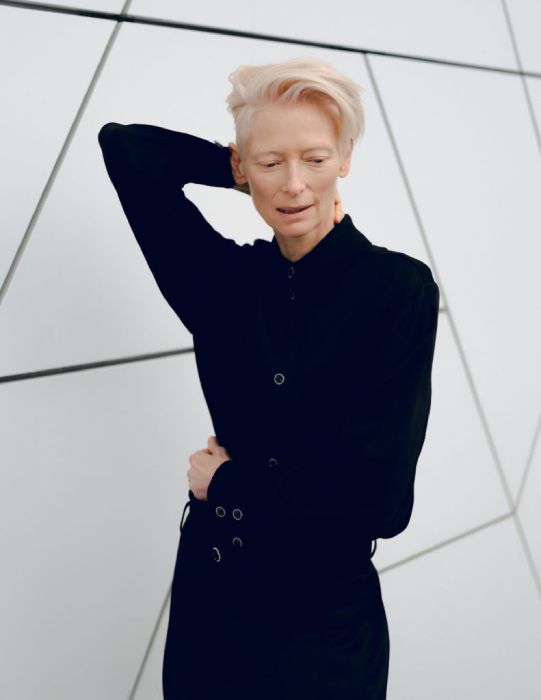
Tilda Swinton in front of Eye Filmmuseum by Victor Wennekes, 2025 © Eye Filmmuseum.
Updated information as of January 27, following the announcement of the exhibition’s extension, which will now close on March 15.

No one has posted any comments yet. Be the first person!