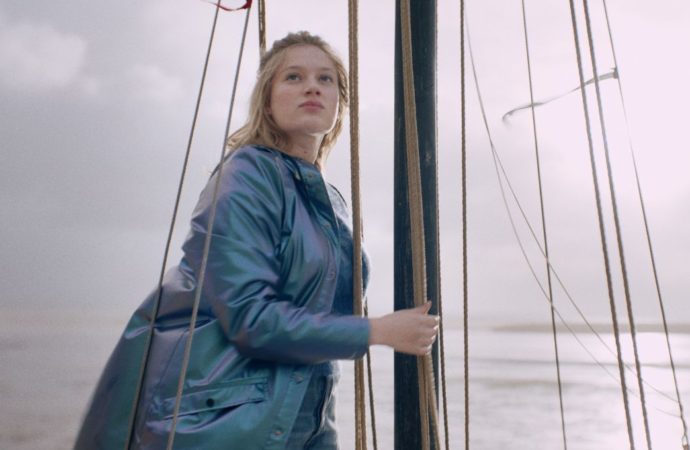
The Island of Belladonna is home to a group of seven elderly people, cared for by a young woman. Gaëlle (Nadia Tereszkiewicz), 30 years old, protects them with the same tenderness as a mother—feeding them, accompanying them, and trying to shield them from any activity that might put them at risk. The calm of this isolated, unreal, dystopian place is significantly—yet gently—disturbed by the arrival of three characters by sailboat: a brother and sister (Dali Benssalah and Daphné Patakia) and the latter’s daughter. As one might expect, the narrative structure is that of a fairy tale; numbers are symbolic—seven, three…—and at the end of the count, there is no lack of a moral in this intimate yet social story, unmistakably relevant to the present.
Another Look at Old Age
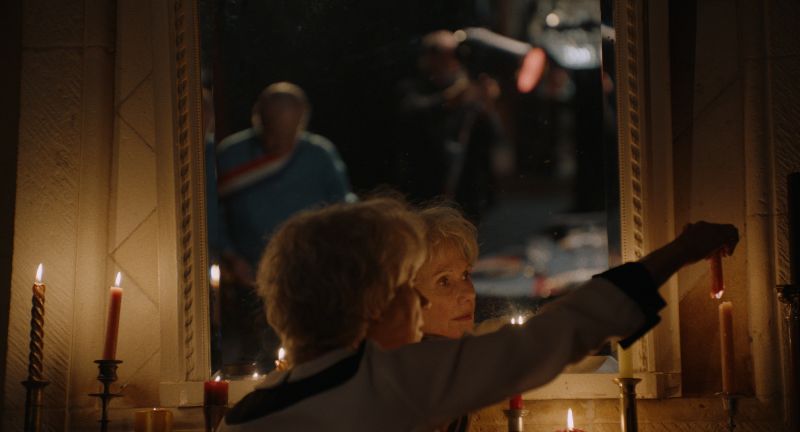
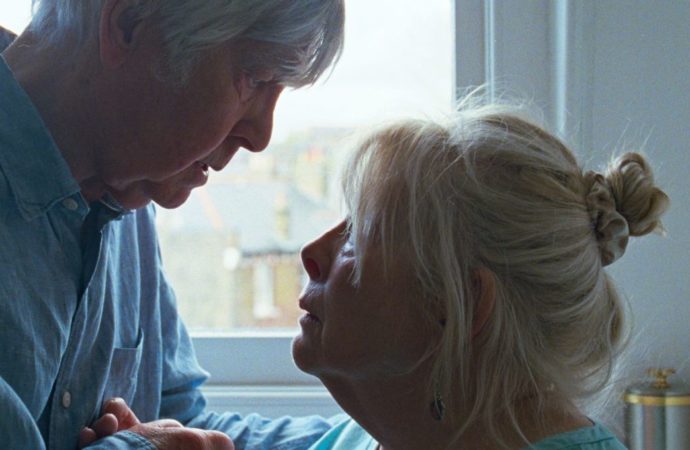
Director Alanté Kavaïté (The Summer of Sangailė, 2015), co-writer of The Ice Tower (Lucile Hadzihalilovic, 2025), reflects on old age by questioning the flattening yardstick that turns elderly people into an indistinct collective. Throughout the film, we sense that the group’s lives are marked by differentiated pasts, united by a desire to live outside a repressive system, in freedom—but it is not until the strangers set foot on the beach that we truly come to know them. Their defining traits then emerge, whereas in the first act, they appear as fragile figures, to whom Gaëlle brings food in a thermos and tends like plants in a greenhouse. Each has a distinct character: Anna (Miou-Miou), acute introspection; Pierre (Patrick Chesnais), the humorist; Olivier (Jean-Claude Drouot), the artist; the beautiful and coquettish Evy (Alexandra Stewart); François (Féodor Atkine), who expresses himself physically; André (Joël Cudennec) and his gluttony; and Yona (Claire Magnin), the group’s Penelope, endlessly weaving and unweaving. Through metaphors and suggestive imagery, the director conveys empathy, tilting the film toward poetry in a distinctive way, beneath its apparent realism.
Between insiders and outsiders stands the indefatigable Gaëlle—attentive, loving, but above all fearful. Protecting her elderly charges at all costs has become her mission, to the point that she has come to ignore her own desires. Kavaïté shows her routines, carried out without weariness, her clothing turned into a uniform, like a sprite flitting from the vegetable garden to the chicken coop. To live longer while dying a little each day, or to shine until the very end: this is the dilemma that runs through the film, laying bare the right we claim to decide on behalf of those who have lost their strength—and sometimes their minds—yet who still retain their own personalities, their desires, and their urge to express themselves freely.
A Legendary Cast and the Talent of Nadia Tereszkiewicz
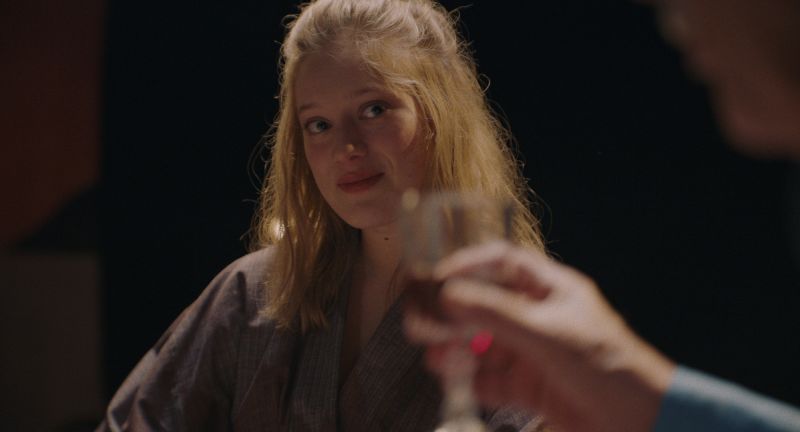
The entire cast of The Island of Belladonna shines in old age, in a way that is also metacinematic: we cannot forget who they were in the past, how much we admired them, and what they represented for cinema at the height of their fame—the transgressive Miou-Miou of the 1970s, for instance, or the striking beauty of Stewart emerging from the Nouvelle Vague. In this way, the director capitalizes on their careers, enriching a film that would be entirely different with an anonymous cast. And yet, among them all, the presence of Nadia Tereszkiewicz rises as both commanding and unsettling.
The immensely gifted actress, awarded the César for Most Promising Actress in 2023 for Forever Young(Les Amandiers, Valeria Bruni Tedeschi, 2022), has worked under the direction of major figures such as Arnaud Desplechin, Stéphanie Di Giusto, François Ozon, and Robin Campillo. She has long since ceased to be merely a promise of French cinema, establishing herself instead with the solidity of a confirmed talent, with more than twenty-nine films already in her young career. Tereszkiewicz combines candor with mystery, and an inexplicable determination expressed through her distinctive gaze, suspended between absence and fixation. She conveys a natural depth and is capable of transforming herself into a bearded woman who is both credible and beautiful; as such, her Gaëlle is an effortless role for an actress of her stature.
Her interaction with the rest of the cast is impeccable, although—like the production as a whole—it suffers from an excessive languor, an unnecessarily slowed rhythm in the final stretch, where echoes of Babette’s Feast (Gabriel Axel, 1987) also become apparent. It is a pity that the temptation toward solemnity ultimately unsettles the film’s balance at the end, given that its message is made perfectly clear from the outset.
No one has posted any comments yet. Be the first person!
Estamos utilizando cookies para darle la mejor experiencia en nuestro sitio web. Puede encontrar más información sobre qué cookies estamos utilizando o desactivarlas en configuración.


No one has posted any comments yet. Be the first person!