
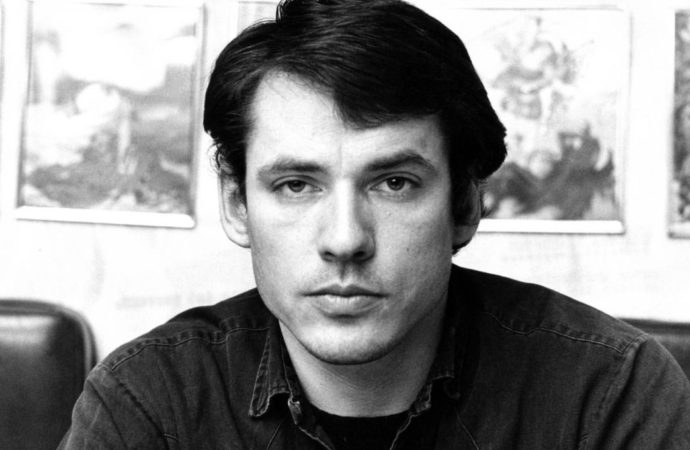

Arthouse Kinos Frankfurt has organized a retrospective for the coming months, where several of his most significant films will be screened, including Stadt der verlorenen Seelen (1983), Meine Mütter (2007), and Satanische Sau (2025), the filmmaker’s final work, presented at the 75th Berlinale and at recent editions of the Freiburg Gay Film Week, the Pink Apple Festival in Zurich, and the Madrid International LGBTIQ+ Film Festival. Considered his cinematic testament, the film was described by the director himself as a farce about his own sexual life, his death, and his rebirth.
On December 17, at the age of 83, Rosa von Praunheim passed away in Berlin, three days after marrying his partner, Oliver Sechting, and announcing it on his Instagram account. What continues to surprise me is the limited impact his death has had in international media—both cultural and strictly cinematic—even within LGBTIQ+ circles, given that von Praunheim was a fundamental figure in international activism for gay rights and a key figure of the New German Cinema alongside Fassbinder, Herzog, Wenders, Schlöndorff, and von Trotta, among others. Von Praunheim was known for breaking taboos and scandalizing German society, even publicly outing prominent figures from political and cultural life. One can only hope that in 2026 some festivals will revisit his work and grant him the tributes he so clearly deserves.
This Frankfurt retrospective will also include the iconic Nicht der Homosexuelle ist pervers, sondern die Situation, in der er lebt (1971). Premiered at that year’s Berlinale, it is considered the German Stonewall, and within it lies the origin of the homosexual liberation movements in Germany, Austria, and Switzerland. The film also influenced certain North American collectives and was later reclaimed by filmmaker Bruce LaBruce in It Is Not the Pornographer That Is Perverse… (2018).
Shot as a silent film with numerous critical intertitles, this work is a fierce indictment of stereotypes surrounding homosexuals in Germany at the time, launching harsh critiques against gay men who accepted the lifestyle and roles of heterosexual couples and patriarchal society. Von Praunheim’s film advocates for homosexual political activism and for the right to exist from within one’s own difference. In 1973, the film was broadcast on German public television—except in Bavaria. Unsurprisingly, its airing profoundly shocked German society.
Writer, playwright, painter, international icon of the movement for homosexual rights, and above all filmmaker, Rosa von Praunheim possesses one of the most extensive filmographies in queer cinema: more than 150 films, including short and feature-length works, produced over more than fifty years of professional career. Since the 1970s, and because of the influence his work exerted on the demands of gay and lesbian collectives, his oeuvre has been regarded in the German-speaking world as one of the foremost cinematic expressions of the so-called Schwul—or “marica”—counterculture.
Born as Holger Radkeen in 1942 in a prison in Riga (Estonia) during the German occupation, he was put up for adoption after his biological mother died in a psychiatric hospital—an event the filmmaker would later address in his film Meine Mütter. He spent his childhood in East Berlin, but in 1953 his family fled to the West and settled in Frankfurt, where he studied painting at the Offenbach School of Applied Arts—now the Offenbach University of Art and Design—and later at the Berlin School of Fine Arts, although he never completed his studies. Very early on, he became interested in cinema as a means of artistic expression, beginning his filmmaking career in 1969 with the experimental short Samuel Beckett. In 1970 he shot his first feature film, Die Bettwurst, which immediately became a cult film, and in 1971 his iconic documentary Nicht der Homosexuelle ist pervers, sondern die Situation, in der er lebt, mentioned above, which brought him international recognition and with which he participated in Documenta 5 in Kassel.
The cinema of this German filmmaker cannot be separated from the trajectory of the homosexual liberation movements that emerged alongside the counterculture that arose in the United States and the United Kingdom during the 1960s. A movement that, artistically, was profoundly transgressive, using cinema, art, and literature as political tools against the official discourses of the establishment. Within this same context we must situate the work of the Chilean writer and performance artist Pedro Lemebel, a major reference in Latin America, as well as the Spaniards José Pérez Ocaña and Miguel Benlloch, the Mexican Nahum Zenil, the Peruvian Sergio Zevallos, and the Franco-Argentine Copi.
Alongside this artistic and political movement, another artistic movement emerged during the same years, also centered on homosexuality but with a more hedonistic character. Within this latter movement we find, among others, Divine and John Waters, the early Almodóvar and Fabio McNamara, and the musical comedy The Rocky Horror Picture Show. While the former movement continues to be regarded as transgressive and unsettling because of its political action, the latter ended up being aestheticized and turned into a distinctive product.
But that is another story. For now, let us remember the German filmmaker and give him the place he deserves in the history of cinema. Thank you, Rosa von Praunheim, for your films and your commitment.





No one has posted any comments yet. Be the first person!